
How Much Weight Can a Hall Tree Hold? (ultimate Capacity Guide)
How much weight can a hall tree hold? Hall tree weight capacity by part: hooks, bench, shelf, and cubby—plus anchoring facts and a stress-test checklist.
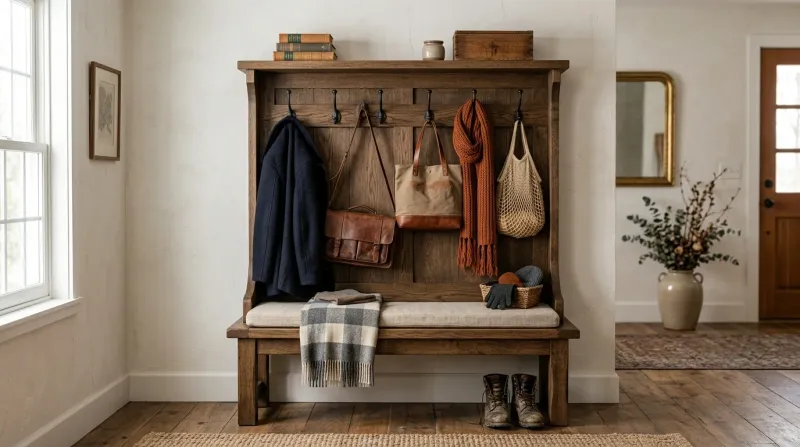
Aug 8, 2026 · Linda Wise
15 min readA secure, anchored hall tree carries roughly 20–30 lbs of coats per hook row, 10–15 lbs per hook, 100 lbs seated on the bench, and 40–60 lbs of shelf load — if the wood is solid and it’s anchored.
That is the short, honest answer to how much weight can a hall tree hold — and the honest part is where most guides stop. The full hall tree weight capacity picture depends on three variables this guide unravels: what the part is (hooks, bench, shelf, or cubby), what the unit is made of (solid wood, MDF, or metal), and whether the hall tree weight capacity numbers were measured with the unit bolted to a wall or standing alone. You will also hear people throw the phrase around the other way — weight capacity hall tree specs, rating, limits — they are all the same question with the same only-partly-printed answer.
The ratings are ceilings, not promises. A wet winter coat weighs more than the tag says — ask anyone with a kid.
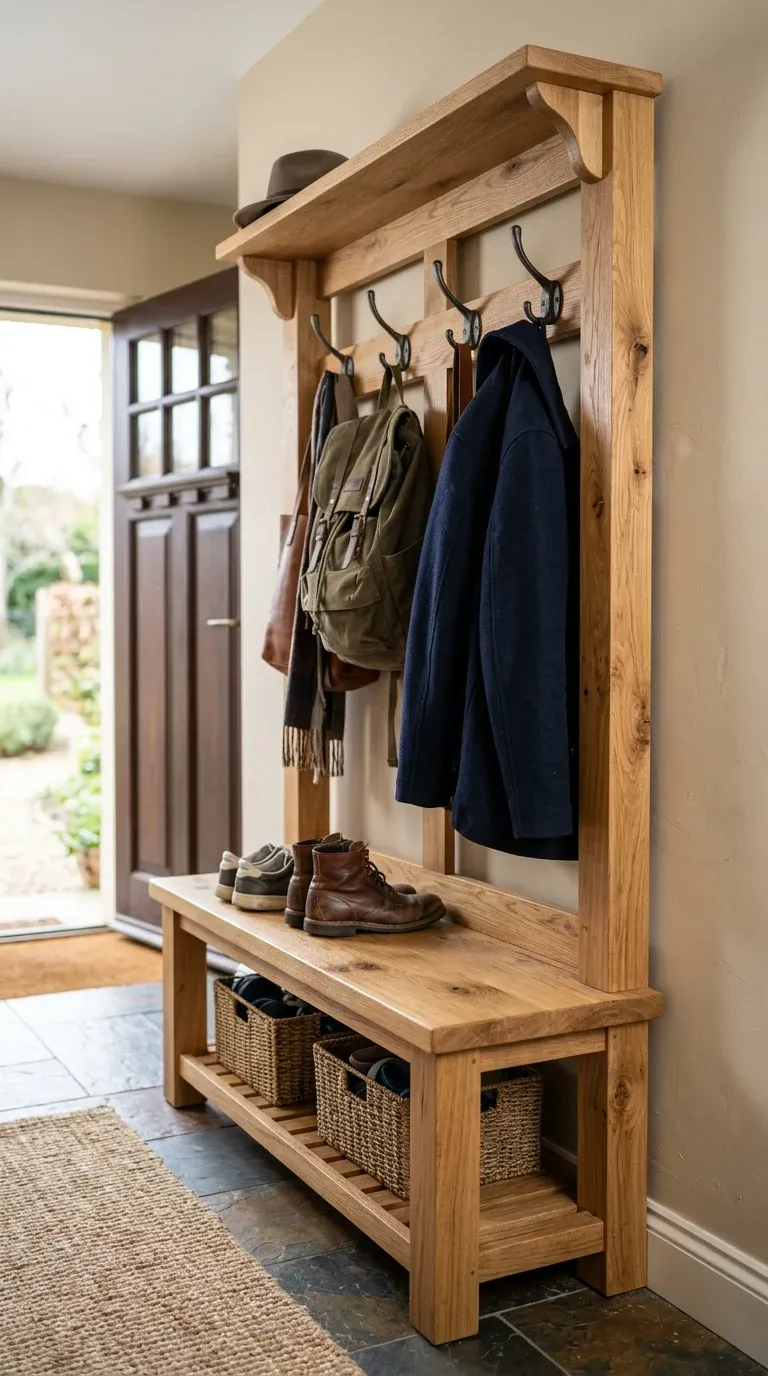
Hall Tree Weight Capacity: The Quick Table (anchored vs. not)
The single most useful table is the one manufacturers never print: the same unit rated two ways. Anchoring to a stud changes every number, because the wall bracket absorbs the forward pull of hanging coats and the tipping force of seated weight.
| Load point | Anchored to a wall stud | Freestanding (no anchor) |
|---|---|---|
| Coats per hook row (3–4 hooks) | 20–30 lbs | 15–20 lbs (tip risk first) |
| Weight per single hook | 10–15 lbs | 6–10 lbs |
| Bench (seated weight) | 100 lbs | 80–100 lbs |
| Top shelf load | 40–60 lbs | 25–40 lbs |
| Whole unit (rated max) | Up to full manufacturer rating | Roughly half of it |
Read that right: the unanchored column is not a different product, it is the same product minus its anchor. That is why every number below is explained twice.
How Much Weight Can a Hall Tree Hold? By Part (hooks, bench, shelf, cubby)
Hooks. 10–15 lbs per hook is the realistic working range when the hook is through-bolted or screwed deep into solid wood. A zinc-alloy hook in particle board with half-inch screws tears out at 10–12 lbs; the same hook in oak with 1-inch screws holds to the hook’s own breaking point. Around 15 lbs, cheap hook bodies snap — the hook fails before the wood does, which is the order you want.
Bench. 100 lbs seated is the comfortable engineering number for a bench span in solid wood or a steel-framed top. Budget MDF benches bow visibly beyond 100 lbs and sag permanently over time under repeated sitting. A kid dropping a loaded backpack onto the bench adds shock load roughly double its static weight — plan for it.
Top shelf. 40–60 lbs spread across the shelf, with heavy items at the corners where the side panels support the span. Concentrating all 60 lbs mid-span turns a shelf into a plank.
Cubbies. Cubbies carry the least glamorous load but the most weight: boots, bins, and bags at floor level. It is the ideal place for heavy items — low storage lowers the center of gravity and makes every other number safer.
Assembly note: cam-lock joints can loosen with vibration and seasonal humidity. A unit rated 100 lbs on assembly day can be a 60-lb unit by your third winter. Re-tighten the fasteners twice a year.
Weight Capacity by Build (solid wood vs. MDF vs. metal)
The material is the second number hidden inside any rating.
Solid wood (oak, maple): stiffness roughly three times that of MDF for the same thickness, and fasteners grip it so well the hardware usually fails before the wood. Creep — the slow permanent bowing under sustained load — barely exists in solid hardwood.
MDF / particle board: affordable and stable in shape, but it sags over time and holds screws poorly. The best MDF units hide mid-span steel rails under the bench and through-bolt every hook. Expect roughly half the rated life of solid wood at the same load.
Metal (steel tube frames): rigid against lateral sway until it isn’t. Budget 0.9–1.2 mm walls crimp and buckle under a hard lean; 1.5–1.8 mm cold-rolled walls shrug it off. Steel frames do the bench strength, but the panels they carry may still be MDF — read both halves of the spec.
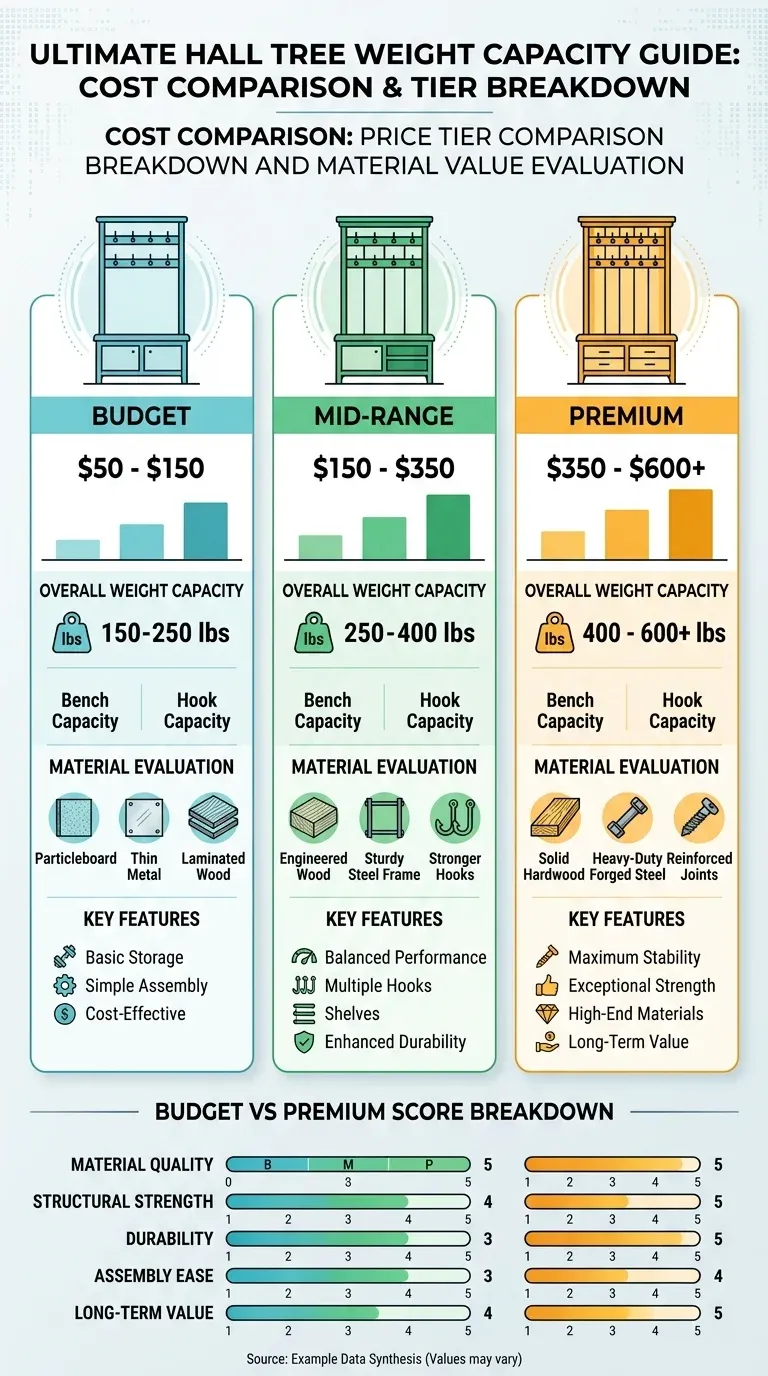
The practical translation: a solid-oak unit rated 250 lbs can carry more real-world abuse than a particle-board unit rated 250 lbs, because the oak’s rating is a floor and the particle board’s is a ceiling.
Why Anchoring Changes Every Number
Anchoring does not add strength to the wood — it removes the failure modes the wood can’t handle. A tall, shallow hall tree is a lever: loaded coats hanging 60 inches up multiply their weight by the leverage ratio of the unit’s height to its base depth. A 30-lb coat load on a shallow, light unit can tip it forward like a seesaw. The wall bracket converts that tipping force into a pull the wall absorbs.
The hardware matters as much as the act:
- Drywall anchors (plastic): pull out under about 30 lbs on a good day.
- Toggle bolts: spread the load across the back of the drywall — roughly 90 lbs of pull-out resistance.
- Screws into a stud: 200+ lbs of holding power per screw.
One screw into a stud doubles the safe load of the unanchored column in the quick table. That is not an exaggeration; it is why every hall tree ships with a strap and why the strap belongs in a stud, not paired with anchors in hollow drywall. If your hallway layout is tight and you are choosing a unit blind, our best hall trees roundup grades every model on whether its anchor hardware can actually reach a stud.
Stress-Test Checklist Before Loading It Up
Before the first coat goes on, run the unit through these six checks — ten minutes, zero tools beyond a screwdriver:
- Fasteners: tighten every cam-lock and hook screw until snug; do not torque particle board, or you strip it.
- Wobble test: push the top rail side-to-side with 20 lbs of force. Rocking means loose joints, not normal wear.
- Bench bounce: sit your full weight, then bounce gently. A visible sag or a creak from the joint line means the bench needs support.
- Hook pull: hang a 15-lb load on each hook and yank sideways once. Screws that shift or spin need through-bolts.
- Anchor check: confirm the strap is in a stud or a heavy toggle, then pull the top forward 10 lbs — the unit should not list.
- Load distribution: heaviest items low (boots, bins), middle weights mid-shelf, light coats on top hooks.
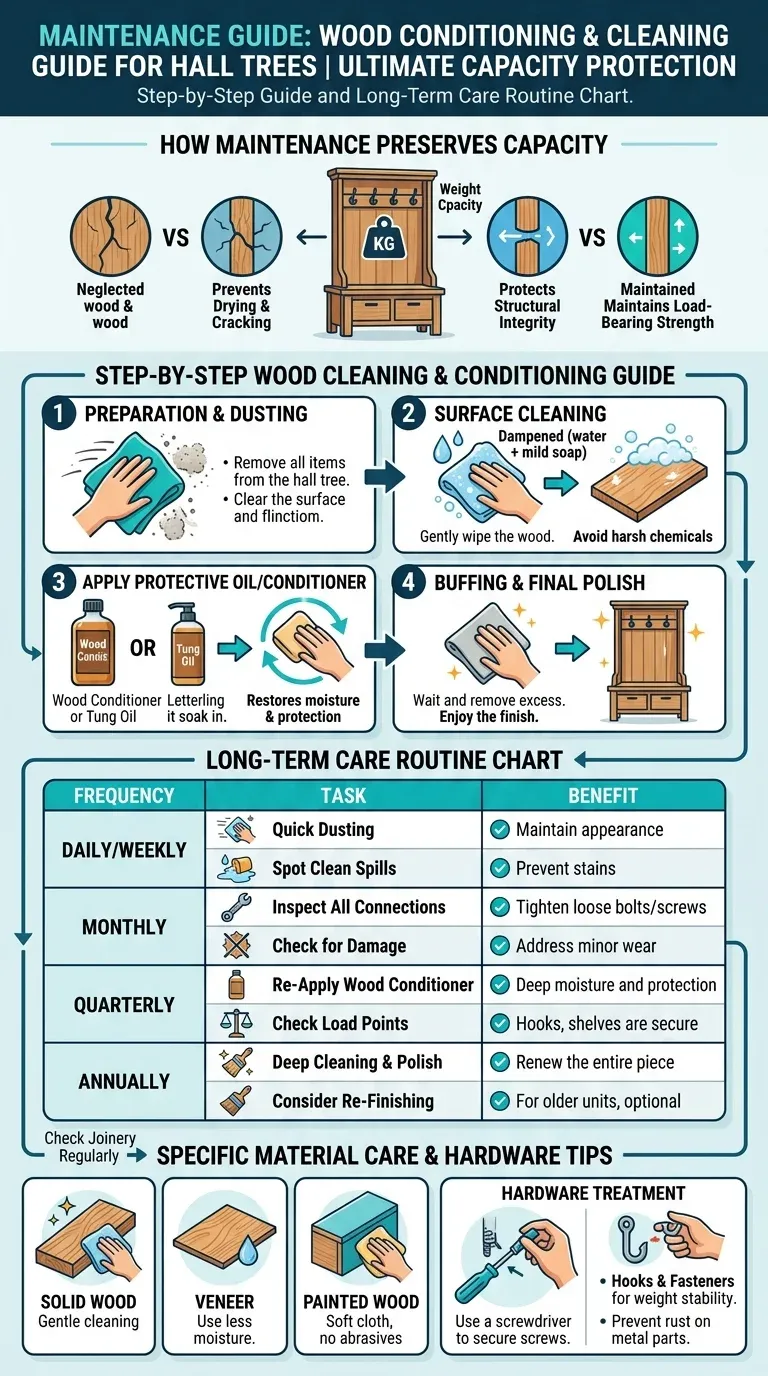
Run the checklist twice a year, at the season change, and the hall tree weight capacity you paid for stays the capacity you get. The answers are never magic: solid wood, sensible hardware, and a stud behind the strap turn “how much weight can a hall tree hold” from a gamble into a specification.
Top Picks: Best Hall Trees & Coat Racks
Editor's shortlist with verified ratings. Prices and availability below — clicking an Amazon link earns us a small commission at no extra cost to you.
| # | Product | Rating | Reviews | Tag | Check Price |
|---|---|---|---|---|---|
| 1 | Crosley Furniture Seaside Hall Tree | 5,410 | Top Pick | Check Price | |
| 2 | HOOBRO Hall Tree with Bench | 2,230 | — | Check Price | |
| 3 | VASAGLE Hall Tree with Bench & Coat Rack | 1,820 | Best Modern | Check Price | |
| 4 | Alaterre Aspen Hall Tree | 980 | — | Check Price | |
| 5 | Pemberly Row Farmhouse Hall Tree | 1,450 | Best Farmhouse | Check Price |
Affiliate disclosure: As an Amazon Associate we earn from qualifying purchases.
Tag: smartlyhomme-20 — change in src/data/topPicks.ts.