
Slim Console Table Benefits: Why 10 Inches of Depth Beats a Whole Dresser
A narrow console in an entryway gives you dresser-level function in a fraction of the depth — 6 real benefits, honest caveats, and styling help.

Jun 29, 2026 · Linda Wise
15 min readA slim console table gives you the function of furniture in the footprint of a picture frame — that’s the whole pitch.
Slide one against a wall with a 10-inch-deep top, and suddenly your entryway has a landing pad where it used to be a blank wall. A whole dresser, 17 or 18 inches deep, would push into the room and make you shuffle sideways through your own front door. The narrow console does the job without the shimmy. That is the trade everyone actually wants.
Let me be honest about the limits: slim does not mean “holds everything.” It means the table stops being a bulky monument and becomes a wall asset — and in a hallway, depth is the only dimension that charges you rent. For the working definition of slim, my guide on what makes a narrow console table keeps the line straight.
The 6 Real Benefits of a Slim Console Table
I organize entryways for a living, and the same question comes up constantly: “I have a hallway, I need a place for keys and mail, and I don’t want to lose half the walkway.” Here are the six real benefits of a slim console table — caveats included.
1. Fits Where Nothing Else Will
Every home has dead zones where a dresser never gets a chance to play: the gap beside the front door, the pocket between two interior walls, the sliver behind a coat rack. Most furniture taps out before the conversation starts. A 10-inch console walks right in.
The classic fit is the space between the door swing and the wall. Standard furniture needs two feet of clear wall and eats another 18 inches of room; a narrow console needs barely a foot of wall and gives most of the hallway back. If your entryway is genuinely tight, the narrow versus standard console breakdown shows where each piece earns its keep — it saved a client of mine from buying a 40-pound mistake.
One caveat, the same one I give everyone: measure first. A 10-inch top serves a 39-inch hallway beautifully. It does not rescue a 20-inch one, and no piece of furniture will.
2. Keeps the Walkway Clear (why 10-inch depth matters)
The difference between 10 inches and 16 inches sounds like a detail. In a hallway, it’s the difference between passing comfortably and turning sideways with grocery bags.
Every inch of depth comes out of your walking lane. Do the math: a 10-inch console leaves roughly an 80/20 split between walkway and furniture, which feels open; a 16-inch console flips that arithmetic and turns the corridor into a tunnel. The 10-inch figure shows up everywhere because it’s roughly the depth of a thick hardcover — so coffee cups, keys, and mail rest fully on the top without hanging over the edge.
3. Multitasks on the Cheap
One piece of furniture, three jobs: catch-all surface, display shelf, and visual anchor for a mirror or wall art. A dresser performs the same roster of tasks but costs three times as much and charges you the whole hallway as rent.
Slim consoles travel well, too: light, easy to move, and cheap enough that buying one for a temporary rental doesn’t feel like a misstep. For the full list of roles — home office side table, bedside landing strip, sofa back — I wrote up the best narrow console table uses in a separate post.
4. Skinnier Is Sometimes Smarter (styling)
The counterintuitive one: a smaller surface forces better styling. A deep tabletop invites piles — mail, sunglasses, whatever lands. A 10-inch top makes you pick: one tall item, one mid-height item, one low tray. The result looks deliberate instead of dumped.
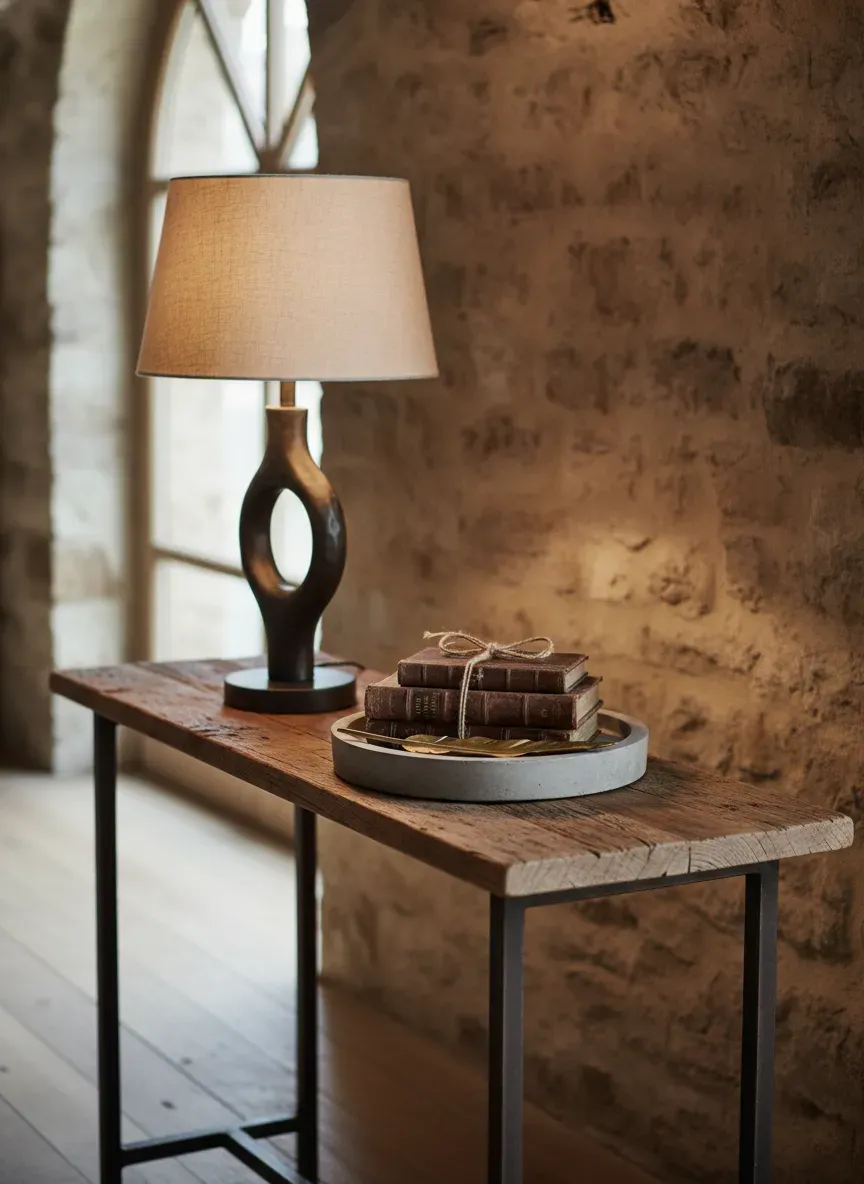
The rough formula I use with clients: a tall vase or lamp on one side, a stack of two or three books mid-table, a small tray for keys on the other, and one plant. Leave air between the groups, and it works on any depth — but it is easier to pull off when the surface refuses to hold more.
The caveat: you can’t style it like a sideboard — three objects, not thirty. Which, honestly, is most of the appeal.
5. Rental-Friendly (no drilling mountain)
Most slim consoles stand on their own four legs. Some float, but the ones that just work sit on the floor with no wall hardware at all. Compare that with a mounted mudroom unit or a bench that needs anchors, and it’s night and day — this is the piece you can take with you when the lease ends.
The honest caveat is safety: shallow furniture is tippy furniture. A 10-inch-deep table tips easily. If you have kids, dogs, or anyone who bumps into things, anchor it to the wall — a single strap usually ships in the box. Do that, and the no-drilling-mountain pitch stays intact.
6. Hides the ‘Drop Zone’ Mess
Every home has a drop zone — where keys, mail, and dog leashes land the second you walk in. Without a dedicated surface, that pile spreads to the kitchen counter and the dining table. A slim console gives it one address.
Baskets on a lower shelf swallow the clutter, and the shallow top keeps the whole surface readable at a glance. With a dresser, the stuff disappears into drawers, and out of sight means out of mind — read: your keys vanish for a week. On a tabletop this shallow, everything sits in front of you.
Narrow Console vs. Skinny Entry Bench: Different jobs, same hallway
A skinny entry bench and a slim console both claim the same strip of wall, but they are not interchangeable — different jobs, same hallway. The bench is for sitting: tying shoes, pulling on boots, waiting for a ride. It trades tabletop space for seat space. A narrow console is for parking things: keys, mail, a lamp, the day’s pocket contents.
My rule of thumb: if anyone sits in your entryway, the bench wins. If your problem is stuff, the console wins. Hallways that get both — bench by the door, console a few feet down — actually function.
Thin hallway furniture is having a moment — here’s why. It’s not a passing fashion; it’s honest real estate math. Hallways stay underused because the furniture that would serve them won’t fit. Thin hallway furniture that fits — consoles, benches, wall hooks — turns a transit corridor into usable space. That’s the definition of a good trend.
I’ll finish with the test I give every client, because it settles the argument faster than anything I write: put a piece of tape on the floor at 10 inches, step back, and look at how much hallway it leaves. The skinny table and the whole dresser stop being a style question and become a measurement question. When you measure your hallway, you’ll understand.
Top Picks: Best Entryway Furniture
Editor's shortlist with verified ratings. Prices and availability below — clicking an Amazon link earns us a small commission at no extra cost to you.
| # | Product | Rating | Reviews | Tag | Check Price |
|---|---|---|---|---|---|
| 1 | Christopher Knight Home Carlton Bench | 3,210 | Top Pick | Check Price | |
| 2 | Simplihome Avalon Console Sofa Table | 2,840 | — | Check Price | |
| 3 | VASAGLE Industrial Coffee Table | 4,420 | Best Value | Check Price | |
| 4 | Walker Edison Modern Farmhouse Console | 1,820 | — | Check Price | |
| 5 | Yaheetech 3-Tier Console Table | 1,320 | — | Check Price |
Affiliate disclosure: As an Amazon Associate we earn from qualifying purchases.
Tag: smartlyhomme-20 — change in src/data/topPicks.ts.