
What Is a Narrow Console Table Used For? 8 Real Uses
Learn what a narrow console table is used for: 8 real uses with placement guidance for entryways, hallways, and behind-sofa spaces, plus styling rules.
Jun 29, 2026 · Linda Wise
15 min readA narrow console table is a slim, wall-hugging table — typically 8 to 12 inches deep — used to hold keys, decor, lamps, and everyday drop-offs in hallways, entryways, and behind sofas. That is the short answer to what is a narrow console table used for: it converts dead wall space into a usable surface without stealing floor area from rooms that have none to spare. Below are the definition, the eight real uses, and where each belongs.
What Is a Narrow Console Table? (Definition)
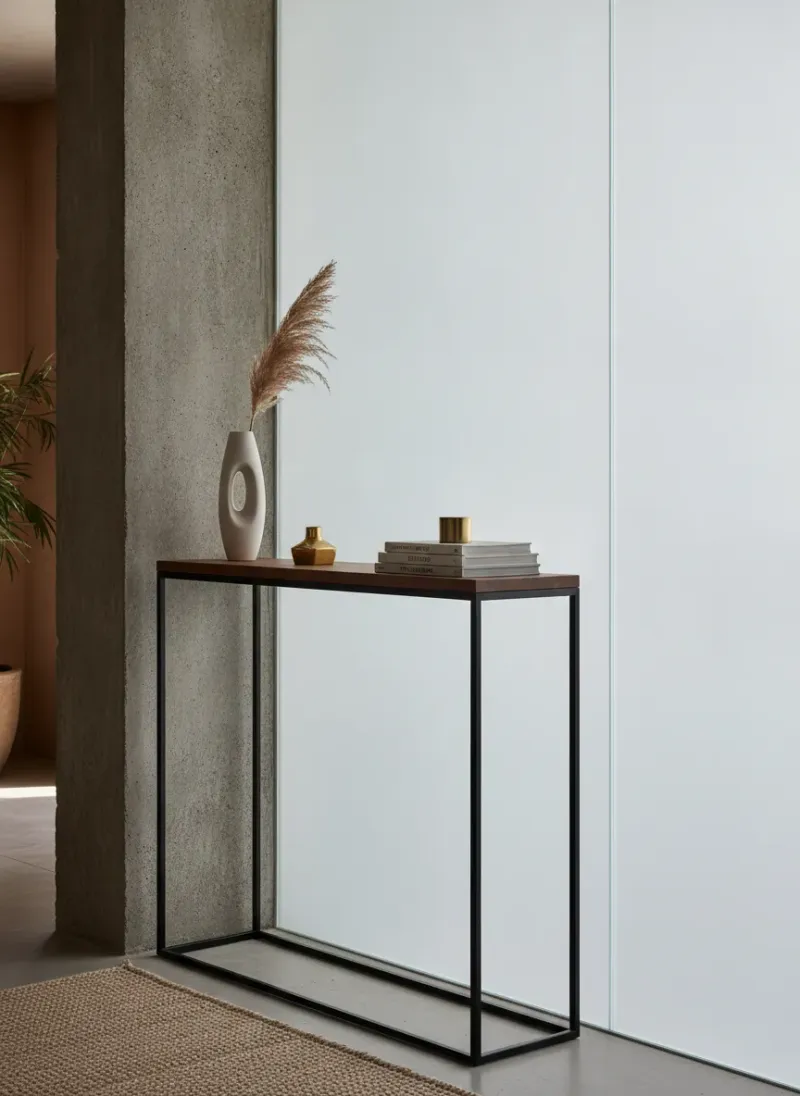
What is a narrow console table? It is a long, low table — usually 30 to 55 inches wide, 30 to 32 inches tall, and only 8 to 12 inches deep — built to sit flush against a wall. A standard console runs 14 to 18 inches deep; a narrow one keeps the walking path clear beside it, and that single dimension is what makes it “narrow” rather than merely smaller. For the form itself, see our narrow console table definition; for how the depth gap plays out in real rooms, compare with a narrow vs standard console table.
8 Real Uses (with where-to-place guidance)
1. Entryway catch-all
Use a narrow console table as your entryway catch-all: it gives keys, mail, sunglasses, and phone a permanent landing spot a step from the door.
Placement note: Sit it 2 to 3 feet from the door, on the wall beside — never behind — the door swing, so the door still opens fully.
2. Hallway walkway saver
Use one in a hallway as a walkway saver: at 8 to 10 inches deep it adds storage and light to a corridor without turning the path into an obstacle course.
Placement note: Center it on a wall run of 4 feet or more, and confirm at least 24 inches of clear walkway remains on the open side.
3. Sofa-back table
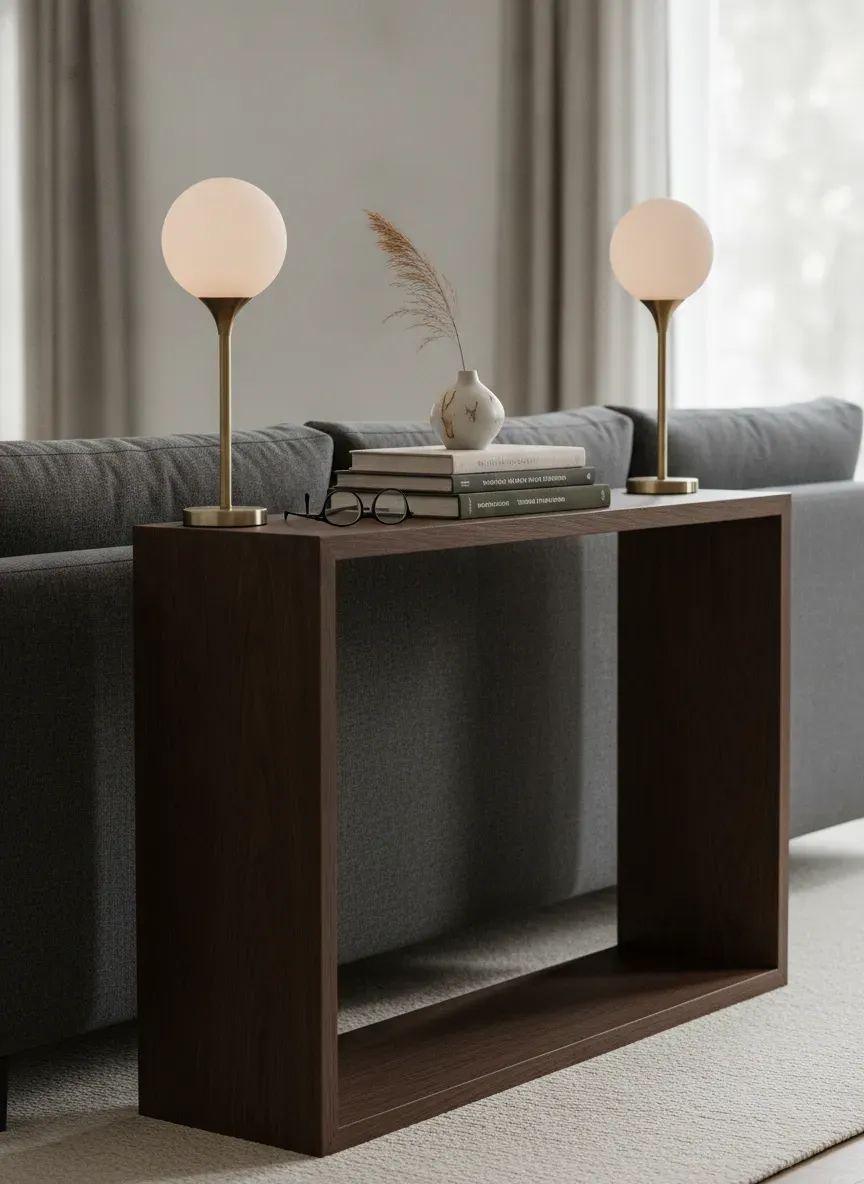
Place one behind the sofa as a sofa-back table: it holds lamps, books, and drinks where a full-size table would block circulation and read as a floating wall of wood.
Placement note: Keep it 6 to 12 inches off the sofa back, at a height just below the cushions so it stays visually “behind” the seating.
4. Kitchen extra counter
Use it as a kitchen extra counter: the slim top gives the coffee maker or toaster a home along a tight wall where a standard cart would block the aisle.
Placement note: In galley layouts, keep 36 inches of passage between console and opposite counter, and place it beside an outlet before adding appliances.
5. Display ledge for art and frames
Turn it into a display ledge: frames, vases, and collectibles read as a gallery moment with far less visual weight than a bookcase or buffet.
Placement note: Hang wall art 6 to 8 inches above the tabletop, keeping the arrangement’s width within the table’s length so it reads as one unit.
6. Plant stand row
Line it up as a plant stand row: three or four pots of varying heights stage beautifully on a shallow table along a bright wall.
Placement note: Put it on the room’s brightest wall, ideally near a window, and leave 2 to 3 inches between pots so leaf edges don’t merge.
7. Foyer catch-all with baskets
Use it in a foyer as a catch-all with baskets: the top handles daily drop-offs while baskets on the lower shelf swallow shoes, umbrellas, and dog gear.
Placement note: Choose baskets 2 to 3 inches shorter than the shelf opening so they lift out easily, and keep the table at least 18 inches off the entry path.
8. Divider in open-plan rooms
Float it as a divider in open-plan rooms: a shallow console between living and dining zones splits functions without a wall, keeping sightlines open.
Placement note: Leave 12 inches of clearance behind sofas or chairs on both sides, and favor a 30-to-34-inch height that screens clutter without blocking views.
Where to Place Yours (room by room)
So where do you place your narrow console table? Wherever wall meets foot traffic and you need a surface — with clearance numbers deciding the rest:
- Behind a sofa: 6 to 12 inches off the sofa back. The gap lets you reach decor and hides cords without pushing the table into the room.
- Along a hallway: at least 24 inches of clear walkway between the table’s front edge and the opposite wall. In a 36-inch hall, that caps the table at 8 inches deep.
- In an entryway or foyer: center it on wall runs of 4 feet or more, keeping the front of it clear of the door swing plus 18 inches of landing space.
- In open-plan rooms: give a floating divider 12 inches of breathing room on each side, and avoid blocking a straight traffic line to a door or stairs.
Those three numbers — 24 inches of walkway, 6 to 12 inches of sofa gap, 4 feet of wall run — cover roughly 90 percent of good placements. For why slimmer almost always wins in these spots, read our slim console table benefits.
Styling Rules for Slim Tables
A shallow surface hides nothing, so styling a narrow console table is restraint plus verticality. Start with three elements at different heights — a lamp or tall vase, a mid-height book stack, a low tray — then stop; leave about a third of the tabletop empty. Keep one or two woven baskets on the lower shelf for texture and storage, and let nothing overhang the front edge by more than an inch, since overhang is what makes a slim table read as bulky. Anchor anything tall or heavy with anti-tip hardware.
Above the table, go vertical: one large mirror or a set of three frames hung 6 to 8 inches above the top draws the eye up and makes the setup feel taller than its footprint. Match the table’s finish to your floor rather than your walls — it grounds the piece instead of dissolving it.
The final rule ties it together: every item on a narrow console table must earn its inches. If it isn’t used daily, it should be beautiful enough to justify the space. One function, one focal point, one shelf of storage — that discipline is what separates a styled console from a cluttered one. Bottom line: a narrow console table does everything a full-size console does, minus the floor space — carry it to your entryway, hallway, sofa gap, or kitchen, respect the clearances, and it outperforms furniture twice its footprint.

Top Picks: Best Entryway Furniture
Editor's shortlist with verified ratings. Prices and availability below — clicking an Amazon link earns us a small commission at no extra cost to you.
| # | Product | Rating | Reviews | Tag | Check Price |
|---|---|---|---|---|---|
| 1 | Christopher Knight Home Carlton Bench | 3,210 | Top Pick | Check Price | |
| 2 | Simplihome Avalon Console Sofa Table | 2,840 | — | Check Price | |
| 3 | VASAGLE Industrial Coffee Table | 4,420 | Best Value | Check Price | |
| 4 | Walker Edison Modern Farmhouse Console | 1,820 | — | Check Price | |
| 5 | Yaheetech 3-Tier Console Table | 1,320 | — | Check Price |
Affiliate disclosure: As an Amazon Associate we earn from qualifying purchases.
Tag: smartlyhomme-20 — change in src/data/topPicks.ts.