
Cube Storage Ideas: How to Organize Cube Storage (plus Decor Ideas)
Cube storage ideas that don't scream dorm room: how to organize cube storage with bins, decorate a cube wall, and build entryway hook-and-bench combos.
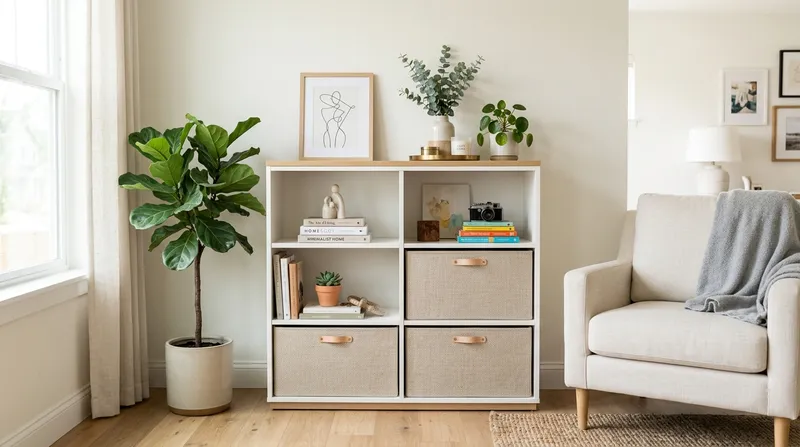
Aug 11, 2026 · Linda Wise
15 min readCube storage is the most forgiving furniture we own: it’s storage you can remix, repurpose, and redecorate in an afternoon.
That’s the good news, and it’s the trap, too. Because cubes are so interchangeable, we tend to treat them as scenery — buy a 6-cube unit, stuff every opening with a matching bin, and call it organized. Then the entryway still looks cluttered, and the cube organizer gets blamed, and the whole system quietly joins the furniture graveyard on Facebook Marketplace.
I’ve organized more cube units than I can count, and the pattern is always the same: the setups that work get three decisions right — what goes in each cube (a plan before a single bin), how much of each cube gets filled (deliberately, not completely), and what the cube wall itself says to the room (styled, not stacked). Here’s how to do all three, room by room, starting with the hardest room of all.
Cube Storage Ideas That Don’t Scream ‘Dorm Room’
The dorm room look has one cause: everything matches too well, empty or crammed. Neat rows of identical all-purpose bins in every square reads as storage equipment, not furniture. The fix is to let the unit read as furniture and treat the cubes like shelves with boundaries.
Three ideas that work everywhere:
- One texture, repeated. Pick a single bin family — all woven seagrass, all natural linen, all slim metal wire — and repeat it, with tone variations instead of color chaos. Repetition is what makes a cube wall look intentional; variety is what makes it look random.
- The half-and-half cube. For every two cubes of storage, leave one cube as display: a plant, a stack of books laid flat, a framed print leaning against the back, a ceramic catch-all. The empty cube is not dead space — it’s the breathing room that makes the filled cubes look curated instead of cluttered.
- Wood over black wire. If the unit itself reads dorm-furniture (black wire frames, glossy black laminate), swap the hardware look: matte wood-tone units, or insert a panel backing in rattan or shiplap so the cubes gain depth and warmth. Wallpaper one cube back for a built-in feel.
How to Organize Cube Storage (bins, baskets, and the empty-box problem)
Organizing cube storage is a planning exercise, not a shopping exercise. Do it in this order and you’ll never redo it:
- Assign categories before you buy a single bin. Write the contents of every cube on sticky notes and stick them to the openings. Shoes top row, backpacks middle row, daily-carry bin lower left, and so on. Retroactively categorizing a full unit is twice the work.
- Measure the opening, not the panel. Internal cube openings run 11x11 to 13x13 inches; the most common bin is 11 inches square. Target bins 0.5 to 1 inch smaller per side so they slide in and out without jamming — the bin size table in the storage bins guide covers the fit math in detail.
- Match bin type to contents. Fabric and woven bins for dry daily items; rigid plastic or metal wire bins for boots, wet gear, and garage-adjacent cubes; clear-lidded bins for seasonal swaps so you can see the season without opening anything.
- Face the empty-box problem head-on. The real disease of cube organization: you buy bins, they arrive in boxes, and the boxes become “temporary” storage that becomes permanent. The drug problem of cube storage: you will buy bins for the bins. Set a rule — no box goes into a cube, ever; recycle the packaging the day it arrives, and if a bin’s contents don’t fill the bin, the bin doesn’t belong in the unit.
The empty-box problem is worth italicizing because it’s the difference between organized and staged: a cube wall organized by bins you can see through, and the same wall hiding a graveyard of Amazon boxes.
Cube Storage Decor Ideas (styling a cube wall)
Once the logic is right, styling is what upgrades the grid from storage to furniture.
- Design the grid, not the cubes. Treat the whole unit as one composition: an alternating pattern where storage cubes and display cubes balance across the wall — never all storage on one side and all display on the other.
- Vary the heights. Books lying flat, a leaning print, a small plant on a stack of books, a folded throw in an open cube. Mixing horizontal and vertical lines inside the cubes makes the wall feel designed.
- Light it. A narrow battery puck light tucked into a display cube — focused on a plant or a lamp — reads as custom shelving, not cube storage.
- One rule per row. Vary tone within one material family per row: linen row, seagrass row, open display row. Change material per row, not per cube.
Styling also means knowing when to stop: a fully loaded cube wall always looks busy. The goal is approximately one-third display, two-thirds function — that ratio is what makes cube storage decor ideas look like they cost ten times what they did.
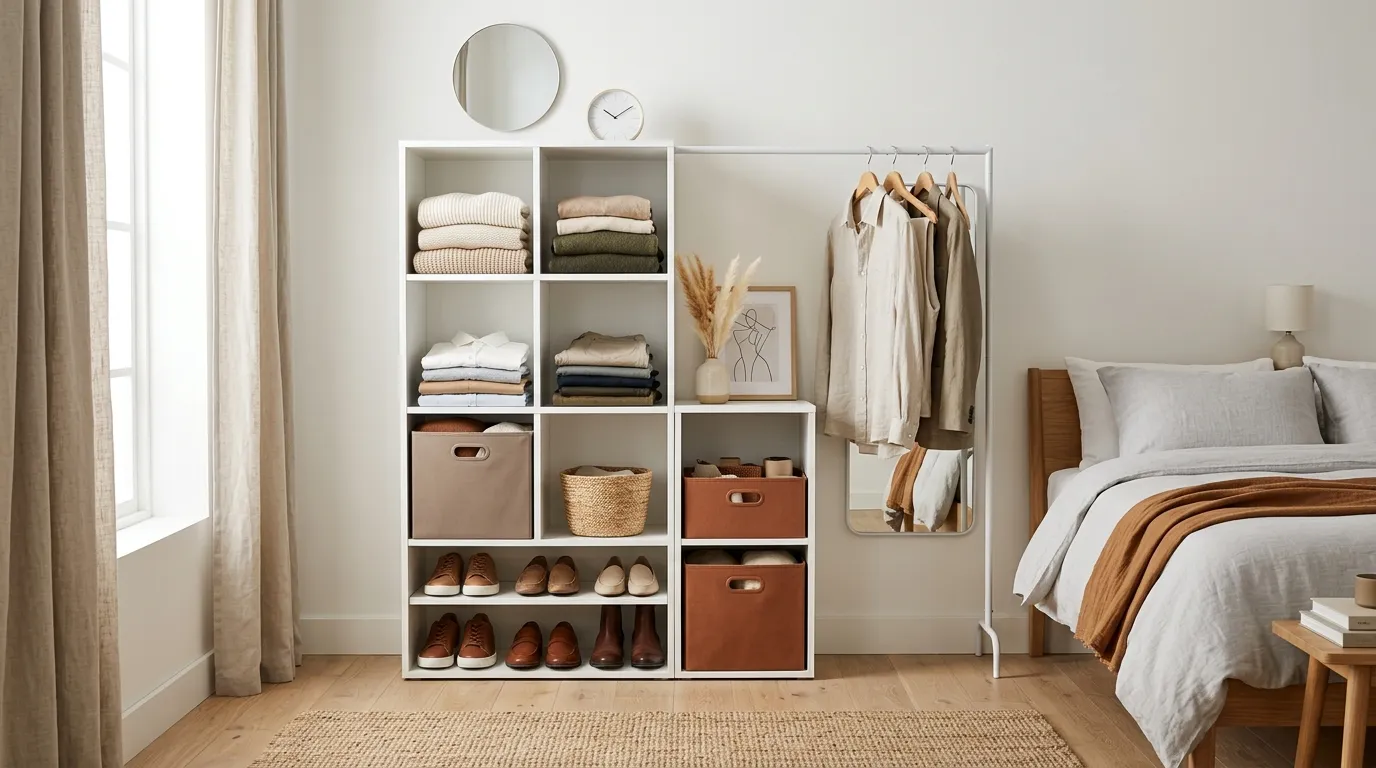
Cube Storage in Entryways (hooks + bench combos)
The entryway is where cube storage earns its keep — and where it needs actual engineering, not just styling. The classic miss is a 6-cube unit filled with decorative bins while the floor in front holds the real shoes, coats, and backpacks. The fix is to design the entryway combos on purpose:
- The cube bench. Lay a 6-cube unit horizontally, add a 16–18-inch cushion attached with a non-slip pad, and you have seating above concealed shoe storage. Bottom cubes for shoes (open or lidded), top cubes for daily-carry. Never let more than one adult sit on a standard 6-cube unit at a time, and anchor it to the wall — it’s furniture holding human weight now.
- The hook strip above. Mount a wall hook rail over the cube unit for coats and bags, one hook per person. Hooks catch the coats that otherwise drape the bench; the cubes catch everything that would otherwise pile on the floor.
- The per-person cubby wall. Two units side by side, one cube per family member for backpacks, one for shoes, one for accessories. This is the locker without the lockers, and it’s the highest-compliance spot-organization system I know.
| Combo | Unit | What the hooks carry | What the cubes carry |
|---|---|---|---|
| Cube bench | 6-cube horizontal | Hats, leashes | Shoes (bottom), daily-carry (top) |
| Hook + tower | 6-cube vertical | Coats, backpacks | Shoes (bottom), seasonal (top) |
| Cubby wall | Two 6-cube units | One hook per person | Bag, shoes, accessories per person |
Follow the entryway rules that make it hold up: bottom cubes are the wet zone — plastic or wire bins only, wet gear dries on a tray before it goes back in; leave a 1-inch air gap behind the unit; and for a bench version of this storage in ready-made form with proper dimensions, the compact storage bench roundup has the furniture-grade alternative.
The One Rule: Never Fill a Cube With a Cube-Shaped Blob
One rule governs every cube setup that stays organized for more than a month: never fill a cube with a cube-shaped blob.
A cube-shaped blob is what happens when a cube gets stuffed with a single undifferentiated mass — eleven shoes in one fabric bin, a mountain of scarves, the shelf where “everything else” lives. It looks like storage and behaves like a landfill: nothing is findable, nothing comes back out easily, and within two weeks the exaggeration “I can’t find anything in there” becomes literally true.
The rule in practice: every cube needs a job and a volume. If a cube’s job is “shoes,” it holds no more than four pairs, placed not thrown. If its job is “scarves,” they’re folded flat, not wadded. If its job is “everything else,” it fails the rule on sight — pick a narrower job. One cube, one use, never more than 80 percent full. The 20 percent margin is what lets you swap, remix, and redecorate in an afternoon — which is the entire promise of cube storage in the first place.
Assign before you fill, leave the breathing room, style in layers, and never let a blob form — do that, and cube storage stays the most forgiving furniture you own: remixable, repurposable, and redecoratable in a single afternoon, for years.
Frequently Asked Questions
What is the best cube storage setup for an entryway?
The most versatile entryway setup is a single 6-cube unit (2 wide x 3 tall) used horizontally: the two lower-row cubes hold shoes, the middle row holds backpacks and daily-carry bins, and the top row takes keys, mail, and a charging bin. In a mudroom, two units anchored side by side with labeled cubes per family member replace a full locker at a fraction of the cost.
What size bins fit a cube storage organizer?
Most standard cube organizers have internal openings of 11x11 to 13x13 inches, and the most common fabric or woven bin is 11 inches square. Measure the internal opening of your unit before buying, and target bins 0.5 to 1 inch smaller per side so they slide in and out easily.
Can cube storage hold boots and wet gear?
Yes, if you choose the right bins. Use rigid plastic (PETG) bins or metal wire baskets for boots, rain gear, and anything wet or dirty — never natural-fiber baskets or untreated fabric bins, which absorb moisture and mildew. Leave a 1-inch air gap behind the unit and let wet gear dry before it goes back in the cube.
How deep should an entryway cube organizer be?
A standard 12-inch-deep cube unit handles shoes (men's size 12 shoes are about 12 inches long), folded bags, and most bins. For a cube bench or boot storage, look for units in the 14-15 inch range. In hallways under 4 feet wide, an 11-12 inch unit with open cubes is the right call — it keeps the walking path clear.
Can cube storage replace mudroom lockers?
For hook-and-cubby duty, yes. A cube wall with a top shelf for hooks, open cubes for backpacks, and lower cubes for shoes covers what most families actually use lockers for. The trade-offs versus a real locker: no hanging rod for coats on hangers, less security for valuables, and you must anchor tall units to the wall.
How do you keep entryway cube storage organized long-term?
Assign a fixed category to every cube before you fill it, label each bin, and run a weekly 10-minute reset. Use closed bins for anything you do not want on display (mail, chargers, winter accessories) and open cubes for frequently used items like the day's shoes and backpacks. Apply one-in-one-out for seasonal gear.
What is the difference between a 4-cube and 6-cube organizer for a hallway?
A 4-cube unit (2x2) suits apartment entries and doorways under 3 feet wide; it fits shoes and daily-carry bins but little else. A 6-cube unit (2x3 or 3x2) anchors a proper drop zone with room for a shoe row, a backpack row, and a key-and-mail tray — orient it vertically in a narrow hall or horizontally under a mirror.
Is cube storage good for kids' entryway gear?
Yes — one labeled cube per child at a height they can reach teaches the put-away habit early. Use the lower row for each kid (one cube for shoes, one for hats/gloves), bold labels with icons for pre-readers, and keep the whole system at waist height or below for the youngest family members.
Top Picks: Best Home Organization
Editor's shortlist with verified ratings. Prices and availability below — clicking an Amazon link earns us a small commission at no extra cost to you.
| # | Product | Rating | Reviews | Tag | Check Price |
|---|---|---|---|---|---|
| 1 | mDesign Stackable Storage Bins | 6,820 | Top Pick | Check Price | |
| 2 | Seville Classics Storage Organizer | 3,210 | — | Check Price | |
| 3 | Simple Houseware Closet Organizer | 2,450 | Best Closet | Check Price | |
| 4 | Rubbermaid Cleverstore Clear Container | 4,120 | — | Check Price | |
| 5 | IRIS USA Storage Bin with Lid | 2,210 | Best Stackable | Check Price |
Affiliate disclosure: As an Amazon Associate we earn from qualifying purchases.
Tag: smartlyhomme-20 — change in src/data/topPicks.ts.