
Vacuum Storage Bags vs. Plastic Tubs: Which Protects Better?
Vacuum storage bags vs plastic tubs compared on compression, pest and moisture protection, and long-term fabric health so you pick the right one per item.

Published · Linda Wise
7 min readLast updated: November 8, 2026 | Reviewed by: Linda Wise, managing editor
The question sounds like a straightforward product comparison. It is not. Vacuum bags and plastic tubs solve two different problems, and most storage failures happen because someone used the wrong one.
Vacuum bags remove air. Plastic tubs remove contact. Neither removes moisture, and moisture is what actually destroys stored belongings. Once you separate those three ideas, the choice per item becomes obvious.
This guide assigns each method to the items it genuinely protects, flags the failure modes that ruin bedding and wool, and gives you a storage setup that survives a humid summer in a garage.
What Each One Actually Does
A vacuum storage bag is a plastic film pouch with a one-way valve. You load it, seal the zipper, and pull air out with a vacuum hose or a hand pump. The contents compress, and the bag becomes a thin, rigid slab.
A plastic storage tub is a rigid container with a lid. It holds shape, stacks, and protects contents from impact, dust, and pests. It does not compress anything.
That difference drives everything else:
- Bags win on volume. A comforter that fills a 66-quart tub can often be compressed into a fraction of that footprint.
- Tubs win on structure. Nothing crushes, bends, or creases inside a tub.
- Bags lose to punctures. One sharp corner and the seal is gone.
- Tubs lose to humidity. Air moves through the lid interface, and condensation forms inside.
Neither is a sealed archive. If you need archival protection for textiles, that is acid-free boxes and tissue paper in a climate-controlled closet, which is a different budget entirely.
The Comparison Table
| Factor | Vacuum storage bags | Plastic storage tubs |
|---|---|---|
| Space savings | High, roughly 50-70% volume reduction on soft goods | None, but stackable and uniform |
| Protection from pests | Good while the seal holds | Good, provided the lid seats fully |
| Protection from moisture | Poor once the seal fails; traps condensation | Poor to moderate; gasketed tubs are better |
| Protection from crushing | None, that is the point | Excellent |
| Reusability | Limited; film weakens and valves fail | Long, though lids crack |
| Access speed | Slow; you open the whole bag | Fast; open one tub |
| Best for | Duvets, out-of-season clothing, pillows | Shoes, tools, decor, documents, anything rigid |
| Typical price band | Low, sold in multipacks | Low to moderate depending on size and lid type |
The table makes the split clear. Bags are a volume tool. Tubs are a protection tool. Buying either one to do both jobs is how people end up with a flattened wool coat in a split bag.
Where Vacuum Bags Genuinely Win
Compression is not a gimmick. For the right contents it is the difference between a closet that closes and one that does not.
Use bags for:
- Down and synthetic duvets and comforters. These are mostly air. Compressing them is close to free storage.
- Out-of-season clothing in bulk. Winter sweaters in July, summer linens in January.
- Pillows and cushion inserts you rotate seasonally.
- Bulky baby and toddler clothing you are holding for a younger sibling.
- Travel packing for a return trip with dirty laundry.
Three rules make bags work:
- Everything goes in bone dry. Not “mostly dry.” A single damp sweater inside a sealed bag grows mildew in a warm closet, and you will smell it through the plastic.
- Leave a little air in soft items. Full compression on down and wool sets permanent creases and crushes loft.
- Store the bag flat or standing, never under heavy weight. A bag compressed under a stack of tubs abrades and fails at the fold lines.
Bags also have a shelf life. The film creases and weakens, zippers collect lint, and valves lose their seal. Treat a bag as a two-to-three-season consumable, not a permanent container.

Where Plastic Tubs Genuinely Win
Tubs are the better default for most household storage, because most household storage is not soft.
Use tubs for:
- Shoes. Structure matters, and a crushed shoe is a ruined shoe.
- Tools, hardware, and paint supplies. Sharp edges destroy bags instantly.
- Holiday decor. Fragile, awkwardly shaped, and often stored in a garage.
- Documents and photos. Rigid protection plus the ability to add a desiccant pack.
- Craft supplies, fabric, and sewing notions.
- Anything you open more than twice a year. Access speed is the underrated variable.
Choose tubs on three criteria, in this order:
- Lid type. Latching lids with a gasket beat snap lids, which beat friction lids. If the lid does not latch, assume air moves freely.
- Wall rigidity. A tub that flexes when you pick it up full will crack at the corners within a few years.
- Uniform footprint. Matching tubs stack predictably and use vertical space efficiently. Mismatched tubs waste the gap above each one.
Clear tubs with opaque labels are the practical compromise: you can see roughly what is inside without opening, and the label tells you precisely. Our roundup of the best storage bins covers material durability in more depth, including why paperboard-core fabric bins are a poor choice for a garage.
The Moisture Problem Neither Product Solves
This is the part that gets skipped, and it is the part that matters most.
Concrete floors wick moisture. Garages and basements swing in temperature, and every swing pulls humid air in and pushes it out. When warm humid air meets a cooler surface — like the inside of a plastic tub on a cold night — it condenses. Water droplets form on the inside of the lid and drip onto your belongings.
The fix is not a better container. It is a better setup:
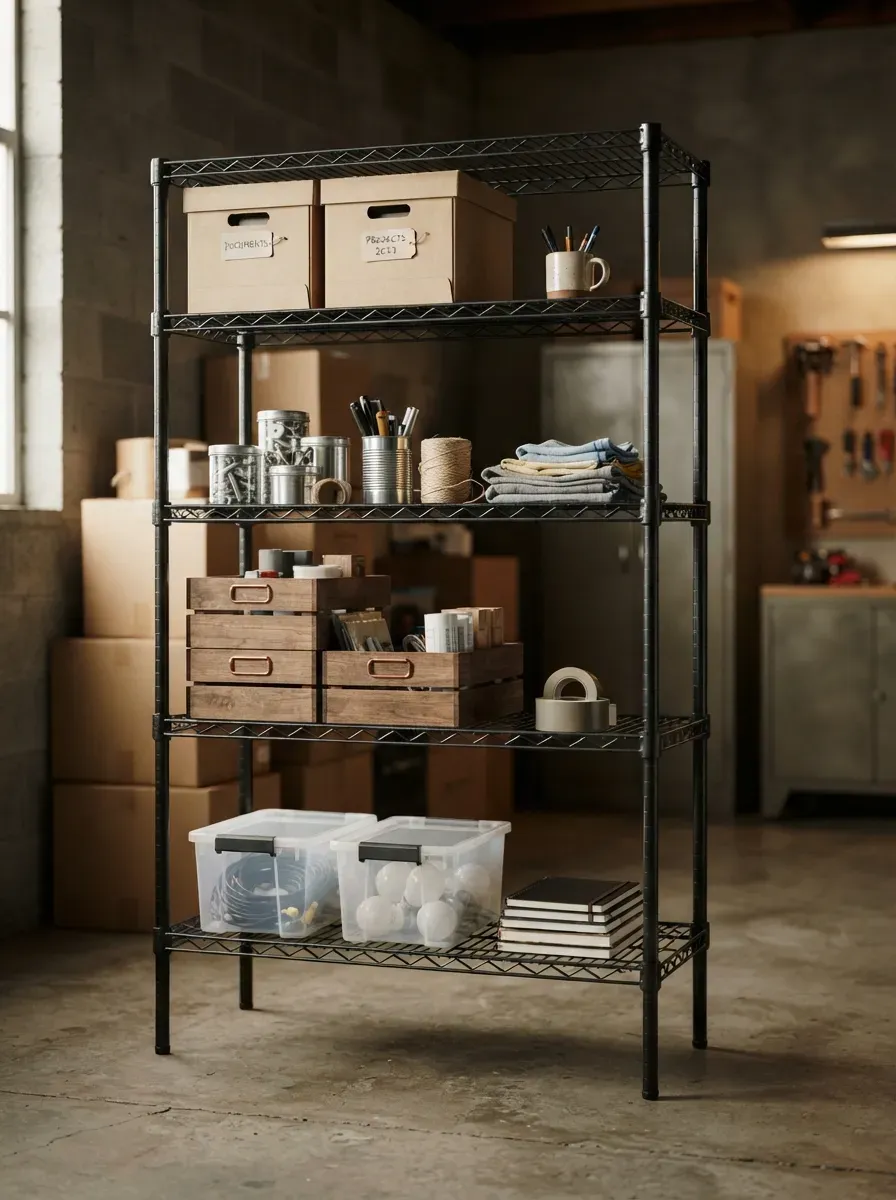
- Get everything off the floor. A pallet, a shelf, or a plastic riser. Four inches of air under a tub changes the condensation pattern.
- Leave a little headroom in tubs. Packing to the lid forces trapped air against the contents.
- Add a desiccant where it counts. Silica packs in document and photo tubs, refreshed annually.
- Keep the space ventilated. A closed, unventilated shed is worse than a garage with a vent.
- Never store textiles directly against an exterior wall. Insulation is thin there and condensation is worst.
For bags, the same logic applies with an extra failure mode: a bag that loses its seal in a humid space becomes a damp microclimate with no escape. That is worse than an open shelf.
A Hybrid System That Beats Either Alone
You do not have to pick a side. The strongest setup uses both, each doing what it is good at.
- Compress soft goods into bags. Duvets, pillows, out-of-season knits.
- Place the bags inside a large tub. The tub protects the bag from punctures and gives it a rigid stackable shell. This is the single best trick in this article.
- Keep rigid and fragile items in their own tubs, with padding between items.
- Label every container on two faces so you can read it from either side of a shelf.
- Keep an inventory list on your phone, updated when a tub changes contents.
That layered approach solves the puncture problem, the stacking problem, and the condensation problem at once. It also means a failed bag stays contained rather than leaking onto the floor.
If you are rotating seasonal goods through an entryway or mudroom, the same logic applies at smaller scale. Our guide to organizing seasonal gear in an entryway covers the swap-out routine, and the seasonal rotation strategy explains how to sequence it so you are not moving the same six boxes four times a year.
A budget-friendly supplement
Costway’s storage and organization range includes stackable bins, foldable baskets, and closet organizers at factory-direct prices. Affiliate link: we may earn a commission at no extra cost to you. Measure first, and buy one sample before committing to a matching set.
What to Never Put in a Vacuum Bag
A short list, because these are the mistakes that cost people real money:
- Anything with residual moisture. Gym clothes, beach towels, a rain jacket that “felt dry.”
- Leather and suede. Compression sets creases and trapped humidity damages the finish.
- Wool suits and structured jackets. They need to hang or lie flat.
- Down sleeping bags for long-term storage. Loft is the product; compression destroys it.
- Antique or heavily embellished textiles. Beading and fragile seams do not tolerate pressure.
- Memory foam. It recovers slowly and unevenly after long compression.
Tubs are the safer home for all of those except the suits and sleeping bags, which want a breathable hanging bag or a loose cotton sack.
Bottom Line
Stop asking which product is better and start sorting by item. Vacuum bags are a compression tool for clean, dry, soft goods you will not touch for months. Plastic tubs are a protection tool for everything rigid, sharp, fragile, or frequently accessed.
In our assessment, most households should buy tubs first and bags second. Tubs handle the majority of what needs storing, stack predictably, and last for years. Add a multipack of bags for the duvet pile, put the bags inside a tub, and you get the space savings without the puncture risk. Then get everything off the concrete and call it done.
Shop Entryway Furniture & Storage Deals on Costway
Factory-direct pricing on entryway benches, shoe cabinets, hall trees, and organizers with fast, free US delivery.
* Affiliate disclosure: We may earn a commission if you shop through this link at no added cost to you.
Check Costway Entryway DealsFrequently Asked Questions
Do vacuum storage bags really save space?
Yes, but less than the marketing implies. Compressing a duvet or a stack of sweaters typically cuts volume by roughly half to two-thirds, depending on the fill and how much air the item holds. Rigid items, structured bags, and anything with foam or down that has been over-compressed will spring back and take up more room than the bag saved.
Can I store clothes long-term in vacuum bags?
For clean, bone-dry, natural-fiber clothing, several months is generally fine. Avoid long-term compression for down jackets, wool suits, structured garments, and anything with elastic or memory foam, because sustained compression can flatten loft and set creases. Rotate those items out annually and let them breathe.
Are plastic storage tubs airtight?
Most are not, despite the lids. Standard tubs with snap or latching lids slow air exchange but do not seal it, and the gasket on a typical tote is a plastic lip, not a rubber seal. If you need a genuine moisture barrier, look for a gasketed, latched container and still store it in a dry space.
Which is better for a basement or garage?
Neither, without help. Both bags and tubs will trap condensation against contents in a space with big temperature swings. Keep everything at least a few inches off the concrete, use pallets or shelving, and prefer tubs over bags in a garage because a punctured bag offers no protection at all.
Do vacuum bags damage quilts and down comforters?
Over-compression can. Down needs loft to insulate, and storing it crushed for a year can reduce recovery. Compress down items only partially, or store them loosely in a breathable cotton bag. For quilts with fragile stitching or antique textiles, skip compression entirely.