
10 Stunning Minimalist Entryway Ideas to Transform Your Home's First Impression
Discover how to master the art of the minimalist entryway. Expert tips on layout, lighting, and storage to create a serene first impression.
Mar 2, 2026 - Written by: Linda Wise

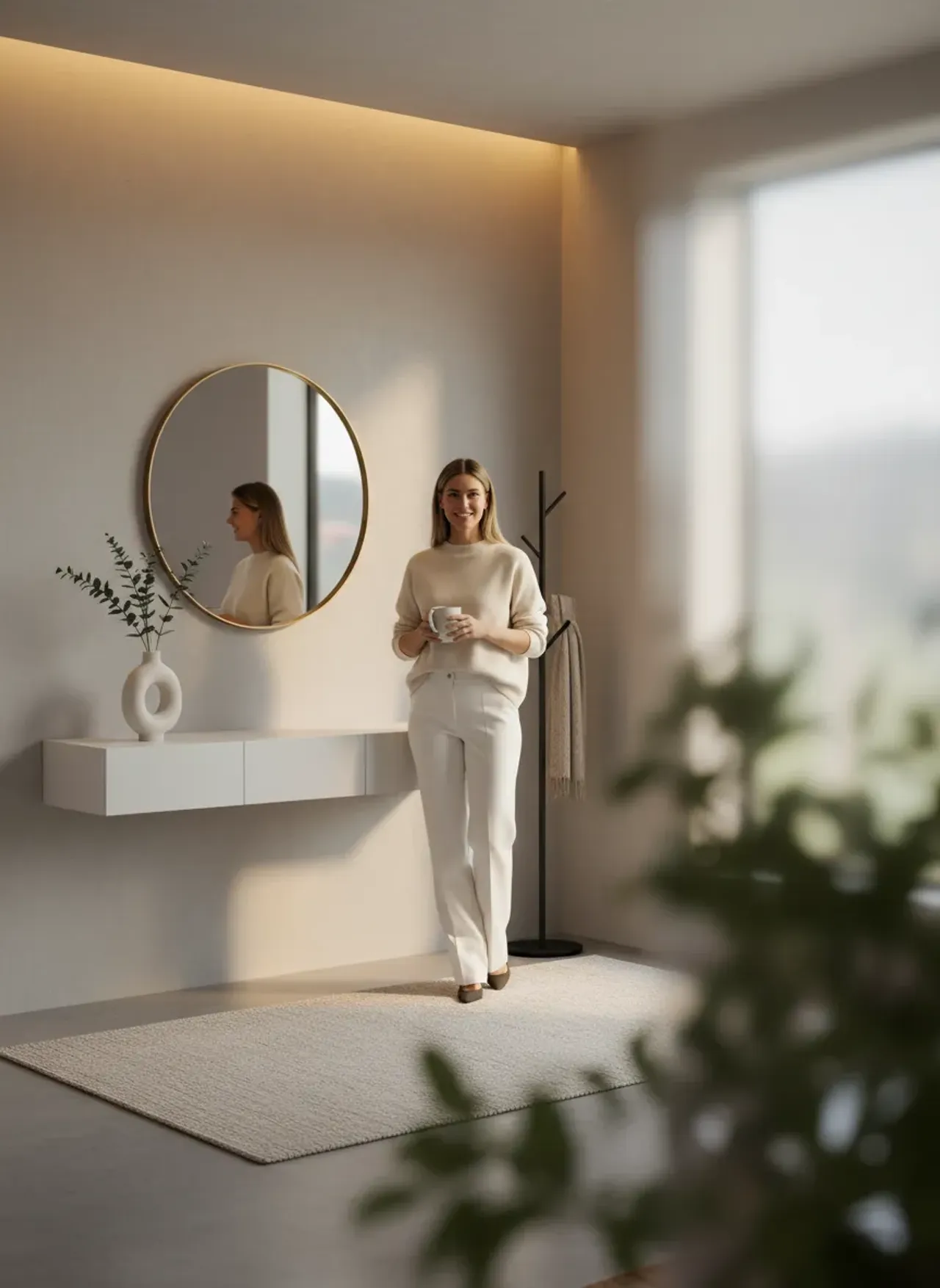
The moment you cross the threshold of your home, a psychological shift occurs. You are either greeted by a wave of visual noise—shoes kicked into corners, a pile of unopened mail, the chaos of daily life—or you are welcomed by a serene exhale. The entryway is the handshake of your home. It sets the tone for everything that follows.
Yet, this space is often the most neglected. We treat it as a dumping ground rather than a design opportunity.
I’ve spent years analyzing interior layouts, and if there is one truth I stand by, it’s that minimalism in the entryway isn’t about barren walls or sterile emptiness. It is about intentionality. It is about stripping away the friction of arrival so that your home serves you, rather than you serving the clutter.
In this deep dive, we are going to explore 10 stunning minimalist entryway ideas to transform your home’s first impression, moving beyond generic advice into the architectural and psychological mechanics of a truly great space.
Pro Tip: Minimalism is not the absence of something; it is the perfect amount of something. Your goal is to create a “landing strip” that handles your daily items without looking like a storage unit.
The Philosophy of the “Pause”
Before we start buying furniture, we need to address the function. A minimalist entryway acts as a “pause” button between the outside world and your sanctuary.
When you strip back the excess, you are left with the essentials: light, flow, and texture. I often tell clients that if you can’t walk through your front door in the dark without tripping, you don’t have a storage problem; you have a layout problem.
1. The Floating Console: Defying Gravity
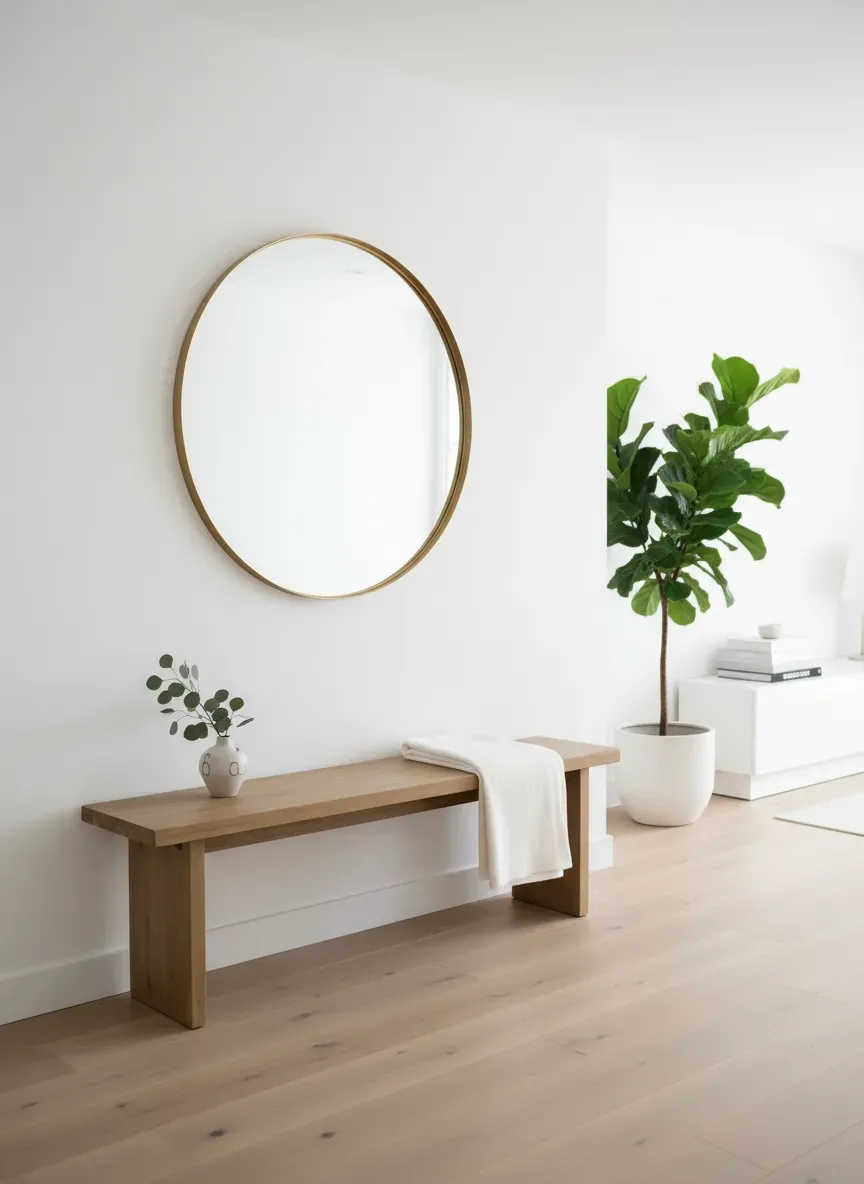
One of the quickest ways to expand the visual footprint of a narrow hallway is to get furniture off the floor. Legs on furniture, even slender ones, create visual stops for the eye. A floating console table solves this immediately.
By mounting a console directly to the wall, you expose the flooring underneath. This trick of the eye makes the room feel significantly wider and airier. It also creates a perfect nook beneath for tucking away baskets or shoes, keeping the floor clear while maintaining utility.
However, you have to be careful with installation. I’ve seen too many DIY disasters where the console starts to sag after a month of holding heavy tote bags. You need to be aware of the structural integrity of your wall. For those planning to install heavy floating units, reading up on calculating load-bearing limits and understanding weight is absolutely critical before drilling a single hole.
Material Matters
Go for natural wood tones to warm up white walls, or a matte concrete finish for an industrial edge. The surface should remain largely clear—perhaps a single ceramic bowl for keys and a structural vase.
If you want the best experience, I highly recommend checking out the Nathan James Theo Floating Wall Mount Desk. While technically a desk, its depth is perfect for entryways, and the dual compartments hide clutter beautifully.
2. The “Drop Zone” Paradox: Invisible Storage
The biggest myth in minimalism is that you can’t have “stuff.” You live there; of course, you have stuff. The secret lies in invisible storage.
We want to create a “Drop Zone”—a designated spot for keys, wallets, and mail—that doesn’t look like one. The key here is closed storage. Open shelving in an entryway is a dangerous game unless you possess the discipline of a monk.
Implementing the Hidden Cabinet
Instead of a coat rack that ends up looking like a fabric monster in the corner, opt for a floor-to-ceiling cabinet with push-to-open doors. Paint it the same color as your walls. It disappears into the architecture, yet it holds coats, umbrellas, and the dog’s leash.
If built-ins aren’t an option, look for ultra-slim shoe cabinets that tilt out. They keep the profile low but swallow up the visual clutter of footwear.
3. The Statement Mirror: manipulating Light
You have likely heard that mirrors make spaces look bigger. That is true, but in a minimalist entryway, a mirror is a dynamic art piece. It reflects light, yes, but it also frames the view of the room behind you.
Don’t just slap a rectangle on the wall. Go for oversized circles or irregular, organic shapes. An oversized round mirror softens the hard architectural lines of the front door and hallway.
Placement Strategy
Ideally, place the mirror perpendicular to a window to bounce natural light into the darker corners of the hall. If your entryway is a windowless corridor, the mirror becomes even more vital as a focal point.
For a piece that balances size and sleekness, the Umbra Hub Wall Mirror is an industry standard for a reason. Its rubber rim adds a modern texture without overwhelming the glass.
4. Monochrome Textures
Color is beautiful, but in a minimalist space, texture is king. A monochromatic palette—think layers of cream, beige, oatmeal, and white—creates a sense of calm sophistication.
When you remove color variety, you must increase tactile variety. If your walls are matte white, your console should be rough-hewn wood. Your rug should be a nubby wool or jute. Your lighting fixture should be smooth brass or ceramic.
Key Takeaway: If everything is smooth and white, your home will look like a hospital. Texture introduces warmth without adding visual noise.
This approach requires discipline. You have to resist the urge to add a “pop of color” just because you feel you should. Let the materials speak for themselves.
5. The Japandi Fusion
Japandi is the intersection of Scandinavian functionality and Japanese rustic minimalism (Wabi-Sabi). It is arguably the most effective style for entryways because it prioritizes order and natural materials.
The Look
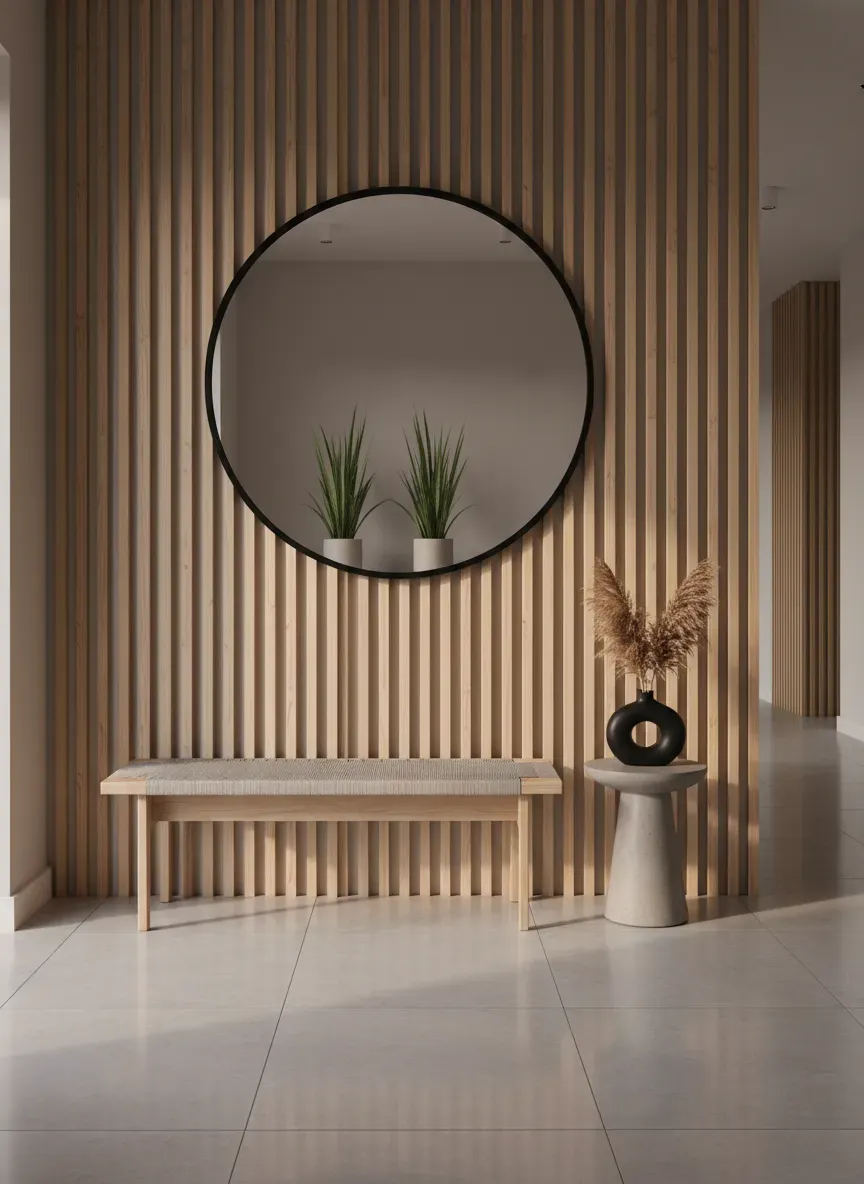
Think low profiles. A low, slat-wood bench. A single branch in a clay vase. Uncluttered surfaces. The color palette leans heavily on warm woods and soft greys.
This style avoids the coldness sometimes associated with modern minimalism. It embraces imperfection. A stone floor with natural variation is better than perfectly polished porcelain.
6. Vertical Utility: The Peg Rail
If floor space is at a premium, you must go vertical. The Shaker-style peg rail is a classic design element that has made a massive comeback in modern minimalist homes.
Running a continuous peg rail along the length of your entryway wall offers infinite flexibility. You can hang a coat, a bag, a mirror, or even a small hanging basket for mail. When nothing is hanging on it, it looks like intentional architectural molding rather than empty hooks.
This is where spacing becomes an art form. You don’t want hooks crowded together. For a guide on visual balance, review our breakdown on ideal spacing far apart to ensure your vertical storage looks curated, not cluttered.
7. The Sculptural Bench
Sometimes, one piece of furniture is all you need. A sculptural bench serves a dual purpose: it is a piece of art, and it is a place to sit while you put on your shoes.
In a minimalist setup, the bench is the room. Look for interesting geometry—arches, tripods, or cantilevered designs. Avoid benches with built-in cubbies (which invite clutter). Keep the space underneath empty. This negative space is crucial for the “airy” feel we are chasing.
The Bottom Line: A bench encourages guests to pause and take off their shoes, subtly reinforcing the sanctity of the home’s interior.
8. Lighting as Atmosphere
Overhead “boob lights” are the enemy of ambiance. In a minimalist entryway, lighting should be layered. You need functional light to see your keys, but you also want mood lighting to welcome you home.
The Sconce Solution
Wall sconces are excellent for saving space. They free up the surface of your console table. Look for fixtures with opaque or frosted glass to diffuse light softly. Harsh, exposed bulbs can create glaring shadows that make a small space feel intense rather than relaxing.
I personally love the look of an articulating sconce that can be directed toward a piece of art or the door handle.
9. The Runner Rug: Directional Flow
Flooring is often ignored, but a runner rug does heavy lifting in an entryway. It directs traffic flow, leading the eye (and the guest) into the main living area.
For a minimalist look, avoid busy Persian patterns or loud geometrics. Opt for solid colors with high texture (like a loop pile) or very subtle, tone-on-tone patterns.
Sizing is Critical
A rug that is too small looks cheap; a rug that is too big looks like wall-to-wall carpet. You need about 4 to 6 inches of floor showing on either side of the runner.
Furthermore, ensure the pile height allows your door to clear it. I’ve seen beautiful designs ruined because the front door gets stuck on a thick wool rug every time it opens. For those dealing with tight clearances, checking standard depth and height measurements for entryway furniture and rugs prevents these functional headaches.
If you need something durable yet stylish, the nuLOOM Rigo Hand Woven Jute Runner offers that perfect organic texture that hides dirt while looking high-end.
10. Biophilic Touches: Life in the Void
Finally, a minimalist space needs life. A sterile white box feels uninviting. Adding a plant brings organic chaos that contrasts beautifully with clean architectural lines.
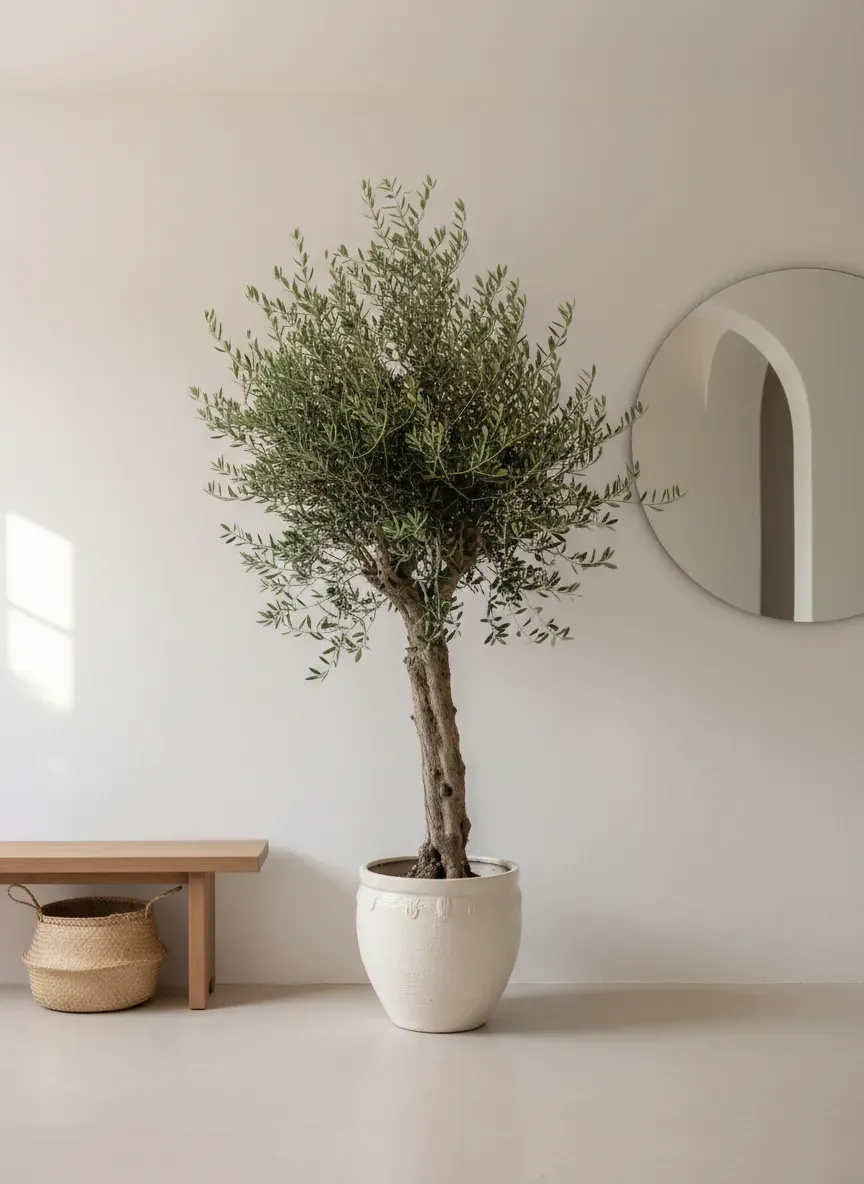
You don’t need a jungle. One large statement plant—like a Fiddle Leaf Fig or an Olive Tree in a stone pot—is enough. If you lack natural light, dried botanicals or high-quality faux olive branches provide the sculptural element without the maintenance.
The green breaks up the monotony of wood and white, adding a breath of fresh air literally and figuratively.
Practical Execution: The Rules of Engagement
Now that we have covered the ideas, we need to talk about the mechanics of setting this up. You can buy all the right items and still fail if the placement is off.
The 3-Foot Rule
You generally need a minimum of 3 feet of clearance for a walkway. If your console table pushes into this zone, it has to go. Flow is more important than furniture.
The Landing Strip Concept
Psychologically, we need a place to put things down within 5 seconds of entering. If your “drop zone” is 10 feet away from the door, you will end up dropping your keys on the floor or the nearest chair. Keep the utility within arm’s reach of the door swing.
Also, consider the sightlines. What is the first thing you see when the door opens? If it is the side of a bulky coat rack, move it. You want the eye to travel to a focal point—art, a mirror, or a window.
For a comprehensive look at how these elements come together, refer back to our core guide on stylish minimalist entryway ideas to see how different layouts can be adapted to your specific floor plan.
Common Pitfalls to Avoid
Even seasoned designers make mistakes here. Here are the traps I see homeowners fall into repeatedly:
- The “One of Everything” Syndrome: You don’t need a bench and a console and a coat rack and a plant. Pick two. Minimalism is about editing.
- Scale Failures: Tiny art on a big wall makes the wall look empty, not minimal. Small furniture in a large hall looks like a dollhouse. Be bold with scale. Fewer, larger items are always better than many small ones.
- Ignoring the Floor: Shoes are the enemy. If you don’t have a plan for shoes, your minimalist entryway will last exactly 4 hours.
Final Thoughts on Curating Your Space
Transforming your entryway isn’t just about impressing guests. It is about respecting your own transition from the public world to your private sanctuary.
When you walk in and see a clean line, a soft light, and a dedicated place for your belongings, your brain registers safety and order. That is the power of minimalist design. It creates space for you to exist without the visual noise of clutter screaming for your attention.
Start small. Remove everything from your current entryway. Only put back the items that are absolutely essential for your departure and arrival. Then, add one element of beauty—a mirror, a plant, or a piece of art.
That is how you build a first impression that lasts.