
Splurge or Save? Entryway Storage Bench Vs. Console Table & Wood Bench Comparison
Discover whether to splurge or save on entryway storage benches. We compare storage benches vs. console tables, upholstered vs. wood benches, and custom vs. budget options.
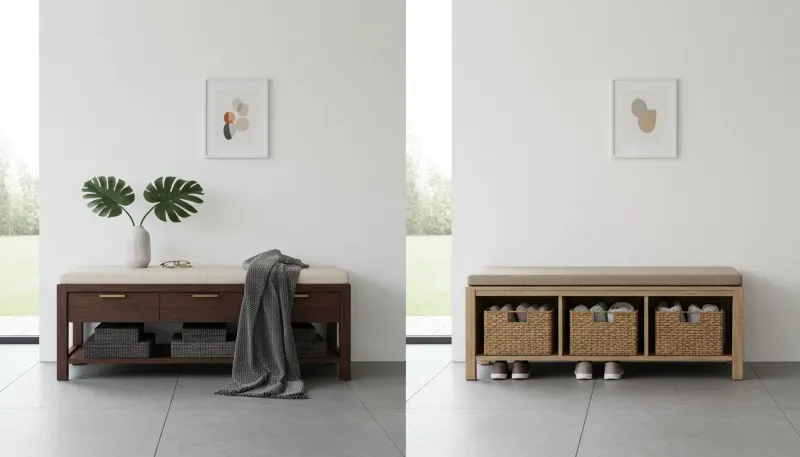
Feb 4, 2026 · linda wise
14 min readThe entryway is the handshake of the home. It is the first physical point of contact for guests and the final threshold you cross before facing the world. Despite its significance, this transitional space is often relegated to an afterthought—a chaotic drop zone for mail, shoes, and keys. However, for the discerning homeowner, the foyer represents a unique opportunity to marry high-end aesthetics with pragmatic utility. Central to this union is the entryway bench with storage.
When curating a home that exudes intention and sophistication, one inevitably encounters a dilemma: should you invest in a luxury piece that promises heirloom quality, or is it wiser to opt for a budget-friendly alternative that achieves the visual objective without the financial commitment? The answer lies not just in the price tag, but in an understanding of materials, construction, and the long-term value of organization.
In this comprehensive guide, we will dissect the anatomy of the storage bench, evaluating where high investment yields high returns and where savvy savings can be made without sacrificing style. Whether you are outfitting a sprawling vestibule or optimizing a compact hallway, understanding the nuance between “splurge” and “save” is the key to a successful interior design strategy.
1. Storage Bench vs. Console Table: The Ultimate Entryway Comparison
When planning an entryway layout, the first major decision is selecting the right category of furniture. Homeowners frequently weigh the choice of a storage bench vs console table comparison for entryway design. Both serve as focal points, but they cater to entirely different lifestyle patterns and organizational structures.
Spatial Footprint Comparison (Top View)
========================================================================
Console Table Layout (Visual Focus, Low-Volume Storage)
------------------------------------------------------------------------
 [ Wall ] ====================================================
   |       [ Narrow Console Table - 10" to 12" Deep ]
   |       (Keys, Mail Tray, Table Lamp)
   |
 [ Flow ]  ======[ Clear Walking Path: Min 36" Clearance ]======

========================================================================
Storage Bench Layout (Functional Drop Zone, Seating, High-Volume Storage)
------------------------------------------------------------------------
 [ Wall ] ====================================================
   |       [ Seating Surface & Storage Compartments - 12" to 16" Deep ]
   |       (Shoe Shelves, Flip-Top Storage, Cubbies)
   |
 [ Flow ]  ======[ Clear Walking Path: Min 30" to 36" Clearance ]======
========================================================================
Comparing Storage Bench vs Console Table: Which is Better?
To determine storage bench vs console table which is better for your home, consider these four critical dimensions:
- Storage Capacity & Type: A console table is designed for small-scale drop items. It holds keys, mail, and decorative accents, but offers nowhere to conceal boots, backpacks, or winter gear. A storage bench excels at heavy-duty organization, providing drawers, drop-front cabinets, or open shoe shelves.
- Physical Footprint: Console tables are generally shallower, often ranging from 10 to 14 inches deep, making them excellent for narrow corridors. Benches require a deeper profile—typically 12 to 16 inches—to serve as comfortable seats.
- Seating Utility: A console table is strictly a display piece. An entryway bench provides a dedicated seating surface, allowing guests and family members to sit comfortably while removing footwear. This single function reduces mud and dirt tracking throughout the house.
- Visual Weight: Console tables feature open bases or long legs, allowing light to pass underneath, which makes small entryways feel larger. Benches, especially those with closed cabinets, have more visual mass and can dominate a small lobby if not selected carefully.
Comparison Matrix: Console Table vs. Entryway Storage Bench
| Feature | Console Table | Storage Bench |
|---|---|---|
| Primary Use Case | Visual display, key drop, lighting | Seating, shoe organization, gear drop |
| Footprint Depth | Slim (10” – 14”) | Standard (12” – 16”) |
| Seat Capability | None | Seating up to 400 lbs |
| Shoe Storage | None (unless baskets sit underneath) | 6 to 12 pairs internally or on shelves |
| Average Cost | 800 | 1,500+ |
| Target Space | Long, narrow hallways | Active family foyers & mudrooms |
For those trying to decide which model is best to choose: storage bench vs console table comparison for entryway layouts, the verdict depends on traffic. If your foyer is a chaotic drop zone for muddy sneakers and backpacks, a storage bench is a non-negotiable utility. If your entrance is primarily a formal gallery walk that guests pass through without lingering, a console table is the superior design choice.
2. Entryway Bench with Storage vs. Without: Cost, Pros, and Cons
If you have decided on a bench, the next step is choosing between a bench with integrated storage and a simple bench without storage. The entryway bench with storage vs without price difference is significant, but so is the daily utility.
Storage Bench vs. Simple Bench Anatomy
========================================================================
Simple Bench (Minimalist, No Storage)
  [ Wood Seating Plank ]
     ||            ||  <-- Simple metal/wood legs
     ||            ||  (Empty space underneath accumulates loose shoes)

========================================================================
Storage Bench (Integrated Compartments)
  [ Cushion / Seating Wood Plank ]
  ---------------------------------
  |  [Drawer 1]   |   [Drawer 2]  | <-- Clean lines, integrated panels
  |-------------------------------|
  |  [Shoe Shelf] |   [Shoe Shelf]| <-- Shelving keeps footwear off floor
========================================================================
Benches with Storage: Pros and Cons
Benches with integrated storage—whether drawers, cubbies, or flip-tops—are organizational powerhouses.
- Pros: They hide shoes, winter accessories, dog leashes, and sports gear from sight. They prevent the entry from looking messy and provide specialized compartments.
- Cons: They are more expensive due to complex joinery, drawer slides, and hinges. They are also heavier, harder to move, and can look blocky in tight spaces.
Benches without Storage: Pros and Cons
A bench without storage (a simple wooden plank on legs) offers a light, airy look.
- Pros: Lower purchase price, lightweight, visually open, and easier to clean around. They are excellent for minimalist foyers.
- Cons: They offer zero organizational value. Any shoes left by the door will pile up underneath, creating visual clutter on the floor.
Pros and Cons of Entryway Bench with Storage
Let’s break down the functional trade-offs of investing in storage-focused seating:
- Pro: Visual Order. By housing shoes inside drawers or cubbies, you eliminate the “shoe pile” at the door.
- Pro: Dust Protection. Closed storage options protect seasonal footwear from dust and pet hair.
- Con: Maintenance. Hinges and drawer slides in high-traffic zones require regular tightening and cleaning to avoid jamming from grit and dirt.
- Con: Moisture Risk. Wet boots stored inside closed wooden compartments can trap moisture, leading to mold, mildew, and wood rot.
3. High-End Splurge vs. Save Wood Benches: Materials & Construction
When evaluating luxury versus general/affordable wood storage benches for lobby use, the differences are not just skin-deep. The choice between a 150 budget import comes down to wood quality, joinery techniques, and hardware durability.
Joinery Comparison: Luxury vs. Save
========================================================================
High-End Joinery (Dovetail Joint)
     ___     ___     ___
  __|   |___|   |___|   |__  <-- Interlocking wood teeth
  |                        |     Provides immense strength without screws
  |________________________|

Budget Joinery (Cam Lock & Dowel)
      [ Wood Panel A ]
         |   |  <-- Steel cam screw
         v   v  <-- Wooden dowel (glued)
      ===============
      [ Wood Panel B ] (Vulnerable to wobbling and stripping over time)
========================================================================
Wood Materials: Real Hardwood vs. Cheap Veneers
The most critical factor in a bench’s lifespan is the base material.
- The Splurge (Kiln-Dried Solid Hardwoods): True luxury benches are built from kiln-dried solid hardwoods like American black walnut, white oak, hard maple, or cherry. Kiln drying is a controlled thermal process that reduces the wood’s moisture content to 6-8%, ensuring the bench will not warp, cup, or split when seasonal humidity shifts.
- The Save (Rubberwood, Pine, and MDF): Budget benches frequently use rubberwood (a plantation hardwood that is sturdy but has a generic grain pattern), soft pine (which dents easily under boot heels), or MDF (Medium-Density Fiberboard) covered in a cheap bench veneer.
- Veneer Nuance: High-quality veneer over furniture-grade plywood is actually a very stable construction method used in mid-century modern designs. However, cheap benches use paper laminates or thin vinyl “3D foils” over low-density particle board. Once this paper veneer is scratched or exposed to water, the underlying particle board swells and crumbles, rendering the bench trash.
Construction and Joinery: Sturdy Bench Structures
A bench must support dynamic loads—the impact force of an adult sitting down quickly.
- High-End Construction: Luxury pieces feature strong bench structures held together by traditional woodworking joints: mortise-and-tenon, dowel joinery, or dovetail corners. These interlocking wood connections distribute weight across the wood fibers, requiring minimal metal fasteners.
- Low-End Construction: Cheap benches rely on metal cam locks, wood screws driven directly into end-grain MDF, and staples. Under daily use, these mechanical fasteners widen their holes, leading to a wobbly, unsafe bench.
How to Tell Wood Quality on Storage Benches
Before purchasing, use these three tests to identify genuine wood quality:
- The Weight Test: Solid wood and high-grade plywood are heavy. If a 48-inch bench feels lightweight and easy to lift with one hand, it is likely constructed from low-density particle board or hollow MDF.
- The Grain matching Test: Look at the corners. On a solid wood bench, the wood grain runs continuously around the edge or shows end-grain pores on the cut sides. On a paper-veneer bench, the pattern is printed, meaning you will see identical repeating patterns or artificial seams.
- The Fingerprint Test: Run your hand along the surface. Solid wood has natural pores and minor texture variations, even under a smooth finish. Cheap laminate feels perfectly uniform, plastic-like, and lacks warmth.
4. Upholstered Benches vs. Wooden Entryway Benches: A Durability Deep Dive
Another major decision point is choosing between an upholstered seat and a solid wood surface. When comparing durability runs of upholstered benches vs wood benches for entryway installations, both materials have distinct life cycles.
Wear Patterns Over 5 Years
========================================================================
Upholstered Bench (Velvet / Cheap Leather)
  Year 1: Plush, comfortable, gorgeous texture.
  Year 3: Wear spots on edges; minor staining from wet umbrellas.
  Year 5: Fabric thinning; cushion foam loses bounce; requires reupholstery.

Solid Hardwood Bench (Oak / Walnut)
  Year 1: Clean, hard surface; requires throw pillows for soft comfort.
  Year 3: Minor character scratches from keys and boot metal.
  Year 5: Beautiful natural patina; can be sanded and refinished to look new.
========================================================================
Upholstered vs. Wooden Entryway Bench: Pros and Cons
Let’s look at the trade-offs of fabric seating versus bare wood:
- Upholstered Entryway Benches:
- Pros: High comfort level, adds warmth and color, softens the echoing acoustics of a hard-surface entryway, hides internal storage doors with clean fabric panels.
- Cons: Susceptible to staining from wet coats, holds dust and pet hair, fabric can wear thin on corners, harder to sanitize.
- Wooden Entryway Benches:
- Pros: Virtually indestructible, easy to wipe clean, does not absorb odors, can be refinished indefinitely, holds value over generations.
- Cons: Hard seating surface (uncomfortable for long periods), can feel cold or institutional without proper styling.
Fabric Selection: Velvet vs. Leather Storage Bench
If you choose an upholstered model, the fabric determines how well the bench survives daily foyer traffic.
- Velvet Storage Benches: High-end velvets are made from dense polyester or cotton-poly blends with a high double-rub count (typically over 50,000 Wyzenbeek rubs). They add a luxurious jewel-toned aesthetic to a lobby. However, velvet can crush or show “shadows” where people sit, and it traps pet hair easily.
- Leather Storage Benches: A wood vs leather storage comparison shows that genuine top-grain leather is the ultimate upholstery for entryways. It repels liquid, wipes clean, and patinas beautifully with use. Avoid bonded or split leather, which uses polyurethane glue to bind leather scraps together; bonded leather will peel and crack within 2 to 3 years.
- Savvy Save Tip: Choose a solid wood bench frame and purchase a separate high-density foam cushion wrapped in a high-performance outdoor fabric (like Sunbrella). This gives you the comfort of upholstery with the durability and washability required for entryway mud.
5. The Economics of Entryway Furniture: Price Breakdowns & Heirloom Valuation
How much should you actually spend? Let’s break down the financial reality of entryway seating, from budget flat-packs to custom built-ins.
Cost & Lifespan Curve
========================================================================
$3,000 |                                                 [ Custom Built-In ]
       |                                                 (Lasts 50+ Years)
$1,500 |                         [ Heirloom Solid Wood ]
       |                         (Lasts 30+ Years)
$500   |        [ Mid-Range ]
       |        (Lasts 8-10 Yrs)
$100   | [ Save ]
       | (Lasts 2-3 Yrs)
_______|________________________________________________________________
       0 Yrs    10 Yrs    20 Yrs    30 Yrs    40 Yrs    50 Yrs
========================================================================
The Average Cost of an Entryway Storage Bench
If you are shopping in 2026, here is the price breakdown you can expect for a standard 36-to-48-inch bench:
- Budget Save Level (200): Flat-pack construction made of MDF, particle board, or thin steel tubes. Typically imported, uses cam-lock assembly, and has a lifespan of 2 to 5 years under light use.
- Mid-Range Level (600): This is the average cost for a decent quality storage bench suitable for a high traffic mudroom or entryway. Materials include solid rubberwood, birch plywood, or thick metal frames. Lifespan is 8 to 15 years.
- Luxury Heirloom Level (1,800): Freestanding benches constructed from solid American hardwoods (walnut, white oak) by custom furniture makers. Features premium hardware, traditional joinery, and can last 30 to 50+ years.
- Custom Built-In Level (3,500+): Custom mudroom cabinetry built flush to your walls and baseboards by a trim carpenter.
Is Buying a Custom Wood Mudroom Bench Worth the Money?
For many homeowners, the ultimate splurge is hiring a carpenter for a custom mudroom build. The question of is buying custom wood mudroom bench worth the money depends on two variables:
- Time Horizon: If you plan to live in your home for less than 5 years, you will rarely recoup the cost of a custom built-in. A high-end freestanding bench is a better choice because you can take it with you when you move. If this is your “forever home,” a custom built-in maximizes every square inch and increases home resale value.
- Wall Geometry: Custom builds are the only way to solve awkward layouts, such as sloped ceilings under stairs, odd corners, or electrical panels that must be integrated cleanly.
How to Avoid Scams on Benches Under 3 Feet Long
When shopping online for smaller benches (under 36 inches), be cautious. A common scam involves listing benches with Photoshopped proportions that look like substantial furniture, but are actually tiny stool-sized products when delivered.
- Check the Dimensions: A functional adult bench must be at least 17 to 19 inches tall and 12 inches deep. Anything under 15 inches tall is a footstool, not a seat.
- Average Price Benchmark: If you see a “solid oak storage bench” listed for 150 to $250** to manufacture and ship.
6. Storage Capacity Calculations & Spatial Layout Rules
A storage bench is only useful if it actually fits your space and holds your items. Let’s look at the math of shoe capacity and hallway clearances.
Shoe Capacity Calculation (36" Wide Bench)
========================================================================
Standard Flat Shelving
  Average adult shoe width: 9 inches
  Width of bench: 36 inches
  Shoes per shelf: 36" / 9" = 4 pairs
  Bench with 2 shelves = 8 pairs total capacity

Cubby Shelving
  Each cubby: 10" wide x 6" high (holds 1 pair of adult sneakers)
  3 cubbies wide x 2 cubbies high = 6 cubbies total (6 pairs)
========================================================================
Shoe Storage Capacity Guide
If you are buying a bench to clean up floor clutter, use this calculator to determine the size you need:
- Open Wire Shelves: Holds the most variety. Bulky boots can overhang the edges slightly. A 48-inch bench with two wire shelves holds 10 to 12 pairs of shoes.
- Closed Drawers: Offer clean lines but reduce capacity. Drawers require thick wood sides that steal internal space. A standard 36-inch drawer bench holds 6 pairs of low-profile shoes.
- Cubbies: Great for kids’ shoes and keeping pairs organized, but tall boots will not fit. Standard cubbies hold 1 pair of shoes per slot.
The Best Storage Benches for Hallways Under 40 Inches Wide
If you are dealing with a tight entryway, space is your primary constraint. Here are the layout rules for what are the best storage benches for hallways under 40 inches wide:
- Choose a Slim Depth: Look for an entryway storage bench slim design with a depth of 10 to 12 inches. Anything deeper will encroach on the 36-inch walking clearance, making the hallway feel like a tunnel.
- Avoid Drawers: Drawers require another 10 to 12 inches of clearance to pull open. Instead, choose a bench with open shelves or sliding doors that do not extend into the walking path.
- Go for Open Frames: A bench with open metal legs or a floating design allows you to see the floor underneath, which fools the eye into thinking the hallway is wider than it is.
7. Integrated Entryway Systems: Luxury Coat Racks & Spacing Standards
A storage bench is rarely a standalone solution. To create a fully functional mudroom drop zone, you must utilize the vertical wall space directly above the bench.
Integrated Foyer Storage System (Front View)
========================================================================
  [ Ceiling Line ]
       |
  [ Wall Coat Rack ]  <-- Top hooks mounted at 60" to 65" height
       |                  Spacing between hooks: 10" to 12"
       |
  ( Hanging Coats )   <-- Clear space of 24" to 30" below hooks
       |
  [ Storage Bench ]   <-- Bench Seat (18" height)
  | [Shoes] [Shoes] |
========================================================================
Spacing and Height Standards for Integrated Systems
To prevent coats from dragging on your bench or overlapping into a messy pile, apply these standard dimensions:
- Hook Height Above Seat: Mount your coat rack 24 to 30 inches above the bench seat. If your bench is a standard 18 inches tall, this places the hooks at 42 to 48 inches from the floor.
- Adult Standard Hook Height: If there is no bench underneath, the standard coat hook height is 60 to 65 inches from the floor to the center of the hook.
- Hook Spacing: Space hooks 10 to 12 inches apart center-to-center. For heavy winter coats, increase the spacing to 12 to 15 inches to allow for natural fabric flare and drying airflow.
Custom vs. Save Wall Systems
- The Custom Splurge: A custom built-in hall tree integrates the bench, backing panel, shiplap detailing, overhead cabinetry, and flush-mounted brass hooks into one seamless structure. It fits your wall perfectly but is permanent.
- The Save Option: Mount a high-quality freestanding storage bench, then mount a separate coordinating wooden peg rail directly to the wall studs above it. This achieves the same utility at a fraction of the cost.
Conclusion: Making the Final Decision
Choosing the right entryway bench is an exercise in balancing your budget with your home’s traffic requirements.
Summary Decision Tree
========================================================================
Are you renting or planning to move soon?
  ├── Yes  -->  [ Save Option: Freestanding metal/bamboo bench ]
  └── No   -->  Is this a high-traffic family entry?
                 ├── Yes  -->  [ Splurge Option: Solid oak/walnut bench ]
                 └── No   -->  [ Save Option: Upholstered bench with custom pad ]
========================================================================
The Splurge Verdict
Invest in a luxury solid wood storage bench if you plan to stay in your home long-term, have a busy household with high traffic, and value the warmth, structural integrity, and durability of solid hardwood joinery. It will pay for itself by outlasting three or four budget alternatives.
The Save Verdict
Save your money and choose an affordable model if you are renting, change your decor style frequently, or are outfitting a low-traffic secondary hallway. Elevate a budget bench by pairing it with high-end storage baskets, a custom performance cushion, or a beautiful mirror mounted above it.
Regardless of your budget, prioritize physical dimensions that fit your space and keep your walkway clear. By measuring twice and choosing the right materials, you can transform your entryway into a organized, beautiful transition that welcomes you home every single day.
Frequently Asked Questions
What is the best storage bench for a hallway under 40 inches wide?
For hallways under 40 inches wide, the best option is an entryway storage bench slim design, typically between 10 and 12 inches deep. Look for models with open metal wire shoe racks or a vertical tilt-out (flip-drawer) structure rather than drawers, which require additional clearance space to open.
What is the average cost for a decent quality storage bench suitable for a high-traffic mudroom?
A decent quality, solid wood or heavy-duty metal entryway storage bench costs between $250 and $600. Lower-end laminate benches cost $80 to $200 but degrade quickly under high traffic. Custom wood mudroom benches built to order typically range from $1,200 to $3,500 depending on dimensions.
Is buying a custom wood mudroom bench worth the money?
Yes, if you plan to stay in your home long-term and need to maximize specific dimensions. A custom wood mudroom bench is built from solid hardwoods, fits your walls perfectly, matches your trim, and lasts for decades. If you rent or change layouts frequently, a high-quality freestanding wooden bench is a better value.
How many pairs of shoes can a standard-size entryway storage bench hold?
A standard 36-inch wide entryway storage bench with two open shelves holds between 6 and 8 pairs of adult shoes. If the bench uses individual cubbies, it typically holds 8 to 12 pairs depending on the compartment sizes. Double-depth drawer configurations can hold up to 12 pairs of low-profile shoes.
How do I choose between an upholstered entryway bench and a solid wood bench?
Choose an upholstered bench if your priority is seating comfort and softening a cold hallway with textures like velvet or leather. Choose a solid wood bench for durability, ease of cleaning, and high-traffic zones where mud, water, and boots would easily ruin fabric cushions.
Top Picks: Best Entryway Benches
Editor's shortlist with verified ratings. Prices and availability below — clicking an Amazon link earns us a small commission at no extra cost to you.
| # | Product | Rating | Reviews | Tag | Check Price |
|---|---|---|---|---|---|
| 1 | Vasagle Industrial Entryway Bench | 8,420 | Top Pick | Check Price | |
| 2 | Simplihome Artisan Solid Wood Bench | 3,127 | Best Solid Wood | Check Price | |
| 3 | Crosley Furniture Seaside Hall Tree | 5,410 | — | Check Price | |
| 4 | Prepac Shoe Storage Bench | 2,980 | Best Budget | Check Price | |
| 5 | Walker Edison Modern Farmhouse Bench | 1,765 | — | Check Price |
Affiliate disclosure: As an Amazon Associate we earn from qualifying purchases.
Tag: smartlyhomme-20 — change in src/data/topPicks.ts.