
10 Genius Small Foyer Layout Ideas to Maximize Your Tiny Entryway
Transform your cramped vestibule into a spacious, functional masterpiece. Expert architectural hacks and layout strategies for the tiny home entryway.

Mar 2, 2026 - Written by: Linda Wise

The moment you cross the threshold of your home, a physiological shift occurs. Or at least, it should. That subtle exhale, the dropping of the shoulders—it’s the signal that you are safe, enclosed, and off the clock. But for those of us grappling with square footage that feels more like a postage stamp than a vestibule, that moment of zen is often replaced by a tripping hazard. You stumble over a wayward sneaker, drop your keys on a pile of mail, and squeeze past a bulky coat rack.
I’ve spent years analyzing spatial dynamics in compact urban apartments, and here is the hard truth: layout beats square footage every single time.
You don’t need a grand hall to create an entry that functions with military precision and welcomes you with a designer’s touch. You need geometry. You need to understand verticality. And most importantly, you need to stop treating your foyer as a storage unit and start treating it as a transition zone.
If you are tired of the clutter and the cramped feeling, these 10 genius small foyer layout ideas to maximize your tiny entryway will fundamentally change how you interact with your home.
Pro Tip: Before moving a single piece of furniture, tape out your proposed layout on the floor using painter’s tape. Walk through it for 24 hours. If you bump your hip, the layout fails.
1. The “Landing Strip” Configuration
For those long, narrow hallways that masquerade as foyers, width is your enemy, but length is your best friend. The mistake most people make here is trying to fit standard-depth furniture into a space that can’t breathe.
The “Landing Strip” layout relies on hyper-slim furniture pushed aggressively against one wall, leaving a clear traffic lane. We are talking about surfaces that are no deeper than 10 to 12 inches. This layout directs the eye forward, creating a sense of movement rather than stagnation.
You’ll want to utilize a console table that is almost impossibly narrow. I’ve personally had great success using the Tribesigns 70.9 Inch Extra Long Sofa Table in these scenarios. It offers massive horizontal surface area for mail and keys without encroaching on your walking path.
Visual Weight Management
In this layout, keep the floor clear. Mount your shoe storage or choose a console with open legs. If the eye can see the baseboard continuously from the door to the living room, the brain interprets the space as wider than it actually is.
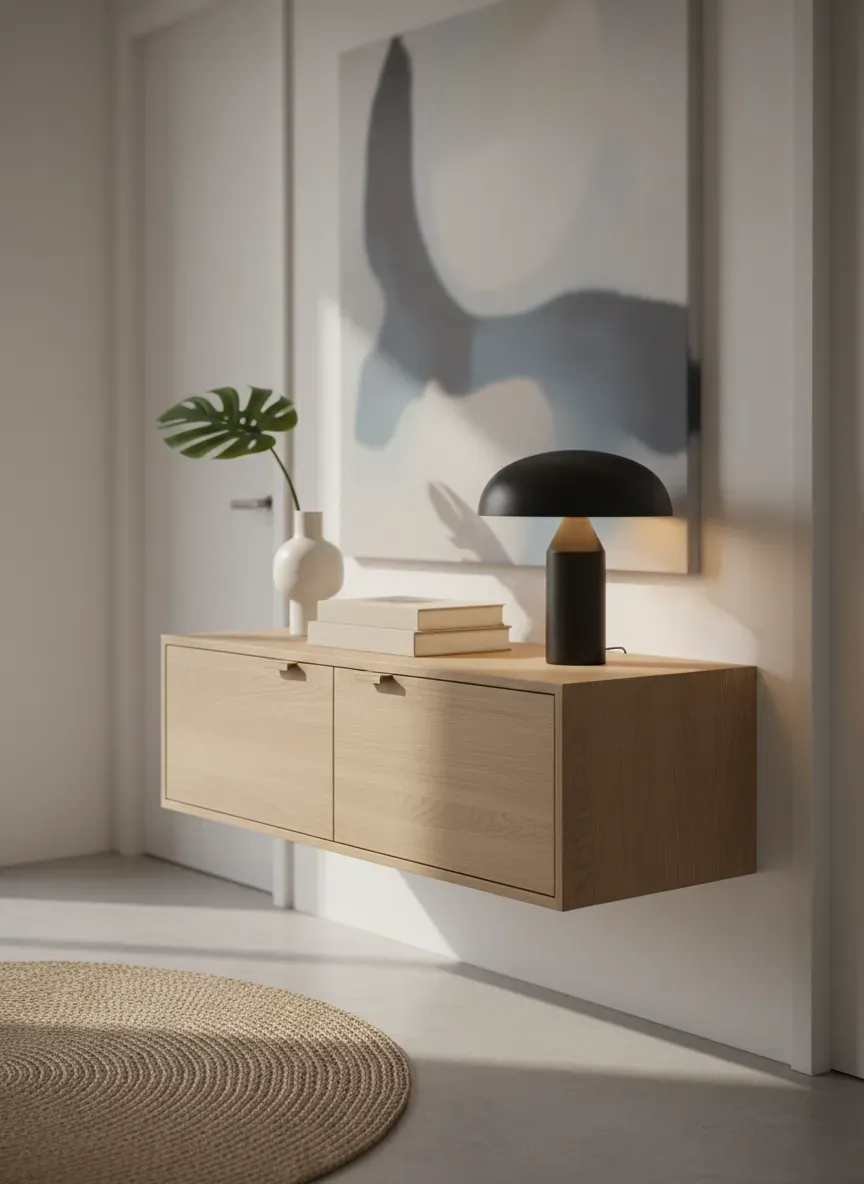
2. The Vertical cantilever
When the floor plan fails you, look up. The “Vertical Cantilever” layout is designed for entryways that are practically non-existent—perhaps just a 3x3 foot square behind the door.
The concept here is to lift everything off the ground. Floating shelves, wall-mounted shoe cabinets, and high hooks replace floor-bound furniture. This is where understanding standard depth height measurements becomes critical. A floating cabinet mounted at hip height (approx. 32-36 inches) creates usable surface area without eating up the floor space required for the door swing.
3. The “Invisible” Foyer (Zone Definition)
Many modern open-concept homes or studio apartments open directly into the living room. There is no hall. There is no nook. You open the door and you are looking at the sofa.
This creates a psychological problem: there is no separation between the outside world and your sanctuary. To fix this, we create an “Invisible” Foyer layout using furniture placement and rugs to manufacture a vestibule.
The Perpendicular Divider
Place a low bookshelf or a sofa perpendicular to the entry wall. This creates a physical barrier that guides traffic. You essentially build a hallway where none existed. The back of the sofa acts as the “wall” for your entryway.
- Zone the Floor: Use a durable, high-traffic runner rug to visually demarcate where the “entry” stops and the “living room” begins.
- The Pivot Point: Place a round table or a tall plant at the end of the “hallway” you’ve created to force a turn, slowing down the entry process.
4. The Corner Conquest
Corners are the most underutilized assets in interior design. In a tiny foyer, a corner is often the only space you have. The “Corner Conquest” layout ignores the flat walls and focuses entirely on the 90-degree angle.
A standard rectangular table cuts into the room. A corner unit, however, retreats. By installing a corner bench or a corner shelf system, you turn dead space into a functional drop zone.
Key Takeaway: If you install a corner bench, ensure the seat opens for storage. This creates a “hidden vault” for off-season items that don’t need to be accessed daily.
5. The Mirror-Wall Expansion
This is old-school design theory, but it works because of physics. Light reflection doubles the perceived volume of a room. However, simply hanging a small mirror isn’t a layout strategy.
The Layout: Cover one entire wall of your small foyer with mirror paneling or an oversized floor mirror. Place your console table in front of this mirror.
The effect is jarringly effective. The furniture appears to float in the middle of a much larger room. It dissolves the claustrophobia of a tight entry.
For this to work, you need a mirror that commands attention. The NeuType Full Length Mirror is robust enough to anchor a wall without looking flimsy. Lean it (safely anchored) or mount it to double your visual square footage instantly.
6. The Door-Back Utility System
Sometimes, you literally have zero walls. Maybe your entry is flanked by the kitchen on one side and a bathroom on the other. In these extreme cases, the layout must shift to the door itself.
This isn’t just about hanging a wreath. It’s about utilizing the vertical plane of the solid door as your primary storage facility. Heavy-duty over-the-door organizers or—better yet—screwing durable hooks directly into solid wood doors (if you own the home) allows the door to carry the load.
Warning: Before loading up your door or adjacent walls with heavy winter coats and bags, you must be proficient in calculating load bearing understanding weight. A standard hollow-core door cannot support a 20lb backpack, and drywall anchors will rip out if you miss the stud.
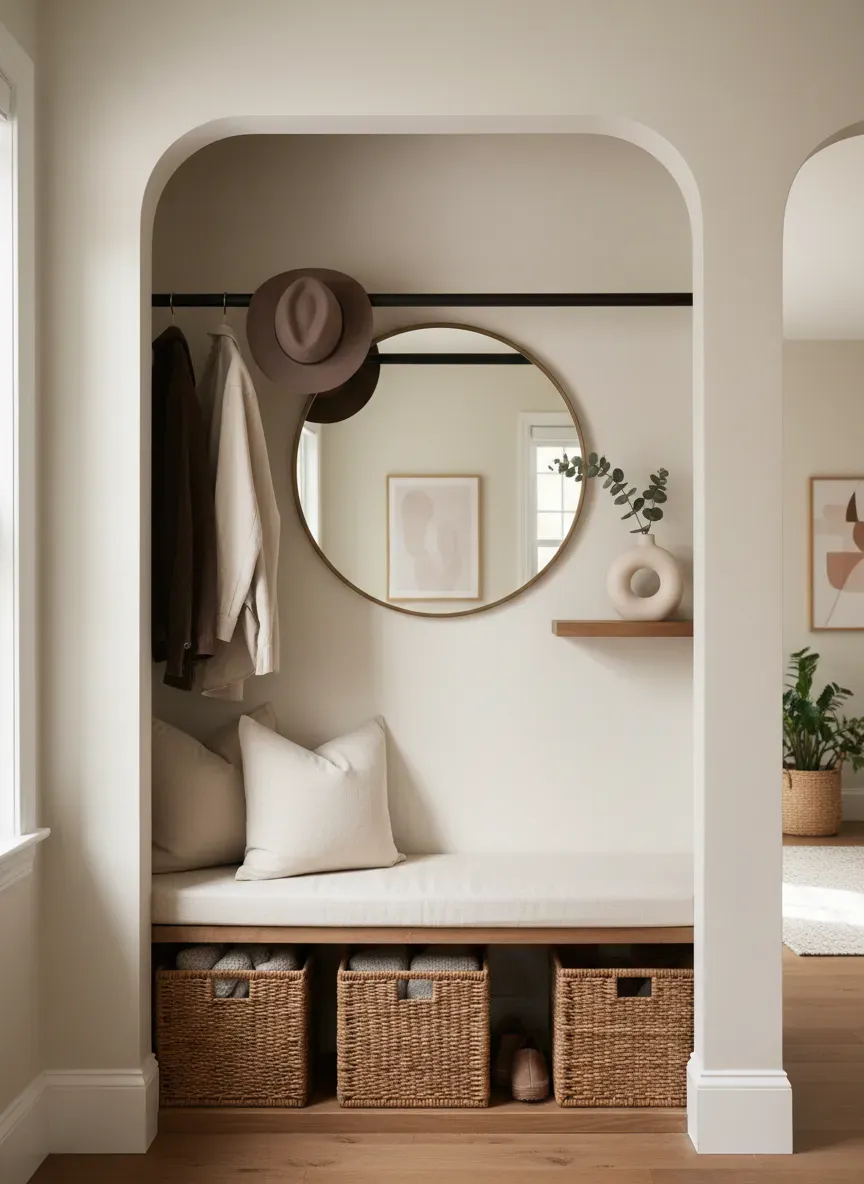
7. The Closet-to-Nook Conversion
This is a controversial move, but for a tiny entry, it is often the genius stroke that solves everything. Most small entryways have a small, inefficient coat closet with a swinging door that blocks traffic.
The Layout: Remove the closet door. Remove the frame.
Inside that cavity, build a bench with hooks above and shoe cubbies below. Paint the inside of the nook a contrasting color—perhaps a moody charcoal or a deep navy. Suddenly, you haven’t just removed a barrier; you’ve created an architectural feature. This recessed “mudroom” approach actually adds depth to the hallway because the eye can travel further than the original flat door allowed.
8. The “Symmetry Pivot”
Chaos feels smaller than order. A cluttered, asymmetrical room feels tighter because the brain has to process more visual noise. The “Symmetry Pivot” layout relies on rigid matching to calm the brain.
- Two identical wall sconces.
- A central mirror.
- A console table perfectly centered.
- Two identical baskets underneath.
This rigid structure creates a “frame” around your entry. It feels intentional, curated, and high-end, regardless of how small the footprint is. When checking small foyer layout ideas, you’ll notice the most viral images often utilize this strict symmetry to create a sense of grandeur in miniature.
9. The Gallery Distraction
This layout uses misdirection. If your foyer is undeniably small and awkward, stop trying to hide it and instead give visitors something else to look at.
Turn the entry walls into a floor-to-ceiling gallery wall of art, photos, or curiosities. Keep the furniture minimal—perhaps just a low bench. The layout here is focused on the walls as the primary feature.
When the eye is busy scanning art, it ignores the tightness of the walls. It creates an “experience” rather than a “passage.”
10. The Radius Flow
Sharp corners are aggressive. In a tight space, hip-checking the corner of a square table is a daily reality. The “Radius Flow” layout swaps all rectilinear furniture for curves.
- A semi-circle console table.
- Round mirrors.
- Circular rugs.
Curved lines encourage a smoother traffic flow. They guide the body around obstacles rather than stopping it dead. This is particularly vital when considering how ideal spacing far apart your furniture should be from the door swing. Curved edges allow you to cheat those clearances slightly without causing bruises.
Key Considerations for Implementation
The “Drop Zone” Necessity
Regardless of which layout you choose, every foyer must have a designated “Drop Zone.” This is a containment strategy for the small items that cause the most clutter: keys, wallets, sunglasses, and mail.
If your layout doesn’t account for these 2-inch items, they will end up on the kitchen counter, the dining table, or the floor. A simple decorative bowl or tray is the anchor that holds the layout together.
Lighting: The Silent Expander
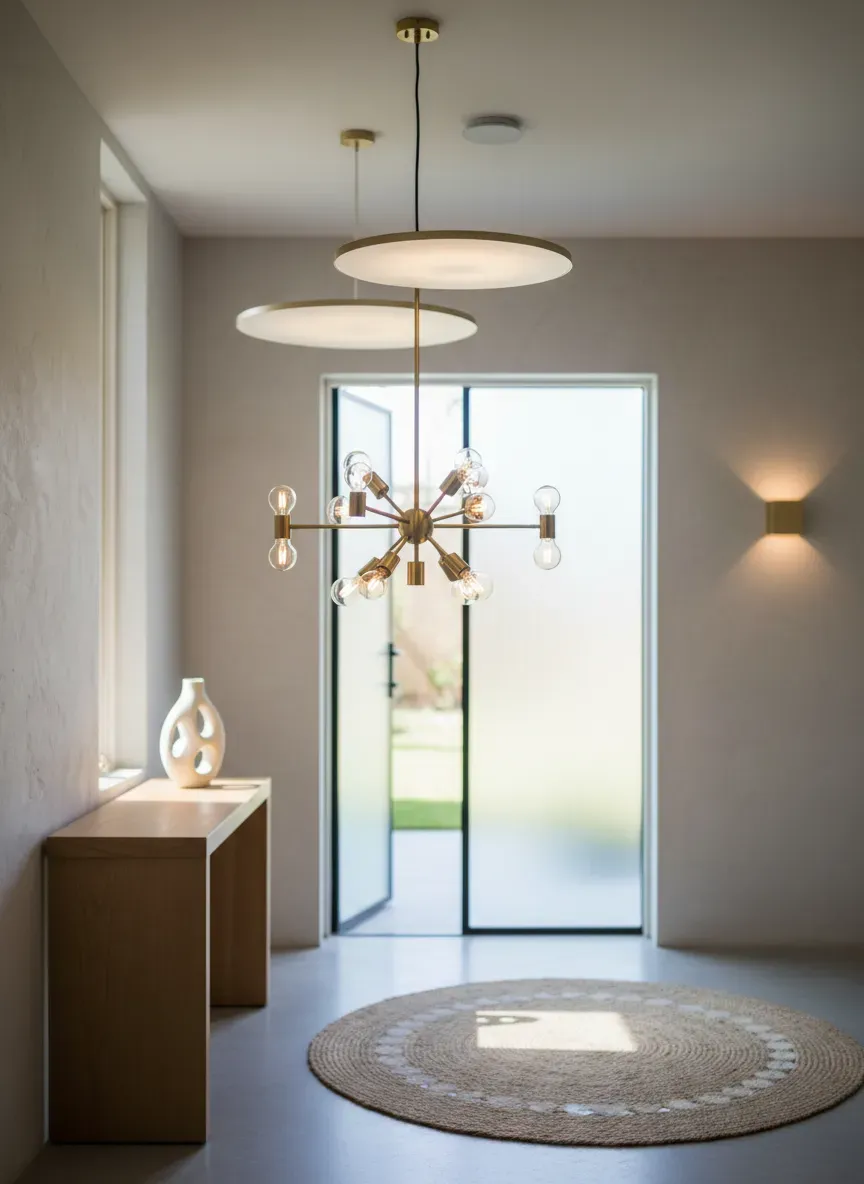
You cannot rely on the single “boob light” flush mount that came with the apartment. Shadows make corners disappear, shrinking the room.
Layer your lighting. Combine an overhead fixture with a table lamp on your console or wall sconces. Lighting the corners of the room pushes the walls out visually.
If you want a statement piece that doesn’t overwhelm the space, look at the Sputnik Chandelier Mid Century Light. Its radiating arms spread light to the perimeter of the ceiling, eliminating shadows and making the ceiling feel higher.
The Bottom Line
Maximizing a tiny entryway isn’t about buying smaller furniture; it’s about smarter geometry. Whether you opt for the “Landing Strip” to maintain velocity or the “Closet Conversion” to reclaim depth, the goal remains the same: create a transition that serves you.
Your foyer is the handshake of your home. It doesn’t need to be loud, but it does need to be firm, confident, and welcoming. Stop apologizing for the size of your entry and start engineering it.
Go tape out that floor plan. You’ll be amazed at what fits.