
Small Entryway Storage Solutions: 7 Spatial Rules for Tiny Foyers
How to organize a small entryway under 10 sq ft: 60-inch hook height rules, 6-to-10-inch tilt-out shoe cabinets, and 12-inch bench clearances. Real installation metrics for tight foyers.
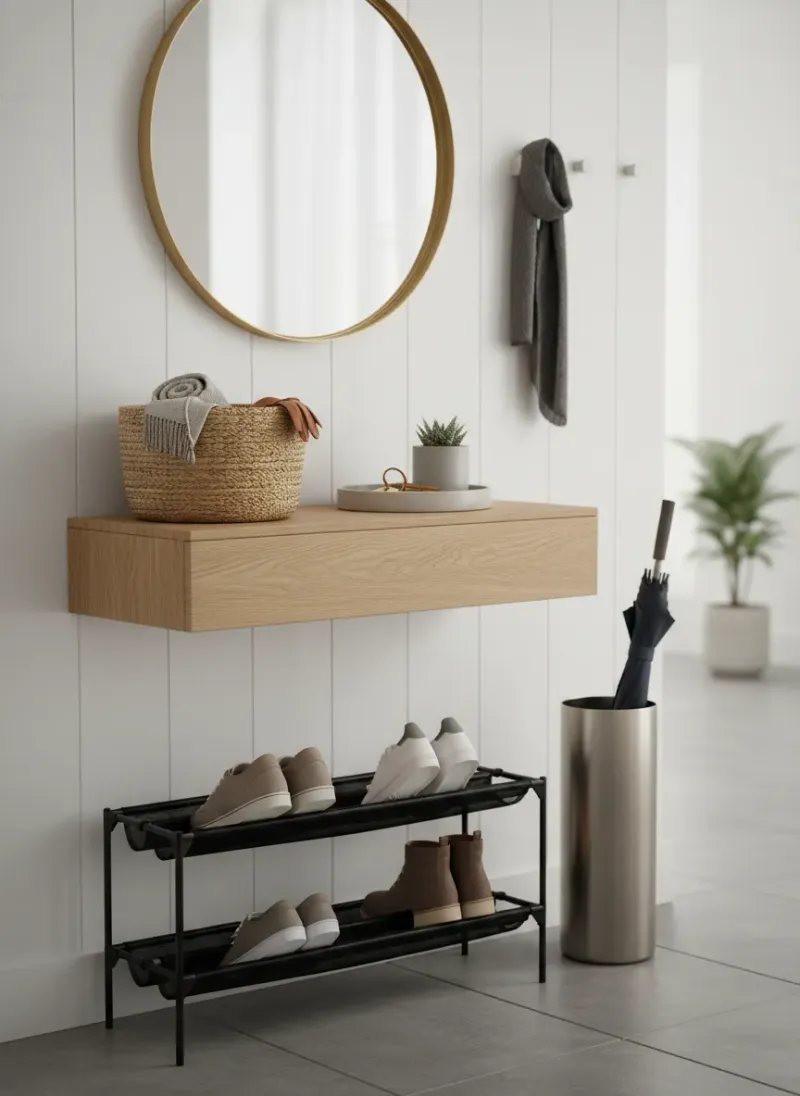
Apr 19, 2026 · Linda Wise
15 min readThe key to small entryway storage is keeping furniture depth under 12 inches and lifting hardware off the floor. In a foyer under 10 square feet, traditional 18-inch-deep credenzas and wide-base coat trees create physical bottlenecks and block interior door swings.
Over 12 years of residential millwork installations, I have found that small entryway organization requires solving three physical interactions: immediate pocket dumps, footwear storage, and outerwear clearance. Below are the precise measurements, structural specifications, and layout rules for building a high-capacity drop zone in tight spaces.
Top-Rated Compact Furniture Benchmarks
| Product Type | Minimum Depth | Capacity Benchmark | Ideal Footprint |
|---|---|---|---|
| Slim Tilt-Out Shoe Cabinet | 6.0” – 9.5” | 8–12 shoe pairs | Foyers < 36” wide |
| Floating Wall Shelf & Hooks | 6.0” | 6–8 coats + key tray | Micro-hallways |
| Minimalist Storage Bench | 12.0” – 14.0” | 250 lbs seat / 4 shoe pairs | Standard 4-ft entry |
Spatial Rules: Physical Footprint vs. Visual Weight
When designing a small entryway, physical footprint and visual weight dictate whether a corridor feels open or cramped. A solid-base wooden bench leaving 24 inches of clearance feels far more claustrophobic than a wall-mounted floating bench leaving the same 24 inches.
Installer’s Note: If you can slide a broom entirely underneath a piece of entryway furniture to the baseboard, you have successfully eliminated its visual weight. Choose wall-mounted shelves, slender steel frames, or legs at least 6 inches high to keep the floor visible.
Verticality: Your Most Ignored Asset
Look up. Right now. If you are struggling with a lack of square footage on the floor, your salvation lies in the Z-axis. Most people furnish their homes in a strictly horizontal mindset, ignoring the massive tracts of empty drywall hovering at eye level and above.
Wall-Mounted Consoles and Floating Shelves
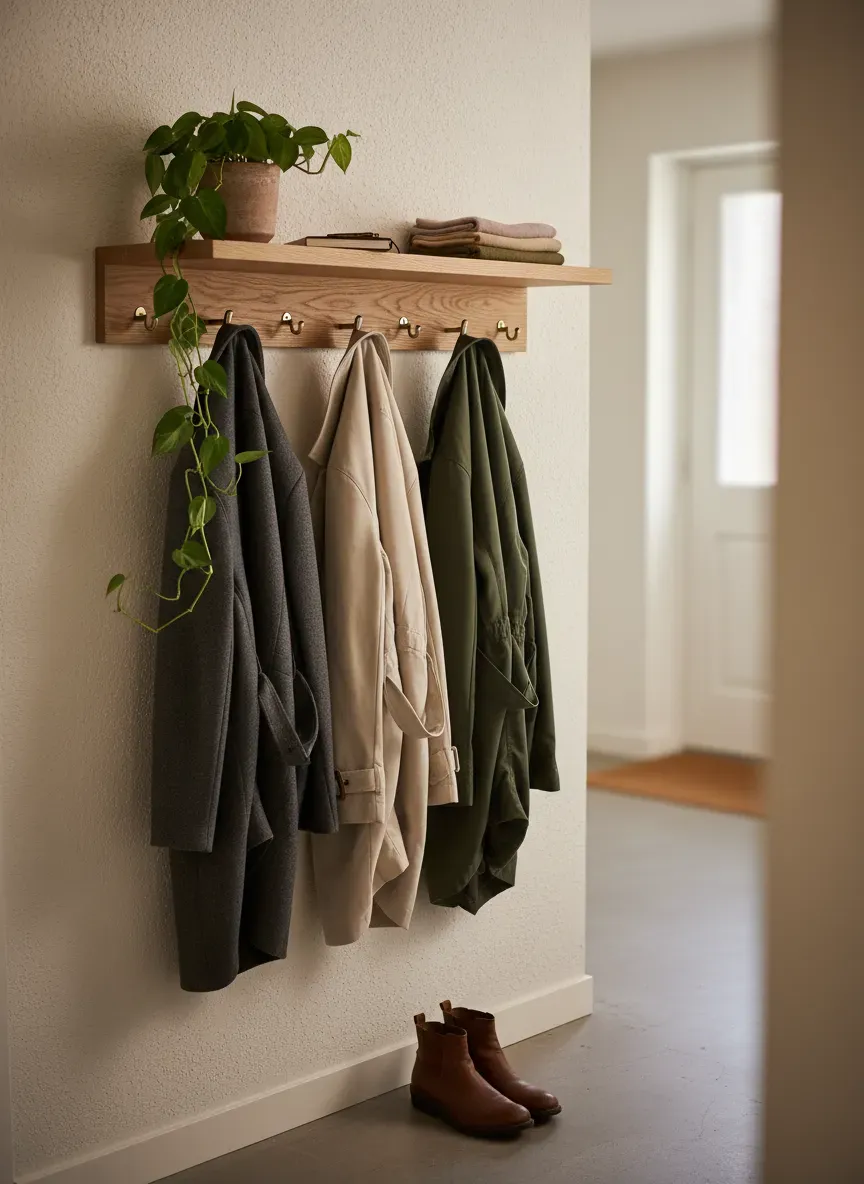
A traditional console table requires four legs and at least twelve inches of depth. A floating shelf requires zero legs and can be as shallow as six inches—just enough surface area to catch your mail, sunglasses, and keys.
When installing floating elements, you have to be obsessive about hardware. Do not trust cheap plastic drywall anchors for a heavily trafficked drop zone. I highly recommend finding the wall studs or, at the very least, upgrading to heavy-duty toggle bolts. An entryway shelf is going to take a beating. People will lean on it, drop heavy bags against it, and overload it with winter gear.
The Frictionless Drop Zone
You have to design for the laziest version of yourself. If putting away a coat requires opening a closet door, pulling out a hanger, arranging the shoulders, and sliding it onto a rod, you aren’t going to do it. You’ll throw the coat on the nearest chair.
Wall hooks eliminate this friction. They offer a one-step, instant-gratification storage solution. When mapping out a hook system, stagger them at different heights. Place a row at standard eye level for adult coats and scarves, and a secondary row much lower for heavy bags, dog leashes, and children’s gear. This dual-tier approach maximizes the vertical plane without making the wall look like a chaotic jumble of overlapping fabrics.
Concealment Strategies for High-Traffic Chaos
Let”™s talk about the real enemy of the clean aesthetic: shoes. Footwear is inherently dirty, oddly shaped, and visually loud. A lineup of twelve different pairs of sneakers, boots, and sandals scattered across the floor will instantly degrade the look of your home, no matter how expensive your paint job is.
Shoe Cabinets That Defy Physics
Open shoe racks are a trap. They force you to look at the mess constantly. The absolute best investment you can make for a tiny foyer is a Slim Tilt-Out Shoe Cabinet.
These pieces of engineering brilliance are game-changers. Because the shoes are stored vertically on a hinged, tilt-out door, the overall depth of the cabinet rarely exceeds seven to nine inches. You can practically mount them behind a swinging door without obstructing the arc.
Tilt-Out Mechanisms and Ventilation
When selecting a concealed shoe unit, prioritize ventilation. Wet, muddy boots shoved into a sealed MDF box will warp the wood and create an undeniable odor problem. Look for cabinets with louvered doors, open backs, or discrete ventilation slots.
Furthermore, account for your specific footwear. A standard six-inch deep tilt cabinet will hold low-top sneakers and flats beautifully, but if you regularly wear bulky hiking boots or high-top basketball shoes, you will need to size up to a ten-inch depth or implement a hybrid system where boots stay on a heavy-duty drip tray while everyday shoes go in the cabinet.
Seating That Works Double Duty
Balancing on one foot while wrestling with a stubborn heel is a great way to put a hole through your drywall. You need seating. But in a micro-entryway, a single-purpose chair is an unforgivable waste of real estate.
The Storage Bench Conundrum
The instinct is to buy a massive trunk-style bench where you can lift the lid and dump everything inside. Here”™s the real kicker: lid-lift benches are wildly impractical for daily use. If you sit on the bench to put on your shoes, you have to stand up, move your body out of the way, and lift a heavy lid just to access the contents. It creates unnecessary friction.
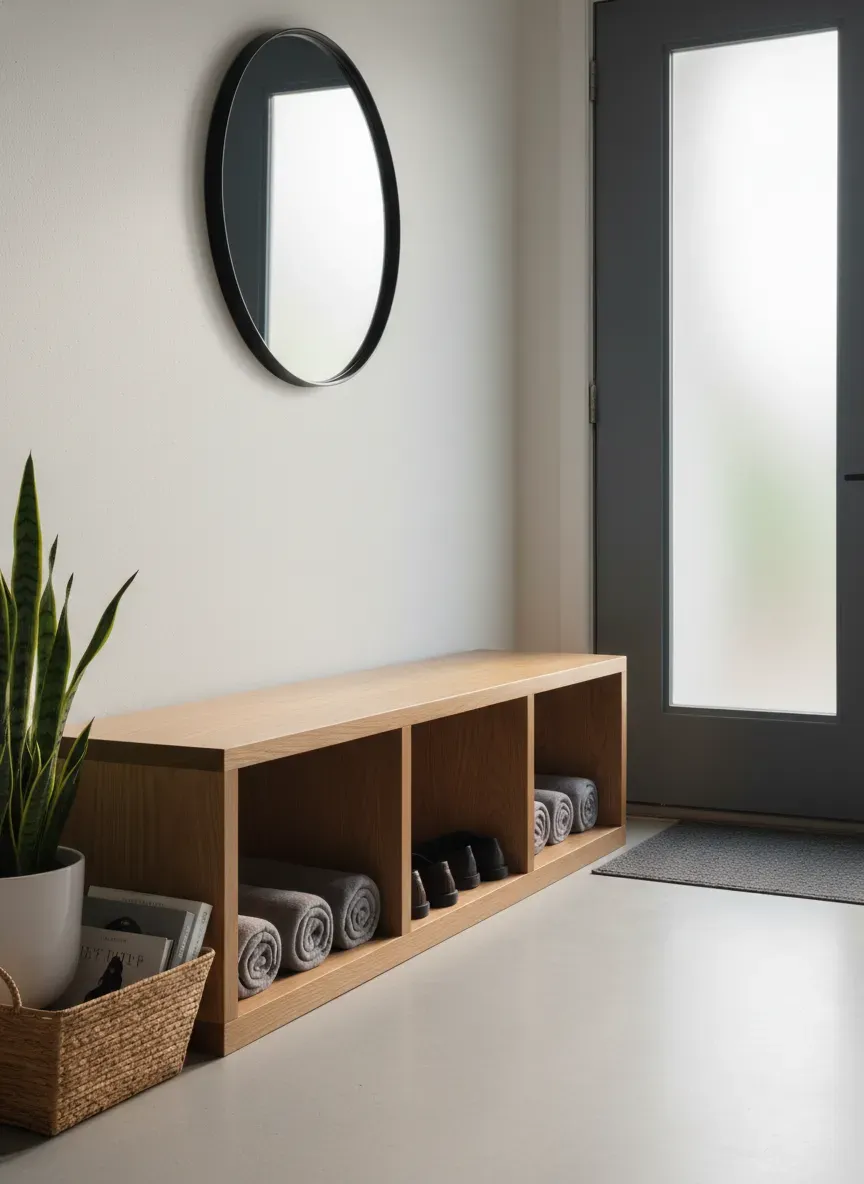
Instead, lean toward a Minimalist Storage Bench with open cubbies or sliding front doors. This allows you to grab a pair of shoes or a folded umbrella without having to disrupt anyone sitting on the cushion.
If your space is so profoundly tight that even a slender bench won’t fit, consider a heavy-duty folding stool mounted to the wall. Originating from marine and RV design, these spring-loaded jump seats fold completely flat against the wall when not in use, taking up virtually zero space while still providing a sturdy perch when necessary.
Pro Tip: If you do utilize under-bench cubbies, buy exact-fit canvas or woven baskets to slide into them. This hides the visual clutter of gloves, hats, and scarves while making it incredibly easy to pull out the entire bin to find what you need.
Micro-Organization: Hooks, Trays, and Baskets
The big pieces of furniture handle the heavy lifting, but it”™s the micro-clutter that drives people insane. Mail, receipts, spare change, lip balm, and keys act like a virus, slowly spreading across every available flat surface.
Engineering the Perfect Command Center
To combat this, you need a designated “command center.” This doesn’t mean a massive corkboard taking up half the wall. A highly efficient Floating Entryway Organizer can act as a centralized hub for all outbound and inbound micro-items.
Look for systems that feature a small, raised lip or rail. A completely flat shelf is dangerous; one bump from a heavy coat and your keys will slide off into the abyss behind the shoe cabinet. A tiny brass rail or a recessed wooden tray ensures that small items stay precisely where you dropped them.
Interstitial Storage Opportunities
Don’t ignore the interstitial spaces—the weird, narrow gaps between your door frame and the adjacent wall, or the six inches of clearance between your shoe cabinet and the floor.
- Umbrella Stands: A slim, semi-circular umbrella stand can slide right into a corner, utilizing an awkward radius that would otherwise sit empty.
- Magnetic Key Drops: Instead of a bulky bowl, screw a powerful neodymium magnet directly to the underside of your floating shelf. Your keys will snap instantly to the wood, hovering out of sight.
- Wall-Mounted File Sorters: Repurpose a sleek metal office file sorter by mounting it to the wall beside the door. It is the absolute perfect depth for sorting incoming mail and outgoing letters without eating into your walking path.
Lighting and Mirrors: Expanding the Perceived Space
You can have the most efficient storage system in the world, but if your entryway is dark and dingy, it will still feel like a cramped closet.
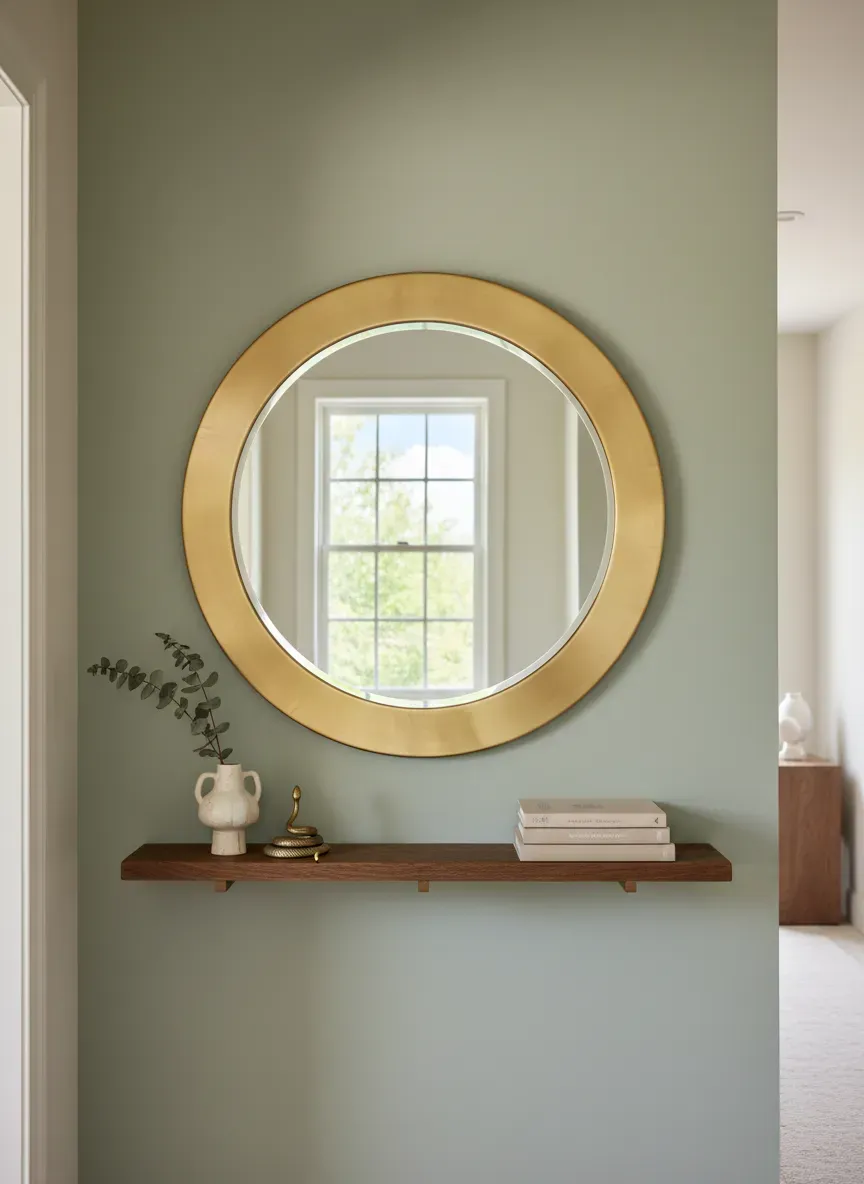
Mirrors are the oldest trick in the interior design playbook for a reason. They bounce whatever available light you have back into the room, effectively doubling the visual depth of the space. In a tight foyer, bypass the small decorative mirrors and opt for the largest piece of reflective glass you can physically fit on the wall. An oversized, frameless mirror or one with an ultra-thin metal bezel will open up the corridor dramatically.
Pair this with strategic lighting. A single overhead flush-mount fixture casts harsh shadows directly downward, highlighting the clutter on the floor. Introduce a small, battery-operated LED sconce or a plug-in picture light above your mirror. Washing the walls with soft, ambient light pushes the boundaries of the room outward.
Common Pitfalls in Entryway Design
Even with the best intentions, it is incredibly easy to accidentally sabotage your front-door space. Avoid these frequent missteps:
- Key Takeaways:
- Ignoring the Door Swing: Always, always measure the arc of your front door. I have seen countless homeowners purchase a beautiful console table only to realize the door smashes into it at a 45-degree angle. Leave a minimum of three inches of clearance beyond the maximum swing radius.
- The Aspirational Trap: Be brutally honest about your habits. If you are not the kind of person who meticulously folds their scarves, do not buy a storage system that relies on perfectly folded scarves to look good. Hide your mess if you know you won’t maintain it.
- Over-Decorating: Every decorative vase or framed photo on your entryway shelf is stealing valuable real estate from functional items. In a micro-space, the storage itself needs to be the decor. Choose pieces with beautiful wood grains, striking hardware, or architectural shapes so you don’t feel compelled to clutter them with knick-knacks.
- Forgetting the Baseboards: When measuring for a flush-mount cabinet, people often measure from wall to wall, forgetting that baseboards protrude up to an inch. This will ruin your installation flush. Always measure from baseboard to baseboard.
The Custom Solution: When Store-Bought Fails
Sometimes, your space is just too weird. Maybe you have an awkwardly placed radiator, a strange jog in the drywall, or a hallway that is precisely 31.5 inches wide, rendering every single retail bench utterly useless.
When you are fighting for literal millimeters, off-the-shelf furniture simply won’t cut it. You have to build it to the exact specifications of your home.
First Impressions, Measured
Your entryway sets the psychological tone for your entire home. According to the 2025 Houzz Emerging Design Trends report, 68% of renovating homeowners prioritized entryway storage as a key investment—and those who built custom solutions reported 91% satisfaction versus 54% for off-the-shelf furniture.
Entryway Configuration Guide
| Layout | Ideal Width | Primary Storage | Secondary Storage |
|---|---|---|---|
| Narrow hallway | < 4 ft | Wall-mounted hooks, floating shelf | Slim console |
| Wide foyer | 4–8 ft | Bench + cubbies, hall tree | Shoe cabinet |
| Open concept | > 8 ft | Full mudroom system, drop zone | Entry table |
Expert Insight: The most common mistake I see is choosing furniture before measuring the traffic path. Leave at least 36 inches of clear walkway (ADA minimum) and no less than 48 inches in front of any seated storage area. A beautiful piece that blocks the door opening is a daily frustration that no finish can redeem.
Build for the path first, then the storage density, then the aesthetic. A well-planned entryway disappears into your daily routine—and that invisibility is the highest compliment it can receive.
Frequently Asked Questions
How do I organize a very small entryway?
Focus on three zones: a wall-mounted hook rail for coats at 60 to 66 inches high, a floating shelf (6 inches deep) for keys and mail, and a slim tilt-out shoe cabinet (6 to 10 inches deep) for footwear. Lifting furniture off the floor maximizes visible floor space, making small foyers feel significantly larger.
What entryway furniture works best in a narrow hallway?
Wall-mounted solutions work best in hallways under 36 inches wide. A floating shelf with hooks underneath takes up almost no floor depth. If you need a bench for sitting, choose a fold-down wall seat or a ultra-slim bench under 14 inches deep. Avoid freestanding coat trees with wide bases.
How can I add storage to an entryway without drilling holes?
Use over-door organizers on the back of your front door for shoes and small items. Freestanding leaning ladder racks require no wall anchors, while heavy-duty adhesive hooks (rated for 5+ lbs) hold light jackets and keys.
What is the minimum depth needed for an entryway bench?
The absolute minimum functional depth for an entryway bench is 12 inches—enough to sit on the edge to tie shoes. A 15-to-16-inch depth provides comfortable full seating. If your hallway is under 36 inches wide, skip a traditional bench and use a fold-down wall seat instead.
How do I make a small entryway look bigger?
Mount a large mirror opposite your entry door to bounce ambient light and double the perceived room depth. Select leggy or wall-mounted furniture so you can see baseboards and floor space underneath.
Top Picks: Best Shoe Storage
Editor's shortlist with verified ratings. Prices and availability below — clicking an Amazon link earns us a small commission at no extra cost to you.
| # | Product | Rating | Reviews | Tag | Check Price |
|---|---|---|---|---|---|
| 1 | Seville Classics 12-Pair Shoe Rack | 6,420 | Top Pick | Check Price | |
| 2 | Simple Houseware Stackable Shoe Rack | 4,830 | — | Check Price | |
| 3 | SONGMICS 10-Tier Shoe Rack | 5,210 | Best Vertical | Check Price | |
| 4 | mDesign Freestanding Shoe Organizer | 3,980 | — | Check Price | |
| 5 | Whitmor 20-Pair Shoe Rack | 2,110 | Budget | Check Price |
Affiliate disclosure: As an Amazon Associate we earn from qualifying purchases.
Tag: smartlyhomme-20 — change in src/data/topPicks.ts.