
15 Genius Small Entryway Furniture Ideas for Your Tiny Space
Transform your cramped foyer into a functional masterpiece. We analyze 15 space-saving furniture strategies, from vertical storage to optical illusions, designed for the tightest homes.
Mar 1, 2026 - Written by: Linda Wise

You know that feeling when you walk through the door and immediately trip over a pair of sneakers, drop your keys into a black hole of clutter, and have nowhere to set down your grocery bags? I’ve been there. We all have. The entryway is the handshake of your home—it sets the mood for everything that follows. Yet, in modern apartments and smaller homes, this critical zone is often reduced to a cramped patch of floorboards or, worse, a non-existent space that spills directly into the living room.
But here is the reality check: limited square footage is not an excuse for chaos. In fact, constraints often breed the most sophisticated design solutions.
When you don’t have the luxury of a sprawling mudroom, every inch of vertical and horizontal space must fight for its right to exist. You have to stop thinking about decoration and start thinking about infrastructure. Over the years, I’ve realized that solving the “tiny entryway” puzzle isn’t about buying smaller versions of big furniture; it’s about rethinking the geometry of arrival.
We are going to dissect fifteen specific, high-impact strategies to maximize your foyer. We will look at ergonomics, visual weight, and the crucial difference between “storage” and “clutter concealment.”
The Physics of a Micro-Entryway
Before we start adding furniture to your cart, we need to address the spatial dynamics of the area. A small entryway fails when it tries to do too much horizontally. The floor is your enemy here; the walls are your best friends.
If you place a standard 18-inch deep console table in a 36-inch wide hallway, you have effectively created a choke point. You interrupt the flow of “Chi,” or if you prefer a less esoteric term, you create a traffic jam.
Defining the “Drop Zone”
Your primary goal is to establish a “Drop Zone” that accommodates the three essentials of leaving and entering:
- The Shed: Coats, bags, and shoes come off.
- The Drop: Keys, mail, and wallets need a designated landing pad.
- The Transition: A psychological shift from “public world” to “private sanctuary.”
If your furniture choices don’t facilitate these three actions, they are just obstacles.
Category 1: The Vertical Revolution (Ideas 1-5)
When the floor plan says “no,” the walls say “yes.” The most common mistake I see is homeowners ignoring the space above eye level or below knee level.
1. The Ultra-Slim Tipping Shoe Cabinet
This is, without a doubt, the MVP of small entryways. Unlike standard shoe racks that extend 12 to 14 inches into the room, a tipping cabinet utilizes vertical height and angled storage to shrink that depth to as little as 7 inches.
I’ve personally installed dozens of these. They hide the visual clutter of multicolored sneakers behind a clean facade. Because they are closed, they stop dust accumulation and smell migration. If you want the best experience, I highly recommend checking out the Baxton Studio Simms 2-Door Shoe Cabinet. It has that modern, unobtrusive profile that blends into the wall rather than shouting “I am storage.”
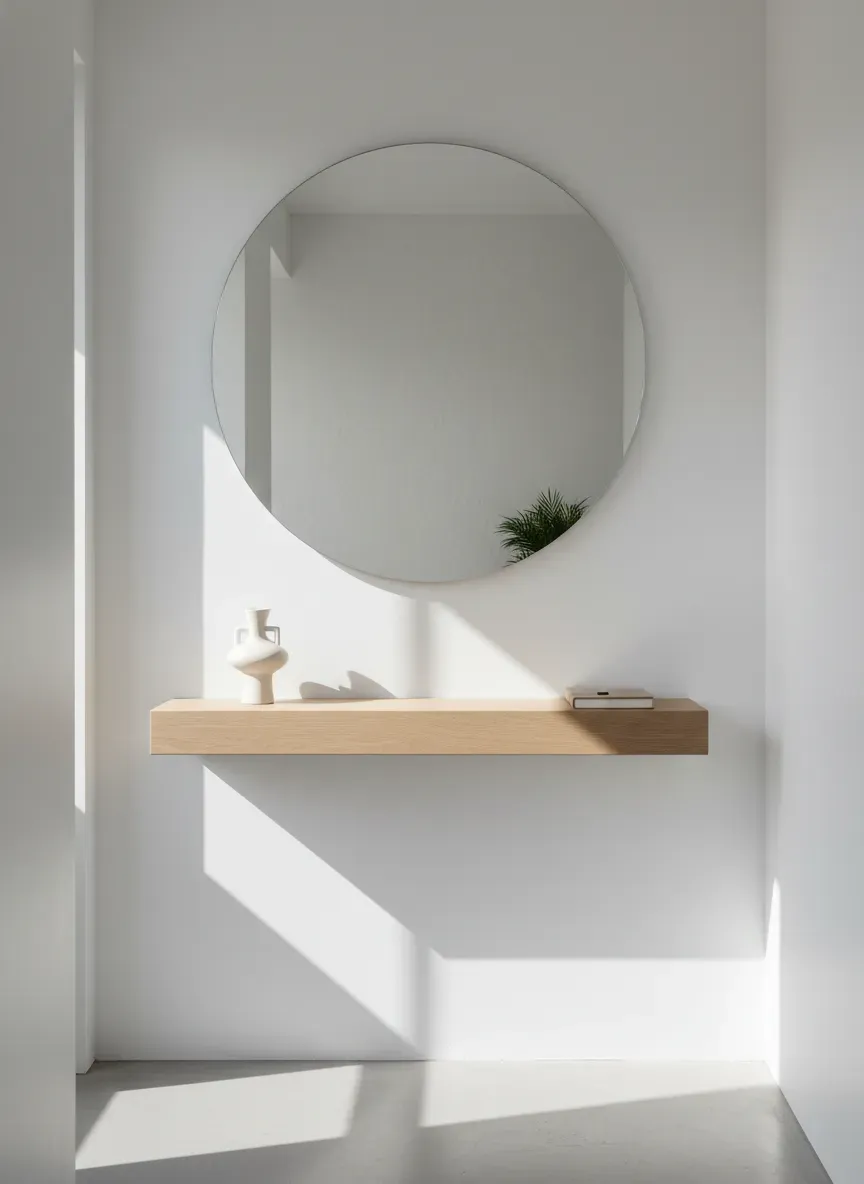
2. The Wall-Mounted Floating Console
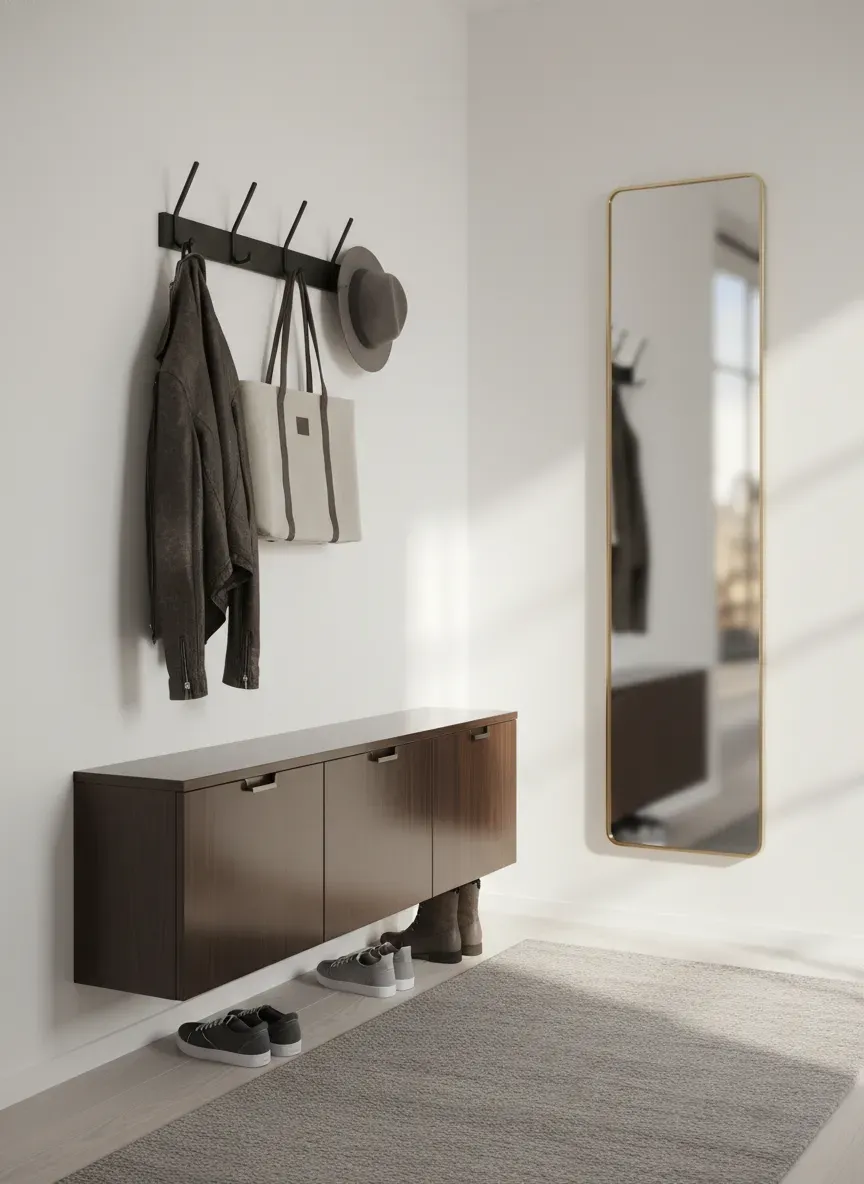
Legs on furniture take up visual space. In a tiny foyer, seeing the floor extend all the way to the wall tricks the brain into thinking the room is larger than it is. A floating console gives you a surface for your mail and keys without the heavy footprint.
Pro Tip: Mount your floating console at elbow height (approx. 40-42 inches). This prevents you from needing to bend down to drop your keys, which is a subtle ergonomic win you’ll appreciate daily.
3. The Pegboard “Command Center”
Borrowing from garage workshops, the pegboard is a modular genius for the entryway. Instead of a static coat rack, a pegboard allows you to reconfigure hooks, small baskets, and shelves based on the season. In winter, you need heavy hooks for coats; in summer, you might need more baskets for sunscreen and sunglasses.
This approach creates a dedicated spot for everything, helping you tackle key and mail management in a small entryway without needing a bulky table.
4. High-Altitude Shelving
Look up. Is there dead space above your doorframe? In 90% of homes, this is unused real estate. Installing a simple shelf running the length of the wall above the door provides a perfect spot for off-season storage—hat boxes, winter boots in summer, or decorative baskets. It draws the eye upward, accentuating ceiling height rather than floor width.
5. The Mirror-Storage Hybrid
Mirrors are the oldest trick in the book for expanding space, but in a tiny entry, a plain mirror is a wasted opportunity. Look for “medicine cabinet” style mirrors or full-length mirrors that slide open to reveal shallow shelving behind them. This is where you hide the dog leash, the lint roller, and the spare keys.
Category 2: Seating That Earns Its Keep (Ideas 6-10)
You might think you don’t have room for a bench. I challenge that. Putting on shoes while hopping on one foot is a recipe for frustration (and wall scuffs). The secret is ensuring the seat does double or triple duty.
6. The Storage Ottoman
If a bench is too wide, a small, cube-shaped storage ottoman can be tucked under a floating console or placed in a corner. It provides a momentary perch for lacing up boots but hides the ugly stuff inside.
7. The “Open” Industrial Bench
While I love hidden storage, sometimes a heavy wooden box makes a small hallway feel claustrophobic. An open-frame metal bench with a wire rack underneath maintains an airy feel. It allows light to pass through, keeping the space feeling open.
For a robust option that balances aesthetics and durability, take a look at the Vasagle Industrial Storage Bench. The mix of wood and metal fits most modern decors, and the grid shelf is perfect for keeping wet shoes off the floor, allowing air circulation to dry them out.
8. The Corner Nook Bench
Corners are notorious dust collectors. A custom or triangular corner bench maximizes this dead zone. It directs the flow of traffic away from the corner and into the room. If you are handy, building a simple triangular floating seat is a weekend project that transforms a useless angle into a functional focal point.
For those interested in the specifics of comfort and height, I suggest reading up on the ergonomics of entryway benches for storage and seating. Getting the height right makes the difference between a bench you use and a bench that just holds pile of junk.
9. The Drop-Leaf Wall Seat
This is a solution often seen in naval architecture or tiny homes. A seat that folds flat against the wall when not in use is the ultimate space-saver. It requires sturdy hardware—you need to anchor this into studs—but the payoff is massive. It exists when you need it and vanishes when you don’t.
10. The Boot-Cubby Bench
If you are a “shoes-off” household, a bench with individual cubbies is essential to prevent the dreaded shoe pile-up. However, avoid deep, dark cubbies where shoes get lost. Look for shallow designs specifically made for narrow hallways.
Category 3: Illusion, Lighting, and “The Ghost” (Ideas 11-15)
Sometimes, the best furniture is the kind you barely notice. This section focuses on materials and lighting that reduce visual weight.
11. Acrylic “Ghost” Consoles
Acrylic (Lucite) furniture is a secret weapon for small spaces. An acrylic console table provides the surface area you need but virtually disappears visually. It doesn’t block sightlines, allowing the eye to travel to the baseboards, which subconsciously registers the room as larger.
12. The Radiator Cover Hack
Many older apartments have bulky radiators right by the door. Instead of working around them, box them in. A well-vented radiator cover serves as a console table. You reclaim that space as a surface for keys and décor while masking the industrial ugliness of the heater.
13. Sconces over Lamps
Floor lamps take up floor space. Table lamps take up table space. Wall sconces take up no space. Hardwiring is ideal, but plug-in sconces with cord covers are a fantastic renter-friendly alternative. Good lighting pushes walls back; shadows make corners feel like they are closing in.
14. The Vertical “Locker” Strip
If you have a narrow slice of wall (even just 12 inches wide), you can install a vertical column of hooks or a tall, thin locker unit. This mimics the functionality of a mudroom locker without the bulk.
For families with heavy gear or sports equipment, you might need something more robust. While usually associated with larger spaces, adapting concepts from heavy-duty entryway locker systems can inspire narrow, reinforced builds that handle heavy winter coats without ripping out of the drywall.
15. The Magnetic/Velcro Wall
For the truly tiny space (I’m talking about a door that opens directly into a wall), standard hooks might protrude too much. Using magnetic boards or heavy-duty velcro strips to hold keys, lightweight pouches, or even sunglasses can organize the essentials with zero projection profile.
The Strategy of Zoning: Creating an Entryway Where None Exists
One of the hardest layouts to manage is the “open concept” where the front door swings open, and you are immediately standing in the living room or kitchen. There is no hallway. There is no foyer.
In this scenario, furniture must act as a partition.
You can use a perpendicular bookcase or a high-backed bench to create a physical barrier. This “artificial wall” stops the eye from seeing the entire living room immediately upon entry, creating a psychological pause. It defines the space: “This side is for shoes; that side is for relaxing.”
If you decide to go the custom route—perhaps building a pony wall or a floor-to-ceiling slat divider—make sure you understand the structural requirements. I’ve written a detailed guide on installation and deep dive building for built-ins which covers how to anchor these dividers securely so they don’t wobble when you lean against them to take off your boots.
Styling: The Finishing Touches
Once the furniture is in place, the styling determines if it feels “cluttered” or “curated.”
- The Rule of Three: Group items on your console in threes. A tray (1), a plant (2), and a lamp/sculpture (3).
- Containment: Never place loose change or keys directly on the surface. Always use a bowl or tray. Loose items look like trash; contained items look like a system.
- Greenery: A tall, thin snake plant adds life and verticality without taking up width.
Also, consider the wall organizer itself. If you want something that looks like art when it’s empty, the Umbra Estique Entryway Organizer is a brilliant choice. It features a perforated metal basket for mail and a series of wooden knobs that are gentle on delicate fabrics, avoiding the “hook bumps” you get from sharp metal hardware.
Common Pitfalls to Avoid
I’ve seen many well-intentioned makeovers fail because of a few simple errors.
1. Ignoring Door Swing
It sounds obvious, but measure the arc of your front door. If your new bench blocks the door from opening fully, it will drive you insane within a week. You need at least 3 inches of clearance beyond the door’s fully open position.
2. Overloading the Hooks
Just because you have five hooks doesn’t mean you should hang five heavy winter coats. In a small space, “visual bulk” is real. Rotate your coats. Keep one or two out, and closet the rest.
3. The Rug Mismatch
A rug defines the zone. If it’s too small, it looks like a postage stamp. If it’s too thick, the door won’t clear it. Look for flat-weave rugs or indoor/outdoor runners that are durable and low-profile.
The Bottom Line
Your entryway doesn’t need to be grand to be great. It needs to be smart. By leveraging vertical space, choosing furniture with slim profiles, and prioritizing “closed” storage to hide the visual noise, you can transform even the tiniest nook into a functional gateway.
Don’t settle for the shoe pile. Measure your space, pick one or two of these genius ideas, and reclaim your entry. For even more inspiration on maximizing every inch, browse through our gallery of small entryway furniture ideas to see these concepts in action across different architectural styles.
The goal isn’t just to store your stuff; it’s to smooth out the transition between the chaos of the outside world and the peace of your home. You deserve that moment of calm the second you walk through the door.