
How to Clean a Wooden Hall Tree Safely: the 15-minute Routine
How to clean a wooden hall tree safely: a 15-minute routine, what not to use, finish care, and what maintenance tips keep a hall tree looking good over time.

Aug 9, 2026 · Linda Wise
15 min readCleaning a wooden hall tree safely is a 15-minute routine: dust, wipe with a barely-damp cloth, and oil twice a year — never soak it, never bleach it.
The short answer to “what maintenance tips keep a hall tree looking good over time?” is: keep it dry, keep it dusted, wipe it with a barely-damp cloth, oil or wax it twice a year, and tighten its hardware on the same schedule. That is the whole routine — five minutes weekly, fifteen minutes for the deep pass, and your hall tree still looks like the day it arrived a decade later.
Most wood damage in entryways is not damage at all; it is a cleaning mistake. Aggressive cleaners, dripping cloths, and “quick” polish sprays account for nearly every white ring, cloudy patch, and swollen edge I see on otherwise good furniture. This guide is the gentler route: the step-by-step clean, the don’ts, the finish-by-finish routine, and the fixes for the scars you already have.
How to Clean a Wooden Hall Tree (step by step)
The full safe clean, in order:
- Vacuum, don’t wipe, the grit. Wet wiping a dusty hall tree is sandpaper on finish. Use a soft-bristle brush attachment to vacuum the seat, shelves, and cubby interiors first — corners especially, where sidewalk grit and pet hair collect.
- Dry-wipe with microfibre. A high-density dry microfibre cloth lifts whatever the vacuum missed. No products, no spray, just the cloth.
- Prep the cleaning solution. One teaspoon of pH-neutral liquid dish soap in one quart of warm distilled water. Distilled matters: tap water minerals leave white deposits on dark finishes. If you don’t have distilled, it is half a dollar and worth it.
- Dampen, then wring until barely damp. Dip the cloth, then wring it out hard. If the cloth is wet enough to drip, it’s too wet. Review your technique. Nothing about this step changes across the years — the drip test is the entire secret.
- Wipe with the grain, in long strokes. Follow the wood grain, front to back, never in circles. Rinse the cloth, re-wring, and move on.
- Dry immediately with a second cloth. The second microfibre cloth, dry, right behind the wet one. No water sits for even a second.
- Twice a year: condition and tighten. For oiled or waxed finishes, apply a thin coat of paste wax or furniture oil, let it haze, buff soft. Same visit: tighten every hook screw and bench fastener, because daily use vibrates hardware loose.
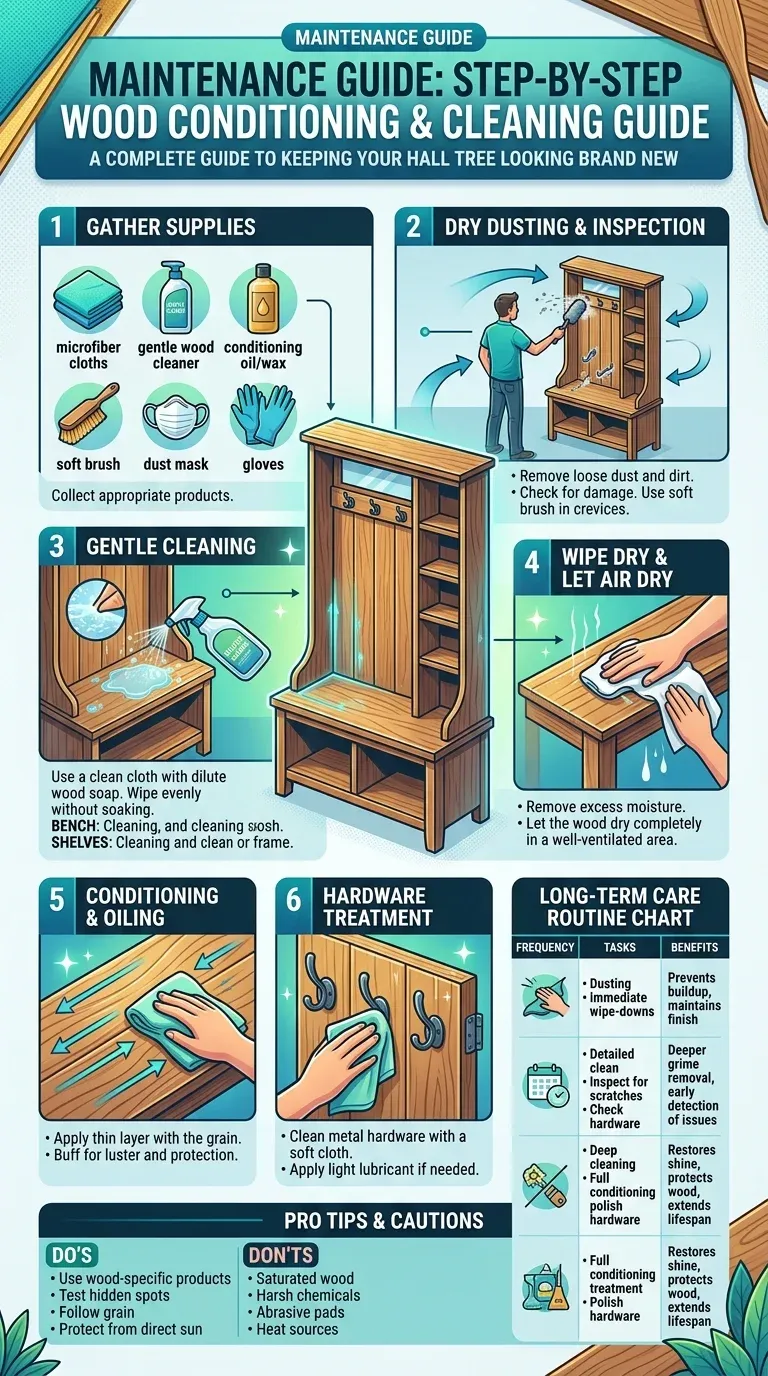
Fifteen minutes, once a month for the deep pass; the weekly version is just steps 1–2 and a quick step-4 pass.
What NOT to Use (water, ammonia, pledge myths)
The don’t list is shorter than the do list and more important. Never let these near your wooden hall tree:
- Standing water. A puddle of water is the one thing that ends a wooden hall tree’s life. It seeps into seams, lifts laminate edges, swells MDF cores, and leaves white clouds under polyurethane. The barely-damp cloth is the only water this wood should meet.
- Ammonia. Glass cleaners and many multi-surface sprays are ammonia-based. Ammonia strips the finish’s sheen at a chemical level — repeated use dulls polyurethane and dissolves shellac outright.
- Vinegar. The grandma hack destroys finished wood. Vinegar is acidic enough (roughly pH 2.4) to slowly eat the clear coat; it leaves sticky residue and is never, ever correct on a hall tree.
- Bleach or citrus-heavy cleaners. Bleach lifts finish and lightens wood unevenly; heavy citrus (d-limonene) softens lacquer after a handful of uses.
- “Pledge” and polish sprays. The myth: polish protects wood. The fact: those sprays layer silicones that attract dust, yellow over time on light wood, and give the finish a greasy film that the next clean must fight. A quality paste wax twice a year is the only “polish” a hall tree needs.
- Steam cleaners. Steam drives pressurized moisture into grain and glue lines. It splits joints, raises grain, and ruins finishes in a single pass. If a product involves a steam mop, it does not involve your hall tree.
One rule of thumb for every product you consider: if it did not come from the wood-care aisle and you are not sure what is in it, it does not go on the hall tree.
Finishes: Painted, Stained, Waxed — Each Has a Routine
Different finishes demand different care. The single biggest cleaning mistake is treating every hall tree as if it had the same topcoat:
| Finish | How to Clean | How Often | Condition It |
|---|---|---|---|
| Painted (lacquer or enamel) | Barely-damp cloth with a drop of pH-neutral soap; dry immediately | Weekly light pass; monthly deep | Nothing — paint needs no oil; spot-touch chips with matching paint |
| Stained + polyurethane | Barely-damp cloth; distilled water solution | Weekly light pass; monthly deep | Wipe-on poly touch-up on worn edges every few years |
| Stained + lacquer/shellac | Barely-damp cloth and instant drying; no alcohol cleaners ever | Monthly | None needed; alcohol-based products dissolve this coat |
| Waxed or oiled wood | Dry dust weekly; a damp pass only when visibly dirty | Weekly dust; monthly clean | Paste wax or furniture oil twice a year — this finish needs the oil |
| Veneered or laminate (MDF) | Barely-damp cloth; keep all water away from edges and seams | Weekly | Seal any chipped edge with edge-band touch or clear silicone before moisture finds the core |
The pattern across finishes: water is the enemy of seams, alcohol is the enemy of lacquer, and oil is the friend of oil finishes only. Felt-tip the finish of your hall tree the day you shop for it — a post-it on the underside — so the care routine never becomes a guessing game.
Maintenance Tips That Keep a Hall Tree Looking Good Over Time (the routine, answered)
Back to the question, now with the full answer: what maintenance tips keep a hall tree looking good over time? The routine, complete:
- Weekly (5 minutes): vacuum or dry-dust the seat, shelves, and cubbies. Grit is the number one abrader of finish.
- Monthly (15 minutes): the barely-damp wipe with pH-neutral soap, immediately dried. Wipe the hooks and hardware too, with the cloth just barely dampened with 70% isopropyl alcohol — keeping alcohol off the wood parts.
- Twice a year: tighten every hook screw and bench fastener; wax or oil the wood; check the wall anchor while you are back there. A tight hall tree is a quiet hall tree, and it is also a safer one — loose hardware is how wobbles start.
- Seasonally: pull out cubby contents and vacuum behind the piece so the wall and baseboard stay dry and clean.
That is the entire maintenance canon. There is exactly one scenario where your hall tree needs more than cleaning, and it is not a cleaning problem: if the piece wobbles, joints are pulling apart, or hook holes are stripping out, that is a repair job — head to our guide on common hall tree problems and how to fix them for the fix. Cleaning keeps a good hall tree good; repairs bring a broken one back.
Dealing With Scratches & Water Rings
Even with perfect care, life happens: a boot buckle gouges the seat, a glass sweats on the shelf. Every fix below is a cleaning-adjacent repair you can do without refinishing:
- Light surface scratch: rub the cut side of a fresh walnut half over the mark. The oil darkens the exposed wood fibers and makes shallow scratches disappear. Reapply every few months as the effect fades.
- Water ring on a polyurethane finish: place a clean dry cotton towel over the ring and pass a warm iron (steam off) over it in ten-second intervals. The gentle heat lets trapped moisture escape below the topcoat. It usually takes two or three passes; it works surprisingly often.
- Deep scratch in solid wood: sand lightly with 220-grit, work matching stain into the bare wood, wipe the excess, and seal with wipe-on polyurethane. On solid wood this disappears completely.
- White clouding on lacquer: this one needs a professional refinisher’s touch — lacquer reading cloudy means the coat itself has blushed, and the safe fix is a thin re-coat, not another cleaner.
- Swollen edge on laminate: this is water damage, not dirt. Trim nothing; seal the raised edge with a thin bead of clear silicone, let it cure, and keep that corner dry going forward. On MDF the swelling will never fully re-flatten — which is why edge sealing is a first-line defense, not a repair.
When in doubt, ask honestly: is this dirty (clean carefully), scratched (touch up), or damaged (repair or refinisher)? Matching the response to the actual condition is what keeps a wooden hall tree looking new for decades.
A Final Word
A wooden hall tree is the rare furniture piece that pays you back for gentleness: fifteen minutes a month of barely-damp care, two oilings a year, hardware tightened twice, and it outlives every other item in the entryway.
If the cloth is wet enough to drip, it’s too wet. Review your technique. That sentence, plus the phrase “nothing with ammonia or vinegar,” plus one paste-wax tin twice a year, is the entire professional system in three lines. Dust, wipe, oil, tighten — the hall tree does the rest, and the hallway looks like someone cares about it.
Top Picks: Best Repair & Maintenance Supplies
Editor's shortlist with verified ratings. Prices and availability below — clicking an Amazon link earns us a small commission at no extra cost to you.
| # | Product | Rating | Reviews | Tag | Check Price |
|---|---|---|---|---|---|
| 1 | Furniture Repair Kit (Wood Filler & Markers) | 9,120 | Top Pick | Check Price | |
| 2 | Gorilla Wood Glue | 21,450 | — | Check Price | |
| 3 | Cam Lock & Connecting Screw Kit | 3,450 | — | Check Price | |
| 4 | Furniture Leveling Feet (Set of 4) | 7,610 | Stability Fix | Check Price | |
| 5 | Anti-Tip Furniture Wall Anchor Straps | 5,230 | Safety | Check Price |
Affiliate disclosure: As an Amazon Associate we earn from qualifying purchases.
Tag: smartlyhomme-20 — change in src/data/topPicks.ts.