
Coat Hook Height & Coat Hanger Height: the Complete Guide (with Chart)
Standard coat hook height is 60–65 inches from the floor for adults. See the coat hanger height chart by user, room, and coat type — plus the clearance formula and ADA rules.
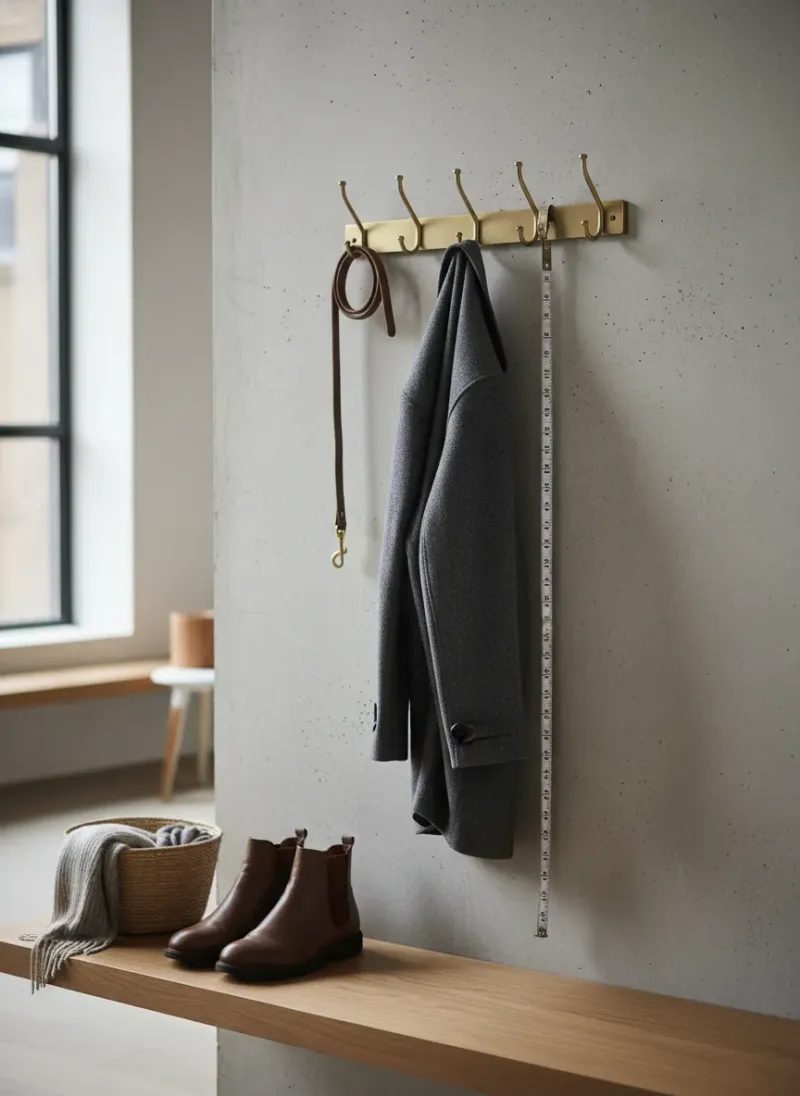
Apr 3, 2026 · Linda Wise
15 min readThe standard coat hook height — and coat hanger height — is 60 to 65 inches (152–165 cm) from the finished floor to the centre of the hook. That single number covers most adults in a standard room, but the right height changes completely depending on who is reaching for it, what room it is in, and how long your coats are.
Mount hooks too low and long winter coats drag over your shoes. Mount them too high and children drop their coats on the floor rather than struggle to reach. Because every drilled hole is a commitment — replastering and repainting are real costs — getting the coat hook height right before you pick up the drill matters.
With 12 years of entryway installation experience, I have put together the complete guide: exact coat hanger height and coat hook height standards for every user and room, the clearance formula, ADA requirements, spacing rules, and the structural anchoring details that keep hooks secure under heavy daily loads.
Standard Coat Hook Height & Coat Hanger Height for Adults
For a general-purpose coat rack used by average-height adults, the standard coat rack height is 60 to 65 inches (152–165 cm) from the floor to the center of the hook. This range works for most people between 5’4” and 6’0” tall, which covers the majority of American adults.
At 60 inches, a standard 40-inch coat hangs with roughly 20 inches of floor clearance — enough to clear shoe trays, baseboards, and puddles. At 65 inches, shorter jackets and blazers stay well above floor level while remaining within comfortable reach.
| Height | Position | Notes |
|---|---|---|
| 65” | Top hook position | Tall adults, long coats |
| 60” | Standard hook position | Average adult shoulder line |
| — | Comfortable arm angle | 45°–90° reach, no strain |
| 20” | Floor clearance | Coat hem clears shoe rack |
| 0” | Floor | Reference point |
Anthropometric data for the average U.S. adult places standing shoulder height at 55 to 61 inches. Placing the hook at 60 to 65 inches allows a natural, low-strain arm extension — no stretching or bending required.
Quick self-test: Have the tallest regular user stand against the wall and raise their arm to a comfortable, natural position — not stretched overhead, just a relaxed upward reach. Mark that spot. That is your maximum. Confirm the shortest regular user can also reach it without tiptoeing. The sweet spot almost always lands between 60 and 65 inches.
Coat Rack Height by User Type
Not every household follows the same pattern. Here are the exact coat hook heights for every user type, from toddlers to wheelchair users.
| User | Recommended Height | Height in cm | Notes |
|---|---|---|---|
| Adults (5’4”–6’0”) | 60–65 inches | 152–165 cm | Standard range for most households |
| Tall adults (6’0”+) | 65–70 inches | 165–178 cm | Prevents stooping; coats still clear floor |
| Teens (12–17) | 54–58 inches | 137–147 cm | Adjustable hooks are smart for this age group |
| Children (5–11) | 36–42 inches | 91–107 cm | Encourages independence; eye-level access |
| Toddlers (2–4) | 24–30 inches | 61–76 cm | Low hooks for lightweight items only |
| ADA / Wheelchair users | 48 inches max | 122 cm max | Required by ADA Standards §308.2 |
| Seated users (general) | 40–48 inches | 102–122 cm | Comfortable forward reach from a chair |
Dual-row strategy for mixed households: In homes with both adults and children, install two rows — an upper row at 60–65 inches and a lower row at 36–42 inches. Children handle their own coats on the lower row; the upper row stays reserved for adult-length outerwear. As children grow, the lower row transitions to bags, umbrellas, or pet leashes.
Coat Rack Height by Room
Every room has different ceiling heights, traffic patterns, and functions. Here is an exact room-by-room breakdown.
Entryway
The entryway is the highest-traffic hook location in most homes. Getting this one right matters more than any other room.
| Scenario | Hook Height | Why |
|---|---|---|
| Single adult row | 62–65 inches | Accommodates long winter coats with floor clearance |
| Dual row (adults + kids) | Upper: 64” / Lower: 40” | Shared family use without compromise |
| Above a bench or shoe rack | 48–52 inches (from floor, not bench) | Keeps coats accessible while seated |
Mudroom
Mudrooms take a beating — wet coats, heavy boots, and rushed mornings. Hooks need to be both reachable and durable.
| Scenario | Hook Height | Why |
|---|---|---|
| Standard adult row | 60–64 inches | Slightly lower for quick grab-and-go |
| With upper shelf | Hook: 60” / Shelf: 68–72” | Shelf stores hats and gloves above hooks |
| Dual row (family) | Upper: 62” / Lower: 38” | Lower row for kids’ rain gear |
Mudroom horizontal spacing: leave at least 12 inches between hooks — 16 inches is better for bulky winter coats. Overcrowded hooks cause coats to fall, defeating the purpose. (For a full breakdown of spacing rules based on gear type, see our guide on how far apart coat hooks should be).
Bathroom (Robe Hooks)
Bathroom hooks serve a different purpose — robes, towels, and the occasional garment in a humid environment. Height matters here not just for reach, but for keeping fabric away from splash zones and floor moisture.
| Scenario | Hook Height | Why |
|---|---|---|
| Robe hook (adult) | 60–65 inches | Standard reach; robe clears floor |
| Behind bathroom door | 60–62 inches | Prevents robe catching on door frame |
| Next to shower/tub | 63–65 inches | Minimum 24” from water source |
| Towel hook (hand towel) | 48–52 inches | Lower for easy daily access |
| Towel hook (bath towel) | 52–56 inches | Higher to avoid floor contact |
| Kids’ bathroom | 36–40 inches | Independent reach for ages 5–11 |
| ADA accessible | 48 inches max | Forward reach requirement |
Bathroom note: use stainless steel or brass hardware. Chrome-plated steel rusts within months in a steamy bathroom. The hook itself matters as much as the height.
Bedroom
Bedroom hooks are about convenience — a spot for tomorrow’s outfit, a bathrobe, or a frequently worn jacket.
| Scenario | Hook Height | Why |
|---|---|---|
| Behind the door | 60–65 inches | Concealed storage for everyday items |
| Next to the closet | 58–62 inches | Quick-access for outfit planning |
| Kids’ bedroom | 36–42 inches | Matches their reach; builds habits |
| Decorative display hooks | 55–60 inches | Eye-level for visual balance |
Hallway
Hallways are secondary hook locations — useful for guests or overflow from the entryway.
| Scenario | Hook Height | Why |
|---|---|---|
| Guest coat hooks | 62–65 inches | Standard height accommodates all visitors |
| Decorative hallway hooks | 55–60 inches | Lower for visual appeal when empty |
| Narrow hallway (under 40”) | 62 inches | Prevents coats from blocking walkway |
Hallway rule of thumb: In hallways narrower than 40 inches, mount hooks at 62 inches or higher. Coats hanging at lower heights stick further out into the walkway and create a claustrophobic feel.
Adjusting Coat Rack Height for Coat Type
A denim jacket and a full-length wool overcoat do not hang the same way. Coat length directly affects how high your hooks need to be.
| Coat Type | Typical Length | Minimum Hook Height | Why |
|---|---|---|---|
| Light jacket / blazer | 28–32 inches | 55 inches | Short garment; lower hooks work fine |
| Standard winter coat | 34–38 inches | 60 inches | Needs clearance above baseboard |
| Long overcoat / trench | 42–48 inches | 65 inches | Must clear floor completely |
| Full-length wool coat | 50–55 inches | 68–70 inches | Requires high mounting or standing rack |
| Kids’ coat (ages 5–10) | 20–26 inches | 38 inches | Low hooks work perfectly |
| Bathrobe | 48–54 inches | 64 inches | Similar drop to a long overcoat |
The Clearance Formula
To find the minimum coat rack height for any specific garment, use this formula:
Example: A 45-inch raincoat with 15 inches of clearance to accommodate a shoe rack underneath:
If you have 50-inch trench coats and want to keep them clear of a 12-inch-tall shoe shelf, the hook must sit at 65 inches minimum.
Example — 48” Trench Coat at 65” Hook: Hook center is at 65 inches. The coat drops 48 inches, placing the hem at 17 inches from the floor — leaving 5 inches of clearance above a 12-inch shoe shelf underneath.
Robe Hook Height: Where to Mount in Every Bathroom Setup
Robe hooks in bathrooms fail faster than coat hooks elsewhere because of constant humidity. Getting the height right is only half the job — hardware material and distance from water are the other half.
Standard robe hook height for adults: 60–65 inches (152–165 cm) from the floor. This keeps a full-length bathrobe (typically 48–54 inches long) with 6–12 inches of floor clearance — enough to stay dry in most bathrooms.
- Behind the door: Mount at 60–62 inches. Behind-door placement already limits clearance, so going higher risks the robe catching on the door frame when opening.
- Next to the shower: 63–65 inches, positioned at least 24 inches from the shower or tub edge. Proximity to water shortens the life of both the hook hardware and whatever you are hanging.
- Kids’ bathroom: 36–40 inches. Low enough for independent use, high enough that a small robe or towel does not drag on wet floors.
- Dual setup (adults + kids sharing): Upper hook at 63 inches for robes, lower hook at 38 inches for kids’ towels. Two hooks, two users, no conflict.
Hardware note: Use stainless steel or solid brass in bathrooms. Chrome-plated steel rusts visibly within months in a steamy room. The hook material matters as much as its height.
Spacing Between Multiple Coat Hooks
Coat rack height is only half the equation. Horizontal spacing matters just as much — crammed hooks mean coats overlap, wrinkle, and fall off.
| Hook Count | Minimum Spacing | Comfortable Spacing | Best For |
|---|---|---|---|
| 2–3 hooks | 10 inches apart | 14 inches apart | Small entryway or bathroom |
| 4–6 hooks | 12 inches apart | 16 inches apart | Mudroom or family entryway |
| 7+ hooks | 12 inches apart | 16–18 inches apart | Large mudroom or commercial space |
Heavy winter coats take up 6–8 inches of horizontal space when hanging — compared to 3–4 inches for a lightweight rain jacket. If your household leans heavily toward bulky outerwear, err toward 16-inch spacing even if it means fewer hooks.
Vertical stagger option: Instead of a perfectly straight horizontal line, stagger alternating hooks at 60 inches and 64 inches. Adjacent coats can overlap slightly without competing for the same space, fitting more coats in less wall width.
Single Row vs. Double Row Layout
Single and double row arrangements serve different households.
Single row works best when:
- All users are roughly the same height (adult-only household)
- You have limited wall space
- Hooks serve a single purpose (guest coats, robes, towels)
Double row works best when:
- Children and adults share the space
- You need to maximize hanging capacity in a limited footprint
- The room is a mudroom or family entryway with high daily traffic
For a double-row layout, mount the upper row at 62–65 inches and the lower row at 36–42 inches. Leave at least 18–20 inches of vertical space between rows so coats on the upper hooks do not block access to the lower ones.
| Row | Hook Height | Spacing | Best For |
|---|---|---|---|
| Upper row | 62–65 inches | 12–16” apart | Adult coats, long outerwear |
| (gap) | 18–20” vertical gap | — | Prevents upper coats blocking lower hooks |
| Lower row | 36–42 inches | 12–14” apart | Children’s coats, bags, rain gear |
For maximum density in limited horizontal space, stagger the lower hooks horizontally — position each lower hook midway between two upper hooks. Coats on the upper row drape cleanly between the lower garments, and neither row blocks the other.
ADA-Accessible Coat Hook Heights
The Americans with Disabilities Act sets clear requirements for coat hooks in public and commercial spaces. Even in a private home, these guidelines are worth following if anyone in the household uses a wheelchair or has limited reach.
ADA requirement: Coat hooks must be mounted at 48 inches or lower from the floor when a forward reach is required (ADA Standards for Accessible Design, §308.2). For side reach over an obstruction 10 to 24 inches deep, the maximum drops to 46 inches.
| ADA Scenario | Maximum Height | Notes |
|---|---|---|
| Forward reach (unobstructed) | 48 inches | Standard wheelchair-accessible height |
| Forward reach (over obstruction 20–25” deep) | 44 inches | Lower to compensate for lean distance |
| Side reach (unobstructed) | 48 inches | Same as forward reach |
| Side reach (over obstruction 10–24” deep) | 46 inches | Slight reduction for reach angle |
In residential settings, mounting hooks at 46–48 inches provides comfortable access for most wheelchair users while remaining usable for standing adults — especially for shorter items like jackets, hats, and bags.
Adjusting for Ceiling Height and Visual Proportions
Wall hardware visually divides a room. You must balance the physical reach height with the visual proportions of the space.
| Ceiling Height | Recommended Hook Height | Visual Result |
|---|---|---|
| 8 ft (96”) | 60 inches | Balanced wall proportion above and below |
| 9 ft (108”) | 63–65 inches | Prevents bottom-heavy look |
| 10 ft (120”) | 66 inches | Elevated hooks fill the taller wall evenly |
| Under 8 ft | 54–56 inches | Keeps garments from feeling crowded near ceiling |
- Standard 8-foot ceilings (96 inches): Stick to the 60-inch standard. This leaves a balanced proportion of wall space above and below the hardware.
- 9-foot and 10-foot ceilings (108–120 inches): A row of hooks at 60 inches makes the wall look bottom-heavy. Elevate to 66 inches (1,676 mm). This balances proportions while keeping the hooks accessible.
- Low ceilings (under 8 feet): In basements or attic conversions, drop to 54–56 inches (1,372–1,422 mm) to prevent garments from feeling crowded against the ceiling.
Wall-Mounted Coat Rack Height vs. Freestanding Coat Rack Height
When planning your entryway, the right height standard depends on whether you are mounting hooks to the wall or using a freestanding rack.
Wall-Mounted Coat Racks
The hooks on a wall-mounted coat rack should sit at 60 to 65 inches (1,524–1,651 mm) from the floor. This provides the optimal coat rack height for adults to reach comfortably without bending, while leaving plenty of room below for a shoe bench or tray. For help choosing the right style and finish for your wall hardware, check our ultimate guide to choosing entryway hooks or see our ergonomic breakdown on where to place entryway hooks.
Freestanding Coat Rack Stands
For entryways where wall space is limited or drilling is not an option, freestanding coat racks are typically 68 to 72 inches (1,727–1,828 mm) tall overall. This extra height ensures long overcoats and trench coats clear the floor. The top hooks on a standard freestanding rack sit naturally at around 60–65 inches — the same functional range as wall-mounted hooks — while the stand’s base adds stability below.
When shopping for a freestanding rack, choose one with a wide, heavy base. A narrow base will tip when loaded with heavy wet winter garments.
Substrate Guide: Structural Anchoring for Coat Hooks
A single coat hook loaded with a heavy winter coat, wet rain gear, and a school bag can hold 25 to 35 pounds of static weight. The dynamic force when someone grabs a jacket quickly can easily tear cheap plastic wall plugs out of drywall.
| Wall Material | Best Anchor Choice | Screw Type & Size | Pre-Drilling |
|---|---|---|---|
| Wood studs | Direct screwing | 2.5” #10 wood screw | 3/32” pilot hole |
| Hollow drywall | Steel toggle bolt | 3/16” toggle bolt | 1/2” drill hole |
| Plaster/lath | Toggle bolt | 3/16” toggle bolt | 1/2” drill hole |
| Masonry/brick | Sleeve anchor | #10 Tapcon masonry screw | 5/32” masonry bit |
Best practice: Always mount into wall studs when possible. Studs are typically spaced 16 inches (406 mm) apart on center. Use 2.5-inch or 3-inch #8 or #10 wood screws and ensure the screw penetrates at least 1.5 inches into the wood stud.
Backer board method: If your hooks do not line up with studs, mount a solid wood backer board horizontally to the studs first (using 3-inch wood screws), then attach your hooks to the board at whatever spacing you prefer. This is the most flexible solution for custom spacing.
Toggle bolts: If you must mount in a stud-free zone, use heavy-duty steel toggle bolts (3/16-inch). Avoid plastic expansion anchors — they loosen over time under daily pull loads.
Room-by-Room Placement Standards
The Foyer
The entryway is the first impression of your home. Hooks are typically integrated into wall molding or wainscoting at 60 to 66 inches. The goal is to keep coats off the floor and maintain a tidy, organized appearance. Focus on symmetry and clean lines.
The Mudroom
The mudroom is high-traffic and utilitarian. Prioritize capacity and ease of access. The standard mudroom layout features a built-in bench at 18 inches high (see our comprehensive guide on mudroom bench height for cushion math and boot clearance specs), with a lower row of hooks at 42 inches (for bags and children’s coats) and an upper row at 66 inches (for adult outerwear).
The Bathroom
Mount bathroom robe hooks at 60 to 65 inches (1,524–1,651 mm). This placement keeps full-length robes clear of damp floors. See the dedicated robe hook section above for precise scenario-by-scenario heights.
The Closet
Inside a bedroom or hallway closet, mount hooks at 63 to 65 inches (1,600–1,651 mm). This maximizes vertical space while keeping garments clear of shoe racks or floor bins.
Common Installation Pitfalls to Avoid
1. Mounting in the Door Swing Arc
Always verify the path of adjacent doors before drilling. Open the door fully and mark its swing path on the floor. Mounting hooks in this arc prevents the door from opening fully and creates a constant bottleneck.
2. Over-Anchoring on Pocket Door Walls
Pocket door cavities leave less than 3/4-inch of clearance behind the drywall. A standard 2.5-inch mounting screw will penetrate the cavity, scratching the pocket door and blocking it from sliding. Use short screws and heavy-duty adhesive or specialized shallow anchors in these locations.
3. Proximity to Radiators and Vents
Never hang coats where they can drape over an active radiator or baseboard heater. Ensure at least 12 inches of vertical clearance between the bottom hem of your longest coat and the top of any heating element.
Precision Alignment: Why the Floor Is an Unreliable Reference
When installing a horizontal row of hooks, do not measure up from the floor for each hook individually. Residential floors are rarely perfectly level — a 1/2-inch slope across a 4-foot run results in a visibly crooked rail.
❌ Incorrect method: Measuring up from the floor at each hook location separately. A sloped floor produces a visibly slanted hook rail.
✅ Correct method: Mark your target height at one point on the wall, then use a laser level to project a perfectly horizontal reference line across the full run. Mount all hooks to that line.
The correct process:
- Mark the target coat rack height (e.g., 62 inches) at a single point on the wall.
- Use a laser level or long spirit level to project a straight horizontal reference line across the entire wall.
- Align the mounting plates of all hooks to this line — perfectly level regardless of any floor slope.
Quick-Reference: Coat Hook Height & Coat Hanger Height Cheat Sheet
Use this table as your go-to reference when standing in front of the wall with a drill.
| Location | Users | Recommended Height | Spacing |
|---|---|---|---|
| Entryway (adults only) | Adults | 62–65” | 14–16” apart |
| Entryway (family) | Adults + Kids | Upper: 64” / Lower: 40” | 14–16” apart |
| Mudroom | Family | Upper: 62” / Lower: 38” | 16” apart |
| Bathroom (robe hook) | Adults | 60–65” | Single hook |
| Bathroom (towel hook) | Adults | 52–56” | 8–12” apart |
| Bathroom (kids) | Children 5–11 | 36–40” | Single or 12” apart |
| Bedroom (behind door) | Adults | 60–65” | Single hook |
| Kids’ bedroom | Children 5–11 | 36–42” | 12” apart |
| Hallway (guests) | Adults | 62–65” | 14” apart |
| ADA accessible | Wheelchair users | 46–48” max | 14–16” apart |
| Freestanding rack (top hook) | Adults | 60–65” effective | N/A |
Getting It Right the First Time
The difference between a coat hook that works and one that frustrates you daily comes down to a few inches. Measure twice. Account for your longest coat. Think about who is reaching for that hook at 7 AM — if they have to strain, stretch, or stoop, the coat rack height is wrong.
For households that want flexibility without committing to a single height, a freestanding coat rack offers the most forgiving solution. No holes, multiple height levels, and the ability to move it from room to room as your needs change.
By understanding your household’s ergonomics, choosing the right mounting hardware, and aligning your layout to a level reference line, you can build a secure, functional entryway storage system that keeps your home organized year-round.
Last updated: August 2026
Frequently Asked Questions
What is the standard coat hook height from the floor?
The standard coat hook height is 60 to 65 inches (152–165 cm) from the finished floor to the center of the hook. This range works for most adults between 5'4" and 6'0" tall, provides a comfortable reach without straining, and leaves enough clearance below for a shoe rack or boot tray.
What is the standard coat hanger height?
The standard coat hanger height — meaning the height at which a wall hook or peg holds a coat hanger — is 60 to 65 inches (152–165 cm) from the floor. At 60 inches, a standard 40-inch coat hangs with roughly 20 inches of floor clearance, which is enough to clear a shoe tray or boot rack underneath. For taller users or longer coats, go up to 65 inches.
How high should a coat rack be for kids?
For children aged 5 to 11, mount hooks at 36 to 42 inches (91–107 cm) from the floor. For toddlers aged 2 to 4, go as low as 24 to 30 inches. For teens aged 12 to 17, 54 to 58 inches works well. A dual-row setup with an upper row at 62–65 inches for adults and a lower row at 36–42 inches for children is the ideal family entryway configuration.
How high should you hang a coat rack on the wall?
A wall-mounted coat rack should be hung so the hooks sit at 60 to 65 inches from the floor for adults. If you also need children to use the rack, add a lower row at 36 to 42 inches. Always use a laser level to keep the rail perfectly horizontal before drilling.
What is the ADA-compliant coat hook height?
Under ADA Standards for Accessible Design §308.2, coat hooks must be mounted at a maximum of 48 inches from the floor where a forward reach is required. For side reach over an obstruction 10 to 24 inches deep, the maximum drops to 46 inches.
How high should robe hooks be in a bathroom?
The standard robe hook height for adults is 60 to 65 inches from the floor. For behind-the-door placement, drop to 60 to 62 inches to avoid the robe catching on the door frame. For kids' bathrooms, use 36 to 40 inches. Mount bathroom hooks at least 24 inches from the shower or tub edge to limit moisture exposure.
How far apart should coat hooks be spaced?
Space coat hooks 12 to 16 inches apart for general use. For heavy winter coats, 16 inches of horizontal spacing prevents overlap and keeps garments from falling. A minimum of 12 inches between hooks is the practical lower limit for most entryways.
Top Picks: Best Mudroom Storage
Editor's shortlist with verified ratings. Prices and availability below — clicking an Amazon link earns us a small commission at no extra cost to you.
| # | Product | Rating | Reviews | Tag | Check Price |
|---|---|---|---|---|---|
| 1 | Prepac Mudroom Cubbie Locker | 1,980 | Top Pick | Check Price | |
| 2 | HOOBRO Hall Tree with Bench | 2,230 | — | Check Price | |
| 3 | Crosley Furniture Seaside Hall Tree | 5,410 | Best Storage | Check Price | |
| 4 | Alaterre Asheville Mudroom Storage | 612 | — | Check Price | |
| 5 | Yaheetech 4-in-1 Mudroom Locker | 1,455 | Best Value | Check Price |
Affiliate disclosure: As an Amazon Associate we earn from qualifying purchases.
Tag: smartlyhomme-20 — change in src/data/topPicks.ts.