
10 Genius Hidden Storage Solutions to Maximize Your Narrow Hallway
Transform your cramped corridor into a sleek organizational powerhouse. Expert Linda Wise reveals 10 architectural hacks and hidden storage methods that maximize space without sacrificing flow.
Mar 2, 2026 - Written by: Linda Wise

The hallway is the architectural underdog of the home. It’s the artery connecting your life, yet we usually treat it like a dumping ground for mail, muddy boots, and that one umbrella nobody actually uses. If you are dealing with a corridor that feels more like a claustrophobic tunnel than a welcoming entrance, you aren’t alone.
Here is the reality: narrow hallways are notoriously difficult to furnish. You can’t just drop a dresser in a space that’s only 36 inches wide without creating a fire hazard or a shin-bruising obstacle course. But ignoring the space is a waste of valuable square footage.
I have spent years optimizing tight layouts, and I’ve learned that the secret isn’t more storage; it is smarter, stealthier storage. We are talking about solutions that disappear when not in use, utilize the voids inside your walls, and trick the eye into seeing more space than actually exists.
If you are ready to reclaim your square footage, here are ten genius hidden storage solutions to maximize your narrow hallway, ranging from simple DIY retrofits to structural modifications.
1. The “Between the Studs” Recessed Niche
Most people look at a wall and see a solid barrier. I look at a wall and see empty cavities waiting to be filled. In standard residential construction, walls are built with 2x4 studs, typically spaced 16 inches on center. That leaves you with a recurring cavity roughly 14.5 inches wide and 3.5 inches deep.
This is prime real estate.
Instead of mounting a cabinet on the wall—which encroaches into your walkway—you can install shelving inside the wall. This is arguably the most effective way to gain storage without stealing a single inch of floor space.
How to Execute This
You cut the drywall, frame out the box, and trim it. You can install a full-length mirror over the opening on hinges, effectively creating a hidden medicine cabinet for keys, wallets, and dog leashes.
Pro Tip: Before you start sawing into drywall, you absolutely must understand what is happening behind the scenes. Wires, pipes, and structural integrity are major factors. I recommend reading our guide on calculating load bearing understanding weight to ensure you aren’t compromising your home’s structure.
2. The Ultra-Slim Tilt-Out Shoe Cabinet
If I had a dollar for every time I tripped over a sneaker in a client’s hallway, I could retire to the Italian Riviera. Shoes are the enemy of narrow spaces. They are bulky, irregular, and visually chaotic.
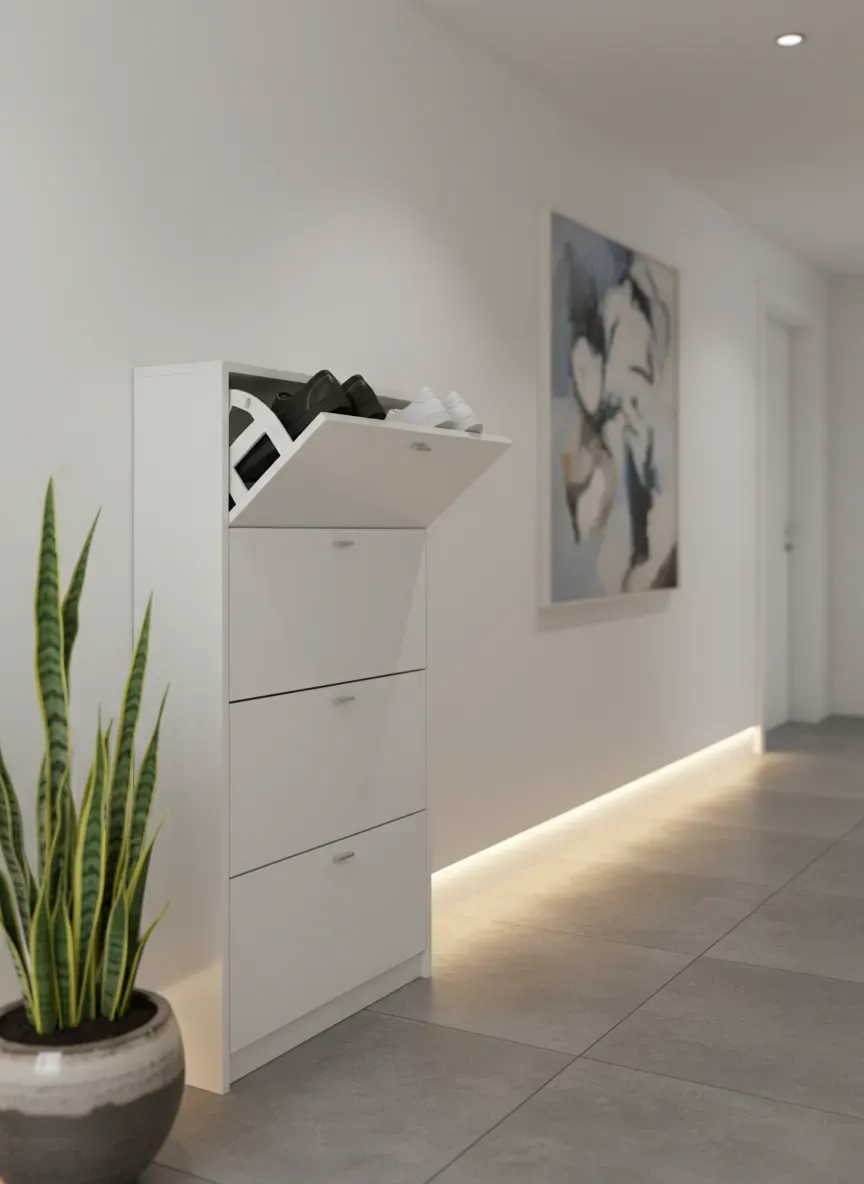
Standard shoe racks are too deep (usually 12 to 14 inches). The solution is the tilt-out cabinet. Because the shoes are stored vertically rather than horizontally, these units can be as slim as 6 or 7 inches deep.
When closed, it looks like a sleek, floating console. When opened, the drawer tilts forward, revealing your footwear. It keeps the floor clear, which is a massive psychological trick for making a hallway feel wider.
For a high-end look without the custom carpentry price tag, I often point clients toward the Simpli Home Acadian Solid Wood Shoe Storage Cabinet. It has a robust build quality that doesn’t feel like flimsy particle board, and the profile is slim enough to maintain traffic flow.
3. Ceiling-Mounted “Air Gap” Shelving
Look up. Higher. Above the door frame.
In 90% of homes, the space between the top of the door frame and the ceiling is dead air. This is the “air gap,” and it is perfect for long-term storage of items you don’t need daily access to—think off-season hats, decorative bins, or archives.
You can install a simple shelf running the perimeter of the hallway at this height. Paint the shelf and the brackets the exact same color as the wall and ceiling. This “drenching” technique makes the storage visually disappear. It doesn’t feel heavy because it’s above your direct line of sight.
The “Library Ladder” Effect
If you have high ceilings (9 feet or more), you can take this a step further with floor-to-ceiling shelving. However, keep the lower shelves open or mirrored to avoid the “canyon effect.”
4. The Radiator Cover Disguise
If you live in an older home or a city apartment, you likely have a chunky cast-iron radiator sitting in your hallway, hissing at you and taking up precious space. You can’t move it, but you can hide it.
A custom radiator cover does three things:
- Safety: Protects kids and pets from burns.
- Aesthetics: Hides the ugly metal fins.
- Storage: Provides a surface for a console table.
But here is the hidden genius part: build the cover with side compartments. The space strictly needed for the radiator is often less than the visual footprint. You can incorporate a slim vertical cabinet on either side of the radiator within the cover design to hold umbrellas or gloves.
5. Seamless Floating Consoles with Hidden Drawers
Legs are visual clutter. In a narrow hallway, seeing the floor extend all the way to the wall creates an illusion of width. Furniture with bulky legs interrupts that view.
Enter the floating console.
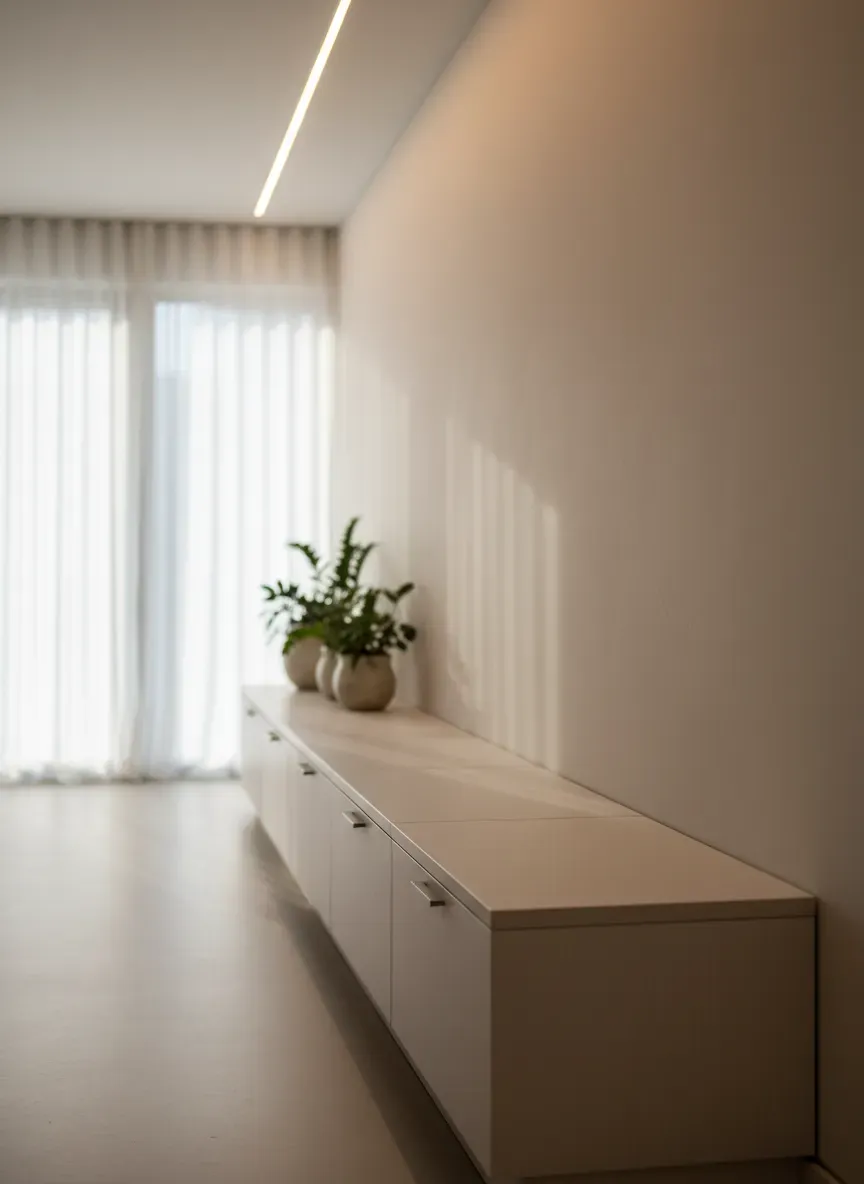
Mounted directly to the wall studs, these units hover off the ground. The key here is to ensure the console isn’t just a shelf, but a box with a drawer. You want to hide the clutter, not display it. A shallow drawer (even just 3 inches deep) is enough to swallow up mail, pens, and sunglasses.
Key Takeaway: When selecting a floating console, depth is your most critical dimension. You generally want to stay under 10 inches deep for a standard hallway. Check our breakdown of standard depth height measurements to see exactly what fits your specific corridor width.
6. The “Secret Agent” Full-Length Mirror
Mirrors are the oldest trick in the book for expanding space. They bounce light and double the visual depth. But a standard mirror is a passive object. We want active storage.
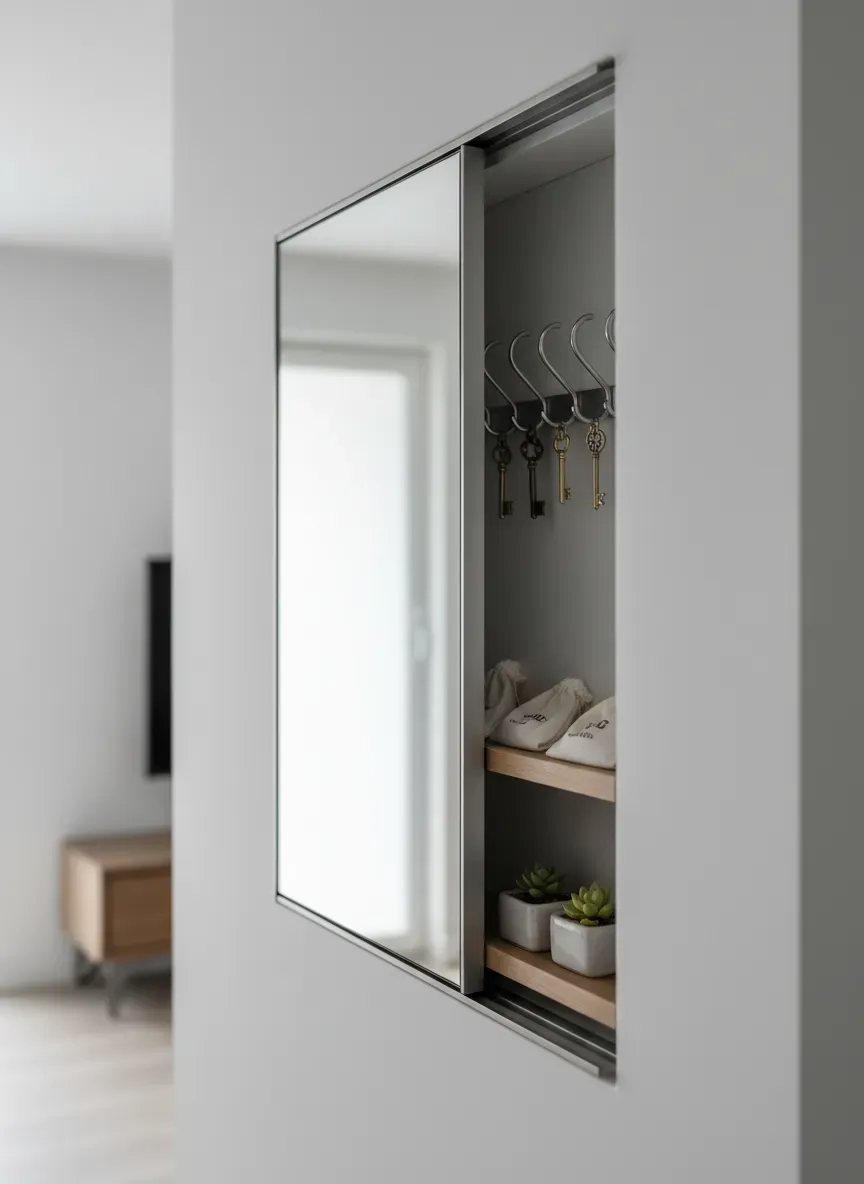
I love using a sliding mirror mechanism. Imagine a full-length mirror that looks permanently affixed to the wall. However, it’s mounted on heavy-duty drawer slides (horizontally) or a piano hinge (vertically).
Behind the glass? A recessed cavity or a shallow pegboard system. This is the perfect spot for jewelry, keys, or even an emergency flashlight. It’s completely invisible to guests. To them, you just have a lovely mirror checking your outfit before you leave. To you, it’s the command center.
For a turnkey version of this concept that locks (adding a layer of security), the Cabidor Mirror Behind The Door Storage Cabinet is a fascinating piece of engineering. It attaches to your existing door hinges, utilizing the dead space behind a door without requiring wall surgery.
7. Retractable Wall Hooks (The Piano Rack)
Hooks are great, until they aren’t. When empty, a row of large, protruding coat hooks can look aggressive and snag the shoulders of passersby in a tight hall.
The solution is retractable hooks, often called “piano racks” or flip-down hooks. These look like a piece of sculptural wood art or a decorative molding strip when not in use. When you need to hang a coat, you flip a slat down. When the guest leaves, you flip it back up, and the wall becomes flush again.
Spacing Matters
One mistake I see constantly is overcrowding these racks. If you mount them too close together, bulky winter coats will overlap and puff out, choking the hallway width. You need to understand the geometry of hanging garments. I’ve detailed the math on this in my article regarding ideal spacing far apart, which explains how to keep your coats from fighting for space.
8. The False Plinth (Toe-Kick) Drawer
Let’s get down to floor level. If you have any cabinetry in your hallway—perhaps a built-in bench or a linen cupboard—you have a toe kick. That acts as the recessed pedestal the cabinet sits on.
Usually, this is hollow space covered by a trim board.
By installing a “touch latch” drawer mechanism, you can turn that toe kick into a flat drawer. This is an incredible spot for storing flat items that you rarely need but must keep:
- Warranties and manuals.
- Emergency cash.
- Spare shoelaces and insoles.
- Wrapping paper (if the cabinet is wide enough).
Because it requires no handle (you tap it with your toe to open it), it is completely invisible.
9. The Custom Bench with a “Drop Zone” Interior
A bench in a narrow hallway is a luxury, but it often becomes a clutter magnet. The surface gets covered in bags, and the space underneath becomes a shoe graveyard.
The hidden solution is a “lift-top” bench, but with a twist. Instead of a deep, cavernous chest where things get lost at the bottom, install internal dividers or sliding trays.
Better yet, combine the bench with a wall-paneling system. The back of the bench extends up the wall (wainscoting style). The top rail of the wainscoting can hide a very shallow lip for propping up mail or photos, keeping them off the main bench surface.
If you are not into building from scratch, finding a bench with a specifically narrow footprint is tough. I recently discovered the Vasagle Storage Bench with Padded Seat. It’s surprisingly sturdy, fits tight spaces, and the aesthetic is neutral enough to blend into most hallway decors while hiding a significant amount of clutter.
10. Magnetic Wall Panels
This is for the minimalists who want zero bulk.
You can purchase or build wall panels that have a magnetic core (sheet metal overlaid with veneer or wallpaper). To the naked eye, it looks like a chic accent wall.
However, using high-strength neodymium magnets, you can “stick” items to the wall. You can buy magnetic spice jars (great for holding loose change, paperclips, or screws), magnetic key holders, or even magnetic sunglass clips.
Because there are no fixed hooks or shelves, the storage is fluid. You can rearrange it daily. When you remove the items, you are left with a clean, unblemished wall surface. It is the ultimate in adaptive, hidden utility.
The Psychology of the Narrow Hallway
Implementing these solutions isn’t just about finding a place for your keys. It is about reducing the cognitive load of your home. When you walk through a clutter-free hallway, your cortisol levels drop. You aren’t subconsciously bracing yourself to dodge an obstacle.
The trick to all ten of these methods is integration. The storage shouldn’t look like an add-on; it should look like part of the house.
The Bottom Line: Don’t let the constraints of your floor plan dictate your organization. By utilizing the voids in your walls, the air above your head, and the mechanics of tilting and sliding hardware, you can turn even the tightest corridor into a high-functioning storage machine.
For a broader look at how these specific hacks fit into a whole-home strategy, check out our comprehensive guide on hidden storage solutions for narrow hallways, where we break down the budget and tools required for each project.
Your hallway is more than just a path from A to B. Treat it like a room, and it will serve you like one.