
Smooth Out the Chaos: 10 Expert Tips for Better Entryway Traffic Flow
Is your foyer a bottleneck? Discover 10 expert-backed strategies to optimize traffic flow, reduce clutter, and reclaim your entryway's calm.

Mar 2, 2026 - Written by: Linda Wise

You know the dance. You open the front door, arms laden with groceries, only to trip over a stray sneaker. You pivot to avoid the coat rack, bump into the console table, and perform a clumsy pirouette just to get into the living room. It’s the “Entryway Shuffle,” and frankly, it’s a terrible way to start or end your day.
The entryway is the handshake of your home. It sets the emotional temperature for everything that follows. Yet, most homeowners treat it as an afterthought—a dumping ground for muddy boots and junk mail rather than a functional transitional space. I’ve walked through hundreds of homes where the foyer acts more like a bottleneck than a gateway.
The secret isn’t just buying more baskets. It’s about understanding spatial dynamics, human behavior, and the subtle art of traffic management. We need to look at your foyer not as a storage locker, but as a highway intersection that needs clear lanes, signage, and exits.
Here is a comprehensive, deep-dive into smoothing out the chaos and mastering the flow of your home’s most critical threshold.
1. The “Desire Path” Audit
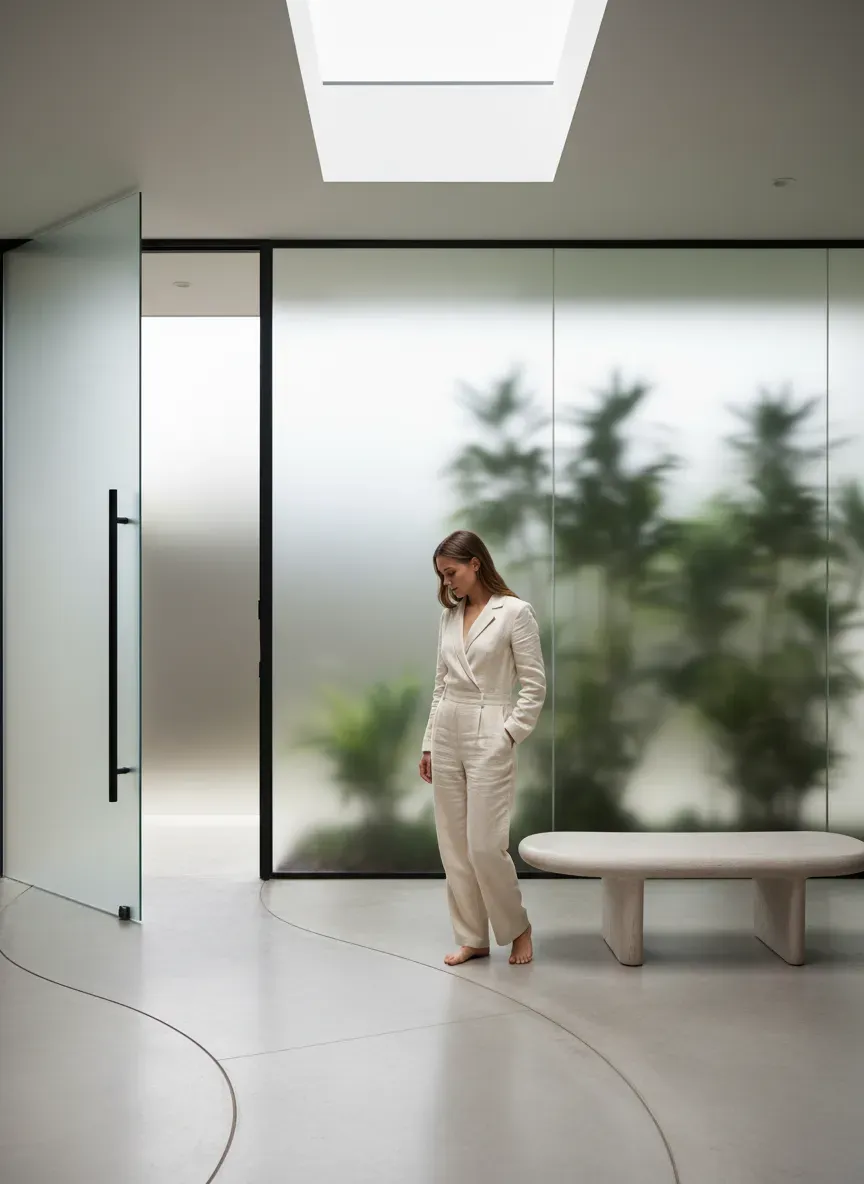
Before you hammer a single nail or buy a new rug, you have to play the role of an anthropologist in your own home. In landscape architecture, there is a concept called a “desire path”—the eroded dirt trail across a patch of grass where people actually walk, ignoring the paved sidewalk provided for them.
Your family creates desire paths in the entryway every day.
Identifying the Friction
Stand in your doorway. Where do you naturally drift? Do you hug the right wall? Do you cut a sharp diagonal to the kitchen? Any furniture placed directly on this invisible line creates friction. It forces the body to adjust, twist, or slow down.
Pro Tip: “Sprinkle a very light dusting of talcum powder or flour on the floor before the family comes home (on a hard surface, obviously). Watch where the footprints go. The areas that remain clean are your ‘Dead Zones’—the perfect spots for storage. The messy path is your sacred traffic lane. Keep it clear.”
The Three-Foot Rule
In architectural standards, a hallway needs a minimum of 36 inches of clearance for comfortable single-file walking. If you’re looking to create a feeling of luxury and ease, you want closer to 42 or 48 inches. If your console table encroaches on this lane, it’s visually and physically aggressive. You might need to sacrifice storage depth for walking width.
I’ve written extensively about mastering your entryway traffic flow, and the golden rule remains: movement takes priority over static storage.
2. Zoning Mechanics: The “Landing” vs. The “Launchpad”
One of the biggest mistakes I see is mixing up the “Landing Strip” with the “Launchpad.” While they occupy the same real estate, they serve different functions. If you conflate them, you get gridlock.
The Landing Strip (Input)
This is the immediate drop zone. When you walk in, you are usually carrying something. Keys, mail, coffee cups, dog leashes. If there isn’t a surface within two steps of the door, those items end up on the floor or the nearest chair.
- Requirement: A waist-height surface (console or shelf).
- Location: Within 48 inches of the door swing.
The Launchpad (Output)
This is where you prep to leave. This requires more space—putting on a coat, tying shoes, checking your reflection.
- Requirement: Floor space and seating.
- Location: Further down the hall or recessed into a nook.
By separating these two mental zones, you prevent the person taking off their boots from blocking the person trying to put down their keys. It creates a circular flow rather than a collision course.
3. Verticality and the “Shoulder Brush” Effect
We tend to think of floor plans in 2D, but traffic flow is a 3D experience. A coat rack loaded with puffy winter jackets expands outward. A rack that looks slim when empty can suddenly protrude 12 inches into your walkway once winter hits.
This leads to the “Shoulder Brush Effect”—that subtle, annoying feeling of fabric grazing your arm as you walk past. It triggers a psychological response that the space is cramped.
Recessed Storage Strategy
If your entryway is narrow, avoid protruding hooks at shoulder height. Instead, utilize high storage (shelves above 6 feet) or low storage (shoe cabinets below 3 feet). This keeps the critical “torso zone”—where we perceive width—open and airy.
For those tight spaces, understanding standard depth and height benchmarks is crucial to ensuring your fixtures don’t become obstacles.
4. The Geometry of the Door Swing
It sounds elementary, but the arc of your front door is the single most disruptive element in traffic flow. I can’t tell you how often I see a rug that gets crunched up every time the door opens, or a bench that gets banged by the door handle.
The Swept Path
Visualize the quarter-circle your door creates. Nothing—absolutely nothing—should live in this zone. No umbrella stands, no shoe baskets. This is the airlock.
If you have a rug in the entryway, it needs to either sit completely outside this arc or have a low enough pile that the door glides over it seamlessly. If you have to kick the rug flat every time you enter, you’ve already introduced chaos into your arrival.
If you are struggling with clearance, I highly recommend looking into the Gorilla Grip Low Profile Rubber Mat. Its ultra-thin design practically disappears under the door sweep, eliminating that frustrating snag.
5. Strategic Hook Spacing
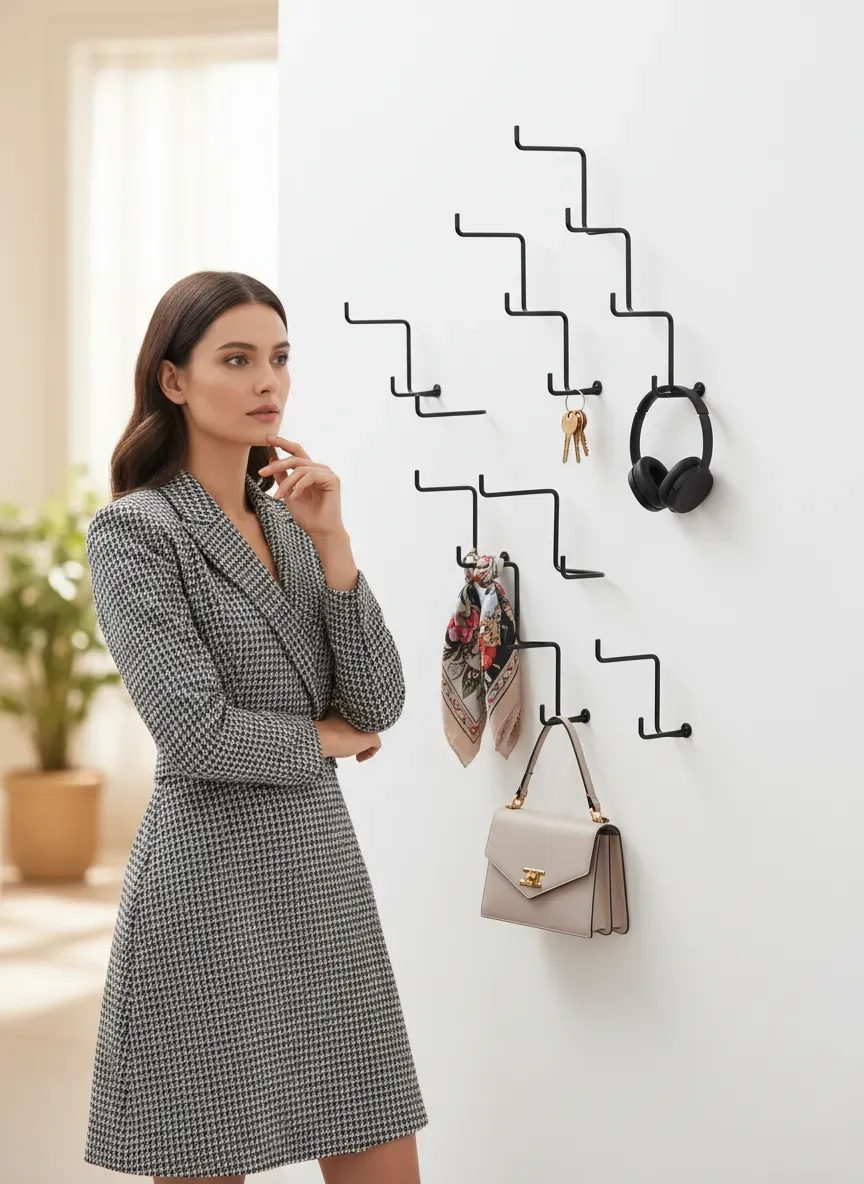
Here is where the visual noise turns into physical blockage. When hooks are placed too close together, coats stack outward rather than laying flat. This creates a “bulkhead” of fabric that eats up your hallway width.
The Stagger Method
Instead of one linear rail of hooks, use two rows.
- Upper Row: For adults and long coats.
- Lower Row: For kids, bags, and shorter jackets.
By staggering them, you distribute the volume vertically rather than horizontally. But precision matters here. You need to know the optimal spacing between hooks to prevent the “coat lasagna” effect where you can never find the bottom layer. Generally, give yourself 8-10 inches between hooks if you want a clean, accessible flow.
6. The Seating Paradox
Everyone wants a bench in the entryway. It looks inviting in magazines. But in a narrow hall, a bench can be a flow-killer. If the bench is too deep, it forces traffic to snake around it. If it’s too high, it dominates the visual field.
The “Perch” vs. The “Lounge”
You don’t need a lounge chair in the foyer; you need a perch. A spot to tie a shoe takes 30 seconds. Look for benches with a depth of 12-15 inches, rather than the standard 18-20 inches of dining chairs.
Furthermore, ensure the bench is sturdy. There is nothing worse than a wobbly piece of furniture making a guest feel insecure. When assessing structural load capacity, always overestimate. A sturdy, narrow bench anchors the space; a flimsy, wide one ruins it.
For a sleek, space-saving solution that combines seating with organization, the Vasagle Industrial Shoe Bench is a phenomenal choice. Its frame is rigid, but its footprint is surprisingly compact.
7. Lighting as a Traffic Director
Humans are phototropic—we naturally move toward light. You can use this biological quirk to manipulate traffic flow without saying a word.
The Beacon Effect
If your hallway is dark, people hesitate. They shuffle. If you place a bright, warm light at the end of the entryway (drawing them into the home), they naturally accelerate through the bottleneck.
Conversely, if you want people to stop and take off their shoes at a specific spot, pool light there. A focused downlight over the shoe rack acts as a subtle “Stop Here” sign.
Key Takeaways:
- Ambient Light: General illumination for safety.
- Directional Light: Pulls people into the main living areas.
- Task Light: Focused on keys/shoes to aid the transition.
8. Flooring Transitions and Visual Speed
The floor is the map. Changes in texture and pattern signal the brain to change pace.
The Runway Effect
A long runner rug with linear stripes elongates the space and encourages movement—it says “keep walking.” This is great for getting people out of the doorway quickly.
The Boundary Mat
A rectangular, coarse-textured mat perpendicular to the door says “pause.” It visually arrests movement. Use this right at the threshold to encourage wiping feet and pausing to assess the “Landing Strip.”
The Bottom Line: Use a rough texture at the door for the pause, and a smoother runner beyond it to re-initiate flow.
9. The “Floating” Furniture Aesthetic
In tight traffic areas, floor space is gold. The more floor you see, the larger the room feels. Heavy furniture with solid bases (like a chest of drawers that sits flush on the floor) creates a “blocky” feel that visually narrows the path.
Leggy is Better
Opt for furniture on tall, slender legs or, better yet, wall-mounted floating consoles. By exposing the floor underneath the storage unit, you trick the eye into perceiving the hallway as full-width. It also eliminates toe-stubbing hazards, which is a major win for traffic flow.
If you need a wall-mounted solution that disappears when not in use, the Umbra Flip Wall Mounted Floating Rack is the industry standard for a reason. You flip the hooks down when you need them, and snap them flush when you don’t. It’s dynamic architecture.
10. The Seasonal Rotation Protocol
You cannot optimize traffic flow if you are storing July’s flip-flops in December. The single greatest cause of entryway congestion is volume overload.
The Active vs. Passive Archive
Your entryway should only house the “Active” gear—what you have worn in the last 7 days. Everything else belongs in the “Passive” archive (closets, garage, under-bed storage).
Create a hard rule: One coat per person on the main rack. One pair of shoes per person on the main mat. If a new pair comes in, an old pair rotates out. This keeps the “Desire Path” clear of debris.
Troubleshooting Common Pitfalls
Even with these tips, you might hit snags. Let’s troubleshoot a few specific scenarios I see constantly.
The “No-Foyer” Entry
Many modern homes open directly into the living room. There is no hall. In this case, you must manufacture flow using furniture.
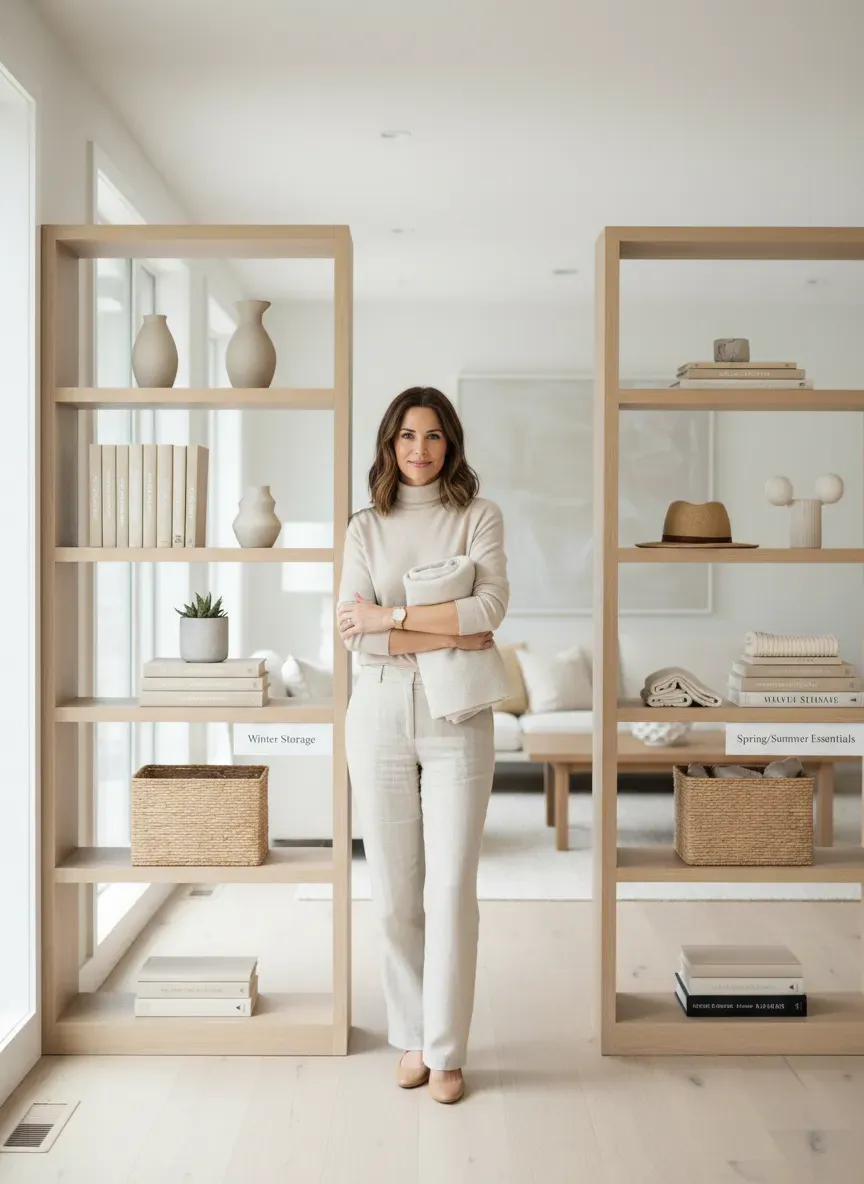
- The Solution: Place a sofa perpendicular to the wall to create a “virtual” hallway behind it. Or, use a tall, open bookshelf to screen the view of the living room, forcing traffic to pause and turn. This artificial corridor defines the space without building walls.
The “Bowling Alley” Hall
Long, narrow, and dark.
- The Solution: Break up the tunnel vision. Place art on one side, then a mirror on the other further down. This forces the eye to zig-zag, making the walk feel less like a sprint and more like a stroll.
The Cluttered Corner
Corners are notorious for trapping dead energy and junk.
- The Solution: Round it out. Use a round hamper or a curved corner shelf. Sharp corners in tight spaces invite hip-bruises. Soft curves facilitate smooth turns.
Designing for the “Tired You”
We often design our homes for our best selves—the version of us that neatly hangs up the coat and sorts the mail immediately. But traffic flow breaks down because of the “Tired You.” The version of you that just worked 10 hours and is holding a crying toddler.
If your system requires two hands and a step-stool to put away a bag, “Tired You” will drop it on the floor.
Design for the path of least resistance.
- Open baskets are better than lidded boxes.
- Hooks are better than hangers.
- Drop zones are better than drawers.
When you lower the barrier to entry, you preserve the flow.
Final Thoughts on Maintenance
Optimizing your entryway traffic flow isn’t a “set it and forget it” project. It’s a living organism. As your kids grow, their coats get bigger (and their shoes get enormous). As seasons change, the bulk of your gear fluctuates.
I recommend doing a “Flow Check” at the start of every season. Stand at your door. Walk the path. Feel for the friction. If you find yourself dodging a specific hook or stepping over a specific pair of boots, it’s time to re-audit.
A smooth entryway is invisible. You shouldn’t notice it. You should simply flow through it, shedding the stress of the outside world, and arriving home without skipping a beat. That is the ultimate luxury.